The Wrath of Kon

Dispatches, thoughts, and miscellanea from writer Jon Konrath

Zen and the Art of Breathing Wrong

p1010016_2

I guess I breathe wrong.  I’ve known this for a while, but I think every shrink I’ve ever met has told me I need to breathe deeper or take a meditation class or something.  This week, my breathing is worse because of a sinus infection, which I’m trying to bomb out with a high dose of Levaquin, which is sort of like trying to hunt for easter eggs by napalming an entire township.  But yeah, I guess I need to learn a new respiratory technique, and I’m sure there’s an app for that, but I’m too lazy to look.

I went through a brief period of wanting to be a Zen Buddhist, I think in 1994 or 1995. I mean, in that period, I went through a phase where I wanted to be everything from a writer to a motorcycle gang member to a Navy SEAL to an Alaskan shrimp boat captain. (I also wanted to be a technical writer and an author, so I guess I’m like 2 for 139 on the series.) I read a pamphlet or magazine in my shrink’s waiting room about controlling depression with meditation. And there’s the whole college path of trying to find your spiritual center, or the meaning in life, whatever that is. The good old fashioned Roman Catholicism baked into me at an early age hadn’t done much in that department.

Prior to this I briefly wanted to go back to Catholicism, mostly because I kept meeting all of these Jewish women, and any Jewish guy would seemingly get a free pass. I wondered if being a good Catholic would net me any free access to bad Catholics, so I did my first confession in a decade and started going to this hippy-dippy college version of a Catholic church, the kind that had a 5

PM Sunday mass so all of the drunks could show up after a night of heavy partying. But after about two or three Sundays, I realized the social awkwardness and alienation that made me a stanger in this world also extended to Church, so I stopped going and went back to the comfort and convenience of atheism.

The zen thing may have partially been because of Bruce Lee. I saw that movie Dragon and really wanted to learn Kung Fu, so I bought a worn paperback from the 60s that illustrated various Kung Fu and Tai Chi manuvers in grainy black and white pictures. That proved to be useless, because you couldn’t hold the paperback open to any given page and do the moves at the same time. But it led to another book of Tai Chi from the dollar bin at the used book store, and I started looking at the various angles of Buddhism, and zen. And that got me started buying these more expensive Zen books with elaborate color artwork and koans depicted in Chinese woodcut illustrations that always reminded me of a menu from a fancy Chinese restaurant, which always made me hungry for Chinese food, so maybe it wasn’t the best learning tool.

I remember plinking away at a couple of zen books, these logic puzzles really, the kind of thing that would say “does the world weigh as much as a pea?” and a good zen master would think about it for an hour and say “of course!” But I could never think that way; I’d be like “well a pea’s mass is a ratio of its mass to the planet’s mass, and it’s really an abstract concept, but something that science defines… etc etc.” There was a high bar for suspension of disbelief, but then I wondered if I had not been indoctrinated with stories of men coming out of tombs after being dead for three days and the parting of seas and the turning of water to wine, maybe that would seem just as crazy. Maybe I needed to reprogram myself. Maybe part of being a better person was burning the synapses in my brain to appreciate knowing these puzzles like the sound of one hand clapping.

I tried to learn to meditate. I burned a lot of incense, and bought a little rug at Pier One to sit on in the middle of my room. I even took a class once. The Student Union had these activities you could sign up for and pay the fees on your bursar bill. Like they had skydiving classes, whitewater rafting, hiking expeditions, ballroom dancing lessons, all of this outdoorsman, Teddy Roosevelt kind of shit, so kids from big cities could ride horses and camp in tents and meet girls who didn’t wear bras. I really wanted to take the skydiving, but every class landed on the day of a test of one of my night classes. Instead, I scoured that catalog, and signed up for this meditation class that promised to help me find inner peace in a single three-hour session on a Saturday morning.

The night before the class… okay, I won’t get into the night before the class, but we’ll just say it wasn’t very zen-like. The next morning, I was running late, but my roommate was heading to campus — this was when I lived a few miles north and had no vehicle of my own, other than a ten-speed — so he deposited me at another dorm for my class, unfed, unwashed, and not in a great state of mind.  I’m badly in need of another shower, my stomach’s rumbling like a motherfucker from a lack of breakfast, I have a touch of a hangover, and I think I slept two hours the night before. Now, let’s learn to meditate!

The class was at Briscoe quad, one of the big party dorms up north of campus. I’d only been there once or twice; some friend of an old ex from my freshman year lived there and we visited her a few times. Her friend had a full-time hobby of having relations with random dudes the way most people collect baseball cards. (So did the ex, but I didn’t find that out until after she moved in with me, which was wonderful.)  Anyway, this was a dorm of questionable choices, and everyone there was virtually guaranteed a large bill for damages from RHS at the end of the year, because someone would have thrown a flaming couch out of the window.

Meditation class was in a tiny classroom next to the weight machines in the dorm’s gym. It was taught by some middle-aged hippy mama that ran a meditation/bodyworks place out of a tiny hut that later became Tom Donohue’s CD store after I left town. Exactly two people signed up for an 8

AM Saturday class: me, and this other girl, a frumpy librarian type that reminded me of a random SNL character. As the class got more boring, I realized this girl probably had no friends and had the same social fears and awkwardness as me, and I knew it would not take much effort to convert this into a date situation, which is horrible.

I learned nothing in the class, except that my breathing was wrong. I thought breathing was an automatic reflex, but I guess I was doing it too much from my chest or doing it out from my chest and not my stomach, or something. I don’t know, it mostly confused me by making me think about my breathing, which made me not be able to not think about my breathing.  The desire to meditate, along with the desire to become enlightened, faded and I quickly became obsessed with writing a vector graphics Missile Command game for linux, or lifting weights, or something else.

The campus was empty in the winter cold, one of those eerie Saturday mornings when nobody was around.  I hiked over to the Brad’s Bagels and got my usual hangover cure, an everything with cream cheese and a giant vat of Coke. After quickly consuming that, I walked home, plodding for three miles in the wind and cold, listening to a Henry Rollins spoken word album, thinking about writing, thinking about what to do next.
Fieldstones and Moleskines

I know I said I don’t do new year resolutions, and I don’t.  But one of the things I’ve been trying to do - it’s more of a course-correction for my post-40 memory loss - is writing down every damn thing that pops in my head, with hopes of later mining this stuff for story ideas.  I know it’s something I should have started doing decades ago, but it’s something I’ve been trying to be militant about.

I just read this book,Weinberg on Writing, which talks about his “fieldstone” method.  The analogy has to do with those fieldstone walls you see on old farms.  (Watch the last five minutes of Shawshank next time it’s on TBS; they run it pretty much daily.  There’s a nice fieldstone wall in that.)  When a farmer builds one of those walls, they don’t go to Wally World and say “gimme a thousand yards of stones.”  They plow the fields, and when they hit a big stone, they pull it aside and save it.  After years of doing this, you have enough stones to build some fencing, or a nice fireplace hearth or wellhouse.  It takes time to find the right stones to fit the odd cracks and holes, but if you’re always looking, you never know when you’ll find it.

Most of the art of writing has to do with dragging your subconscious mind into your conscious mind and then dumping it onto pages in a way that can transfer into someone else’s conscious mind and creep into their subconsciousness.  Anyone that tells you it’s about marketing or the three-act structure or hitting plot points or what your cover looks like is full of bullshit.  That’s about selling books.  Salvador Dali wasn’t a genius because he painted the crying clowns and prairie field landscapes that he knew would sell; he was a genius because he would have fucked up dreams and then immediately paint them with no censorship or conscious thought, and those paintings haunt you and are hard to shake because they drill into the bottom of your mind.

The problem is, you can’t sit at a blank page and consciously think, “okay, let’s dump my unconscious mind into this buffer.”  You just see fits and spurts of what you need: while you’re in the shower, when you’re cleaning up cat shit, when you’re stuck in an endless meeting.  Something pops into your head, and it would be awesome in a story.  And then, if you’re above 40 and have spent your lifetime drinking from aluminum cans, it’s gone in ten seconds.

This requires some way to always capture this shit.  The current strategy is a three-pronged approach:

  1. The iPhone notes program.  It’s pretty easy to use; it syncs up with IMAP in my gmail account, so I can also get at it from my Mac or my iPad, making cut/paste pretty easy.  The downside is typing with my thumbs, and it’s not always easy to whip out a phone and tap away.

  2. A google docs document that does the same as above.  I use this less and less, but there are times where I’m not at any of the above three iOS machines, or where I need to cut/paste in something sizable, like a big chunk of an article.

  3. A moleskine notebook.  The classic, hardcover, lined.  I’ve got a little folding pen that bungees right into the elastic cord, and it stays in my jacket pocket or bag at all times.

moleskine_Page_29

There’s a certain tactile satisfaction to keeping notes in a moleskine; that’s a huge plus.  And there’s an overwhelming joy in filling up one of these leather-bound pocketbooks, like you’ve accomplished something more than just dumping ASCII into a buffer.  I just finished one of the books, and it took me almost two years, just because I write in fits and spurts, and this “capture everything” movement just got into gear.

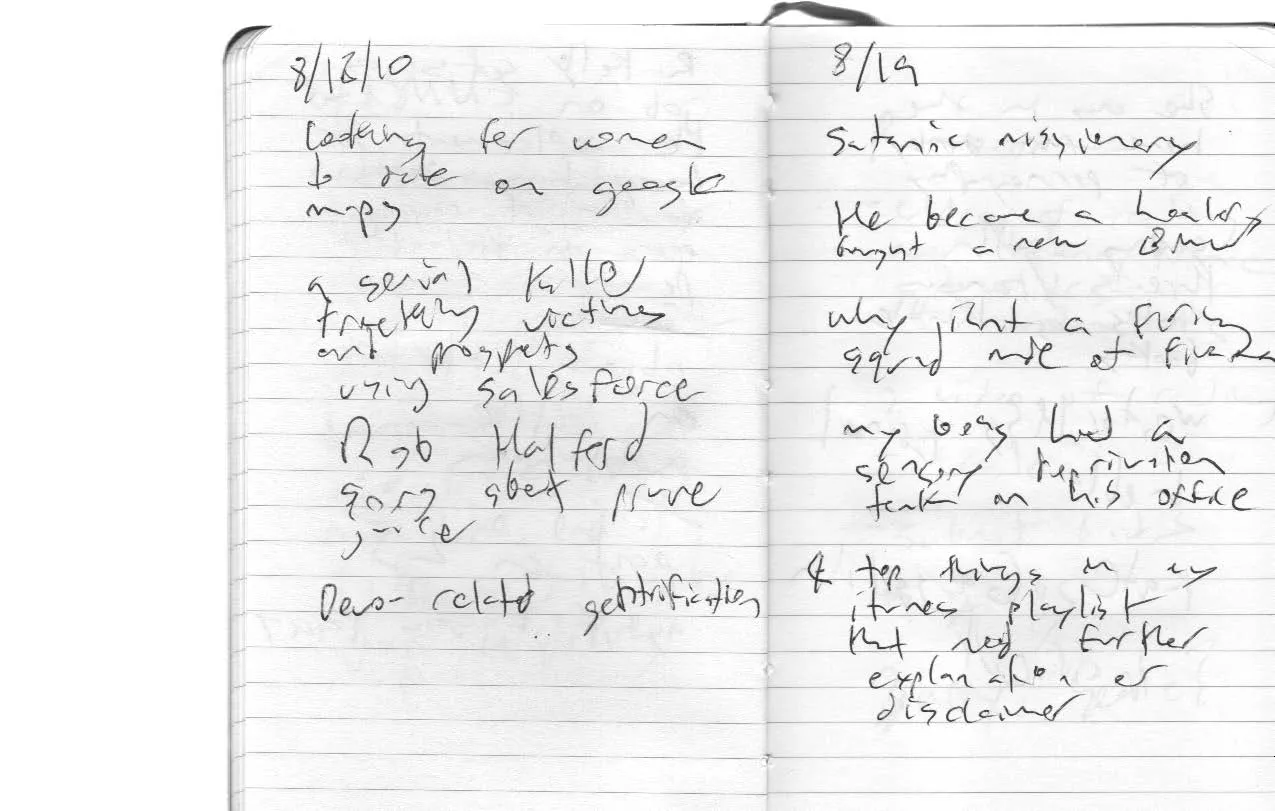
Now here’s the real problem with the moleskine: how to move these fieldstones into the production line.  The iPhone notes thing is easy: Ctrl-C, Ctrl-V.  The notebooks - well, first my handwriting is horrible.  And I barely hit the lines to get all of this stuff parallel to each other so OCR can handle it.  And I can’t ship it off to someone and have them transcribe it, since I can barely read it.

The current workflow is to scan the entire thing in as a single PDF using Preview and my printer/scanner.  This take some work, only because you end up with a 50-meg file, and there’s no way you’ll do a hundred scans without Preview crashing at least five or six times.  (I know, Windoze people are like “ha, it doesn’t just work”.  But I was able to use a piece of software that came on my system for free, without spending 19 days researching what third-party program works with my brand of scanner, brand of USB chipset, version of Windows, brand of USB cord, IRQ settings, motherboard configuration, and then find out the software I paid fifty bucks for is a “lite” version and the “pro” version costs $999.)

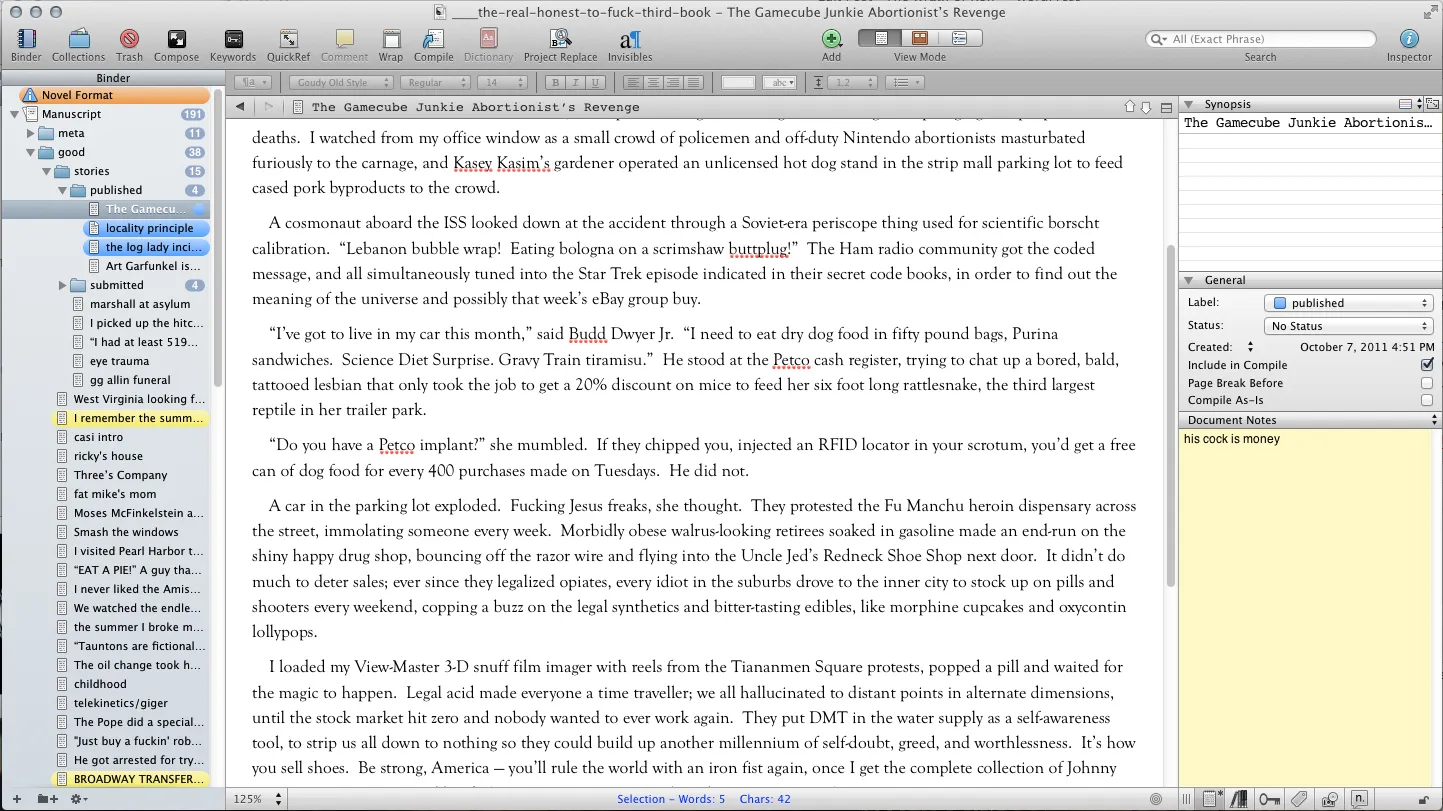
Then, I split the PDF into a hundred or so PNG images.  I have a Scrivener project that’s just a dumping ground for all of my fieldstones, failed stories and books that still have some reusable bits, and whatever else.  So I create a folder for the book, and dump the PNGs onto a file in the binder, then split that up into a bunch of files, and either type in the bits of each page, or ignore them.  (Sometimes a page will just be a partial grocery or todo list, or something I’ve already used, so not everything is gold.)

The process of turning these fieldstones into working stories and books - that’s another project, and a workflow I haven’t mastered yet.  But a lot of The Earworm Inception  came from fieldstones that were grouped and fleshed out, and this next book is using a lot of stuff collected like this.  Some of them will be duds; some just become a single line in someone’s dialogue, or a little aside.  And some will be the nucleus of an entire work.

So I’m having fun, transcribing this stuff, finding little gems.  And I’ve got the next Moleskine up and running, ready to capture whatever happens in the back of my head during my TPS report filing during the day.

Twenty years of e-publishing

xenocide

I have been e-publishing for just a few days shy of twenty years.  Not twenty months.  Twenty years.

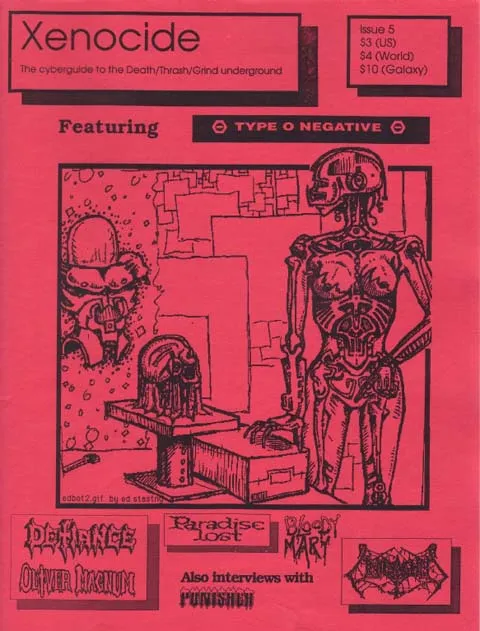
Back in 1989, my friend Ray started a zine.  We listened to a lot of obscure metal, thrash and death metal, and you could barely find Metallica tapes in northern Indiana back then, let alone underground music.  Ray scoured the earth for this stuff, and started writing letters to weirdos in Sweden and Germany and Japan, trying to trade tapes or score free shit, and he eventually started writing reviews and printing a little homemade magazine that he gave away at record stores and sent to record labels to get free stuff.  He eventually got me to start writing for him, too.

(Various things we did not know at the time: these “major labels” like Earache and Nuclear Blast America and Roadrunner were run out of tiny closets of offices; the people in “signed” bands like Napalm Death probably made less money than I did washing dishes in college; there was a whole universe of zines outside of the arena of death metal that was about to explode; there was a whole world outside of Indiana that was infinitely more interesting, too.)

Ray handled all of the business issues with the zine, which was great because his mom ran a business that did some mail-order stuff, and things like postage rates and bulk-ordered envelopes and offset printing quirks were totally within his wheelhouse.  And so was finding all of this unknown metal music and talking to record labels and getting people to buy ads.  I never could have started a zine like this, because I wasn’t plugged into any of this, and this was long before the days of google, where you could just put “where can I find a printer that’s not totally into jesus” or “what the fuck is media mail” in a search engine and get your results.

I have no idea what it would take to publish a real magazine, but even publishing a zine was an arduous process.  Once you actually got all of the reviews and interviews done, you had to put them in a word processing program.  I knew a little about this, but Ray was the one that actually owned a computer, and he used some weird program called GeoWorks to get all the fonts done correctly.  When you had the actual pages done, you had to go to a printer and get a thousand or two of them printed at once, which cost hundreds of dollars.  (You could photocopy, but then each issue would cost two or three times as much, and look like garbage.) Then you had to sell those, and pay postage to get them all out to people.  All told, it didn’t seem like you could really do a zine for under a couple of thousand dollars, although once you made the nut on the printing, you could use the proceeds from orders to cover the postage.  But issues that went to trades or to record labels or otherwise as promotional fodder would come out of your own pocket.  You’d never print a thousand copies and sell exactly a thousand copies.

I went back to college in Bloomington in 1991, and this major revolution in publishing was about to happen, and I didn’t realize it.  First, I spent all day fucking around on usenet news, and found some heavy metal newsgroups where I actually found other people who listened to bands like Carcass and Unleashed.  Sure, this was interspersed with a whole bunch of people who wouldn’t shut the fuck up about Guns N’ Roses or that new Metallica album Smell the Glove, but making fun of them was almost as fun as finding out about that new Entombed album before it came out.  This was as cool as writing to some freak in Denmark who knew all about the cool bands, except it didn’t cost a bunch of money in postage, and it was instantaneous.

This got me thinking: what if you did a zine where the whole thing was just a text file that you posted on usenet or emailed to people?  You could put in the latest news, maybe interview some people, review stuff, have addresses or ads for bands trying to sell tapes, and tell people to email in their news or band info.  There was no way to sell issues like this, and you couldn’t include any artwork or band logos or photos.  You also needed a computer to read it, along with a way to get email, and this was before AOL was everywhere, when a new PC cost four or five grand and a 2400-baud modem would run you a hundred more bucks. But it would be free to “publish”, and people would be able to write back right away if they liked it.

Ray came down to Bloomington in February, to sleep on the floor of my tiny apartment and hang out for a long weekend.  The band Prong was in town, and while they were not super high on our list of most extreme bands ever, but we got maybe one cool show a year in town, and tried not to squander it.  It was right after Valentine’s day, and I had been whatevering with this girl for a week or two and went straight from third base to the friend zone, so I was insanely depressed and in need of loud music and fun.  Me and Ray stayed up late every night, and talked about this zine thing, and whether it would work or not.  Late one night in one of the computer clusters, we typed something up, and I posted it online.

That was February 18, 1992.  Here is the original post.  It is somewhat horrible, far more than cringe-worthy, filled with typos and stupidity and corny fake satanism.  But it’s been there for almost twenty years.

This was insanely confusing to people at record labels.  My main goal was to get them to send me free stuff, and it was like explaining the Kindle to a geriatric.  Nobody had email then, and I tried printing out some copies and mailing them in, but that confused them even more, and defeated the purpose.  I thought about eventually doing both the electronic version and a print version, something whipped up in WordPerfect with some nice fonts and a few pictures and whatnot, and by the 4th issue did that, but I also wanted something out of a god damned Bruce Sterling cyberpunk story, a computerized mind-meld of text and music and artwork and interactivity.

There was a lot of disparate pieces of technology that weren’t linked together that offered pieces of what I envisioned. There was this thing just starting to show up called Gopher, a hypertext system that let schools and libraries publish linked documents on the internet.  It didn’t really have graphics, and only big institutions had servers running, without an easy or obvious way to publish your own info, unless you ran a university science lab somewhere, or worked at NASA.  We swapped a lot of text on the web in usenet and email, but just very unstructured stuff, with no real centralized organization.  Those of us in the know used FTP servers to look at pictures, mostly porno stills that would take hours to download and then offered blocky pixelated images.  And you could digitize music to .au files, which were gigantic, but could sound great.

Later that year, some people at CERN came out with a great improvement on gopher, that let you post pictures and sounds and let almost anyone make their own pages.  I quickly created a thing called a hyplan that played a sound clip from a Cannibal Corpse song, but didn’t envision that this would take off to the point where anyone in the world would use it to read zines online.  But of course, that’s basically what happened.

My little zine only lasted five issues.  Ray’s zine, Metal Curse, is still around today.  I didn’t make any money, although I got some free tapes and met some cool people and interviewed a couple of  decent bands.  More importantly, this put this idea in my head to write creatively, which eventually led to stories, and then to books.  And it instilled some DIY ethic in me, which made me start another zine, and then decide to publish my own book in 2000.

I have not made millions self-publishing.  (Someone with a name similar to mine has.  That’s not me.)  I think that aforementioned dishwashing gig brought in more money than all of my books combined.  The internet thing did land me a career doing technical writing, though.  I think if I added up all of my paychecks from when I started doing that in 1995 to today, it’s in the seven figures, and it gave me free health insurance and paid vacations, but also involved a lot of dumb meetings and things that make TPS reports look like a god damned Tolstoy masterpiece. But self-publishing gave me the ability to do what I wanedt, to not have to worry about changing me by changing my writing because Rumored to Exist doesn’t contain enough vampires or teenaged wizards to sell enough copies to keep a roof over my head.  It hasn’t been easy, but it’s been fun.

So here I am, 20 years down, 40,000 words into the next big book, and wondering what the next 20 will bring.

More Scrivener Tips

Screen-Shot-2012-03-24-at-9.20.34-AM

I switched to using Scrivener as my full-time writing tool last year, and still love it.  I always had a lot of trouble coming up with a good way to seamlessly manage a bunch of little chunks of writing, and now I have a perfect way to do that.  And it’s not trapped in a weird proprietary format; I can easily export it into different forms. Since last April, I’ve used it to put out two books (Fistful of Pizza and The Earworm Inception) and re-release Rumored to Exist as a Kindle book. I’ve also been using it for other ongoing projects, and have been pulling in all of my old books and writing, with eventual hope of either rereleasing them or cannibalizing them for parts.

One thing about Scrivener is that a program this feature-rich is going to either have a huge learning curve, or a lot of features you’ll  never figure out, or both.  And while Scrivener comes with a huge 446-page manual, I’m often googling away to find the solution to some issue.

So here are a few things that I’ve found that were not amazingly clear in the docs.  Part of my reason for posting these is to help out other Scriveners, but I’d be lying if I didn’t say that I just posted this crap here so I’ll remember it six months from now after I’ve forgotten it, because apparently now that I’m on the north side of the 40 year mark (and I’ve spent a lifetime drinking out of aluminum cans), that happens.

OK, here goes:

  1. Every word processor has its own little shorthand to enter stuff like returns and tabs and other invisible characters into the find and replace dialog boxes.  And Scrivener doesn’t use the typical ^t or \t.  Instead, when you’re doing a find or replace, hold down the Option key and type your special character.  (Your Option key is also known as the Alt, depending on your hardware and key setup.  No idea what it should be on a PC.)  The characters are not shown in the dialog box, but you’ll know you entered them because the little X to clear a field will be visible, showing you’ve got some text in the blank.
  2. If you’ve imported or pasted a bunch of text that was originally a text file, it may have a hard return at the end of every line, like around the 70 to 80 character mark. The way to drive yourself insane fixing that is to move to the end of each line, hit the delete key, enter a space if needed, move down a line, repeat 9374 times.  Don’t do that.  Open a find/replace, and put an Option-Enter in the find box, and a space in the replace box.  You might first have to search for each double enter and replace them with qqqqqqqq, then replace the single enters with spaces and the qqqqqqqqs with enters.  Same for enters followed by tabs.
  3. You can drag and drop text files into the Scrivener binder (that collection of file pieces on the left side.)  But you can’t drag and drop HTML into your Manuscript.  Why?  I don’t know; the docs say you can.  What you can do is drag and drop into any folder other than the Manuscript.  For example, you can drag and drop a web page into the Research folder.  (This is actually a good way to keep a bunch of research material handy.  If you’re offline and you need to get at that wikipedia page about some historical figure or space program or whatever, you can keep it handy within your project.)
  4. If you do the above, you’re left with an uneditable page that can’t be put in your manuscript.  To edit it and move it to the manuscript, do a Documents > Convert > Web Page to Text.  It can’t be undone, and you’ll lose some formatting, but it will become a fully editable text document.
  5. Composition mode.  You know that wave of full-screen, no-distraction writing programs?  No need to buy anything else; just do a Command-Shift-F.  I bump up the width and font, and have a nice picture of Venice Beach in the background, but do whatever brings you to your happy place where you can write.
  6. Typewriter Scrolling lets you change scrolling so your current line is in the middle of the screen, which works great in Composition mode.  Unfortunately, if you set this by using the menu option of Format > Options > Typewriter Scrolling and you’re not in Composition mode, it doesn’t work.  And if you’re in Composition mode… you can’t see the menus.  Solution?  Do a Command-Shift-T when you’re in Composition mode, and it’ll toggle this on.
  7. Labels are neat, but I find the default settings useless.  (They’re stuff like “chapter” and “scene”, but those are things I group with folders and documents, so who cares.)  Status is also neat, but there’s not an easy way to see status in the project binder.  So I edit the labels and change them to stuff like “Needs work”, “eh”, “golden”, “garbage”, and so on.  Then I go to View > Use Label Color In and pick Binder.  Then all of these status colors are shown in the binder, and I can easily find what needs work.
  8. This isn’t a Scrivener tip, but it is an iPad tip that helps when you’re releasing on Kindle.  If you need to see what your mobi file looks like in the iPad Kindle app, go to iTunes, click on your iPad, go to Apps, and scroll down to the File Sharing heading.  Click on the Kindle app, and click Add, and you can copy your mobi file to the Kindle app and proof away on the device without sending anything to the KDP store.
  9. (Not relevant anymore; macOS now does this by default.) If you don’t have it, get Growl and configure it to your liking.  It’s a universal notification system that a lot of different apps can use to send status updates in little popup alerts on your screen, sort of like how Outlook tells you about new mail messages.  You can turn on Growl support in Scrivener and it will open a popup when you’re saving or when you hit your target count.  Also, Growl may prevent you from going to your mail program every damn time you get a new email, if you get a popup and can see it’s only junk mail and you don’t need to stop writing.  And a Growl hint: if you get a ton of popups, Option-click one and they will all vanish.
  10. I use a Scrivener project called “plotomatic” as a catch-all for all of my notes, unexplored ideas, and leftovers.  It’s much easier than having a scattering of notes in ten different places, and it’s easily searchable.  Think about an easy way to do something similar, to limit the amount of searching you have to do for old stuff.

Hope this helps. Happy Scrivening, and please get in touch with any of your favorite tips!

Longest Novel Ever

I’ve been vaguely thinking about scraping some of the old essays I’ve posted here and turning them into a book, so I imported all of my old entries on rumored from 1997 to present into Scrivener just to see what it looked like.  It turns out I’ve written about 650,000 words here, which means if I trim out the 90% I don’t like anymore, you still get a decent-sized manuscript.

A book of this size is difficult to manage. It’s big enough that Scrivener stutters a bit when you try some intensive operations, like if you select all of the text and reformat it in one pass.  (And this is on a relatively fast machine with 8 gigs of RAM).  I also got enough shit when I released my first book, Summer Rain, which was about 220,000 words.  That translated into about 650 pages, which I think is perfectly readable, but that was ten years ago, and now people tune out in the middle of a 140-character twitter update.  But printing a 650,000-word book presents challenges other than attention span.  CreateSpace can’t even handle a single volume that big; unless I made some creative font and margin choices, that would most likely take three books.

I am not sure if I’ll actually pursue this, because I really need to be writing new stuff, and even if I did, it would be some kind of best-of with a couple hundred pages, max.  But I was googling around and looking for the relative sizes of various books (Infinite Jest, War and Peace, etc.) and I found a guy who wrote a seventeen million word book.

Check it: http://marienbadmylove.com - it’s by a guy named Mark Leach.  It sounds interesting, a B-movie romp through time travel and UFOs and all sorts of things, but it also looks like it’s more performance art than readable fiction.  I mean, even if it was the best damn stuff in the world, it would require a year’s sabbatical from life and a forklift to handle all of the possible volumes.  But it appears he’s done a lot of Burroughsian experimental stuff, like using the cut-up method, to generate that much text, so this isn’t like sitting down to a Dan Brown novel.

This makes me think I should take all of those out-at-third-act novels I never finished, dump it into a big cut-up tool, and mix it down into some gigantic sick and twisted mess of a book.  It’s a thought.