The Wrath of Kon

Dispatches, thoughts, and miscellanea from writer Jon Konrath

Review: Editorial by Arthur Graham
Editorial-front-cover

I’m sick of plot. I mean, I’m sick of the unshakeable, so-called undeniable truth that books have to have three acts, a hero’s journey, twelve points, three trials, or whatever the hell archaic structure every hack writer regurgitating genre fiction on the kindle tells you that you must have in order to sell books. Maybe you do have to make something a blatant rip-off of the same exact script mainstream Hollywood has been green-lighting for the last two or three decades in order to sell millions of copies to bored housewives in flyover states, but that doesn’t mean it’s what I personally want to read.

That’s why Arthur Graham’s latest, Editorial, interested me. This novella, recently re-released by Bizarro Press, doesn’t follow the template of every vampire romance thriller the make-money-fast crowd is hawking online. It’s a clever bit of meta-fiction, which starts with a collection of vignettes that are seemingly unrelated: a narrator talking about his days as an orphaned youth, a drifter with a Kafka-esque phase shift into a snake, a world 470 years in the future where global cooling has shrunk the seas and made formerly underwater areas the new waterfront property. There’s also the metafictional appearance of an editor, working on his own science fiction story, which is (or isn’t?) the story you’re actually reading.

It’s admittedly hard to focus while in the first dozen or two pages of Editorial, as I found myself thinking, “where is all of this going?” But the stories start to bleed into each other, in an almost dream-like fashion. I then realized that each story was a ring, and as you passed through the first circle, that ring contracted, telling you just a bit more truth about the interconnectedness of the different pieces.

In my previous failed career as a computer scientist (damn you, Calculus II!) my algorithms classes talked greatly about the concept of recursion, or the repeating of items in a self-similar way. For example, when given a huge list of numbers to sort, us humans like to iterate through the list, start at the beginning and go through it in a linear way, comparing numbers and switching items. That might make sense to us, but it’s an incredibly inefficient way of doing things. Instead, you could define a procedure that compares the first item in the list to the rest of the list, passed into the same procedure. That means that the list minus the first item is sorted the same way, which involves taking its first item out, and sorting the rest with the same procedure, and so on. Eventually, you reach a point where you have just one item, and the base case comparison is obvious, and then you blast through this huge stack of partially completed sub-steps until everything is solved.

Editorial works in the same way. It’s asking the eternal question of what is truth and what is real, but the first half of the book involves a lot of busy-work in setting up all of these self-referential calls. (And I by no means am saying the writing is sub-par or ineffective; there’s a good deal of sharp prose and character building contained throughout.) But once you get past the halfway point, you start to hit the essential truths, the point where those recursive calls hit their base cases and make you start saying “yes! exactly!”

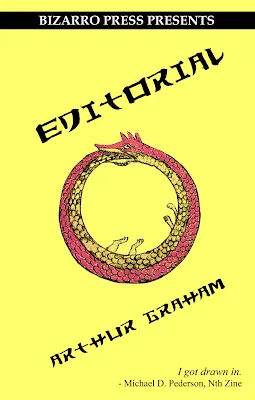
The book also contains a lot of reptilian imagery, characters turning into snakes, or really being snakes, which at first seemed like a curious choice. But there’s this constant return to Ouroboros, the serpent eating its own tail, which you see prominently on the book’s cover. It’s the same as these concentric, ever-constricting pieces within the book, the archetypal representation in Jungian psychiatry of the human psyche. Since Plato, different mythologies use this idea of a snake eating its tail as the central force in the creation of life. Editorial struggles with the basic idea of if this character is alive or being created by the editor. It’s ultimately the same question we’ve always been asking.

Writing style? I’ve seen other reviews throw around mention of Vonnegut, and the book contains little scribbles and drawings similar to what V used in Breakfast of Champions.  It reminded me a bit more of Slaughterhouse-Five, probably because of the unconventional plot.  It goes blue a bit, which is fine by me, but if you’re the type who attends regular book burnings, you might not be cool with a dude who was once a snake hooking up with another dude at a truck stop, so be forewarned.

Editorial isn’t an easy read. I mean, it’s not Ulysses, but it isn’t Twilight, either. It’s a challenge, but a rewarding one, and my only regret is that I have so much difficulty finding this type of book amongst the seas of detective murder mysteries and YA romance stories.  Anyway, check this one out.  It’s available in print and on the kindle.  Also stop by Arthur’s web site at http://arthurgraham.blogspot.com/ and give him a holler on facebook, too.
Summer Rain Redux

rabbit1-small

I’ve spent the last few days doing something somewhat monotonous and incredibly nostalgic: importing the manuscript for Summer Rain into Scrivener.  The import itself wasn’t difficult, except that the original book was written in emacs, which meant every single line ended in a hard return, and all of the quotes were straight quotes.  Both of those are trivial fixes in Scrivener, though.

The reason for this project was to retire the iUniverse and Lulu editions, and do a CreateSpace and a kindle version.  I also wanted to hit the thing for some very basic spelling corrections, a different interior design, and a new cover.  One of the problems with that is just the sheer size of the book: it weighs in at just over 220,000 words.  I had to do the page layout in Word, and also used it as a second opinion on the spell check.  Word can deal with a book that long (about 700 pages), but not without the occasional stutter.  I think if I had the manuscript in a single Word file during its composition, the resulting bit rot of repeated saves would have quickly corrupted it.  Luckily, Scrivener doesn’t have issues with that, because internally, it’s storing the book as fifty or so files.

I had mixed feelings about this book going into the project.  It’s very much not what I’m writing anymore; it’s not gonzo or bizarro in any way.  It’s not even terribly funny.  There might be a chuckle or two in the book, but nothing like my recent stuff.  So there’s a strong desire for me to discount the book, or maybe retire it.  But I also felt some need to revisit it.  I just didn’t want to spend my time rewriting it, trying to do anything similar, or go off on that tangent of straight fiction or creative nonfiction, which isn’t really my bag.  I love to read that stuff, but I’m of the opinion that my real life is much more boring than the twisted world inside my head, and I’m probably better off trying to get that down on paper.

That said, there’s something mystical about going back through this book again.  For one, I don’t know how the hell I managed to write this.  It’s so damn long, and although it’s not as heavily plotted as a best-seller, it’s got some serious amounts of character development.  The most interesting part of this is that one of the main characters is entirely fictional.  I mean, writing semi-autobio stuff lets you cheat on the character development, because you can just ramble on about yourself, and you sort of get it for free.  But I spent a lot of time futzing over the character Amy, trying to make her believable, and I’d forgotten how much went into her story.

And it’s been twenty years this summer since the events in this book happened.  That’s a serious amount of distance, and it makes me think about what did and did not happen.  I mean, at this point, it’s hard to separate what really happened in 1992 and what I think I remember happening, and in that pre-web environment, there’s no clear way to untangle the two.  That’s always why I take great interest in when I run across an old friend from back then, or I find some old trove of photos or an old newspaper or some other relic from that age.

For example, I recently found a youtube clip from this band Haunted Garage, which I absolutely loved back then.  They were a sort of splatter-punk/metal band, sort of like Gwar, with elaborate stage antics that involved a lot of fake blood and guts.  The band only did a single album and then fell apart, but me and Ray used to worship that album, and I played songs from it constantly on my old radio show.  Watching this few minutes of interview was a portal back to the early 90s for me in a strange way, because sometimes 1992 seems like it was 18 months ago, and then I see a video like this, done on crude VHS camcorder technology, and see how it was really last century, and half a life ago.

Going through the book again was full of touchstones like this, bands I’d forgotten about, events that fell out of my brain, feelings I don’t really feel anymore.  And it makes me think about when I wrote the book, too.  I started writing this book in 1995, less than three years after the events really happened.  The difference is that when I was in Seattle or the start of my time in New York, there was still this feeling that I could go back.  I returned to Bloomington a few times in the late 90s, and although the pizza places changed hands and the undergrads looked way younger, it still felt like the same life to me.  I felt back then that I could always go back, that I was a plane ticket away from that summer I spent there.  Now, especially when I was there in December, I don’t really feel that anymore.  I still have fond memories of the place, but I know there’s no real bridge back to the era anymore.  If I moved back to 47404 and rented out an apartment and decided to start over, I would just be that creepy old guy, and not a part of the experience.

The other thing I think about when reading this book again is how the writing has some power and depth in places, how I could capture some of that emotion.  It’s not like when I go back and read Rumored again, which I still find magical and incredible; SR is pretty uneven, and there are some parts that are a total dud.  But, for example, when I read the last chapter in the book, it always feels like I nailed it.

It’s also hard to believe it was almost twelve years ago I handed this thing off to iUniverse and shipped.  I have regrets I haven’t done more in that dozen years, but I’m picking up some momentum, and I know what I need to do now, so there’s that.

Anyway, stay tuned.  I’m hoping to get the new version out there in the next couple of weeks.

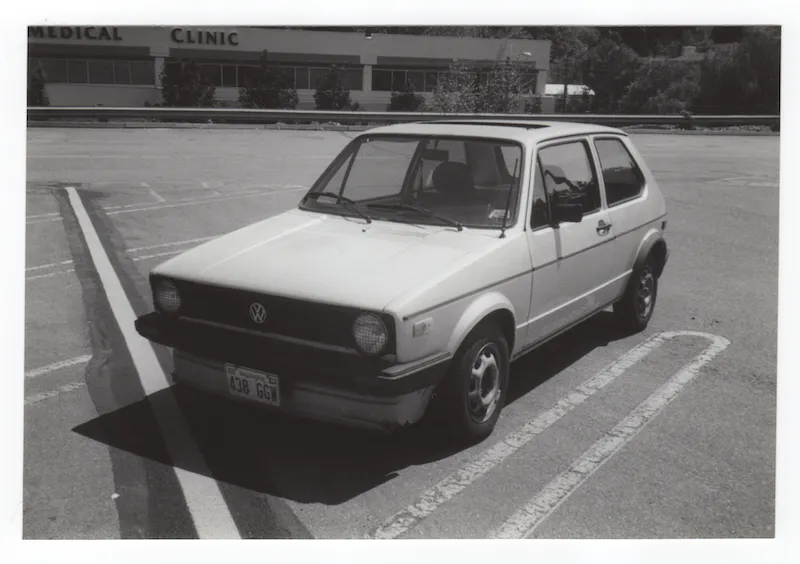
(And that picture of the car above — trade secret — it’s not the VW I had in Bloomington.  I had a second Rabbit in Seattle in 98/99.  It was silver and had the moon roof and was a stick shift, but the one shown above was a two-door, and had a gas engine instead of diesel.  Yes, I bought a near-duplicate car during the writing process of the book.  That’s what you call research.)

And So It Goes

I just finished reading And So It Goes, Charles J. Shields’ biography of Kurt Vonnegut, and have mixed feelings and unchecked nostalgia.

The mixed feelings part: the book was somewhat lopsided, but I liked it more than most of the reviewers.  Like someone reviewed it “and so it goes - into the trash,” and I didn’t have that bad of a reaction to it.  I do think Vonnegut probably deserves a more scholarly approach, something that carefully studies all of his books, analyzes their meanings and connections, and focuses less on his life.  That was the main criticism from many reviewers, that Shields didn’t “get” Vonnegut’s work, and dwelled on stuff like his assholishness and extramarital affairs.  I don’t know if he “got” it or not, but he didn’t spend the amount of time on it I would have liked.

That’s not to say Vonnegut wasn’t an asshole.  There’s plenty of examples covered in the book, from the extended divorce-or-not-divorce antics with both of his wives to the various affairs and infidelities.  There’s also all of this business about Knox Burger.  Burger was one of Vonnegut’s early champions, someone who, as the editor at Collier’s, got his short stories published; later, when at Dell, he got his books put out there.  When Burger was thinking about quitting Dell and taking the great leap into being an agent, Vonnegut whole-heartedly encouraged him to do it, and said he’d totally jump ship from his representation and come over to him.  So Burger quit, and Vonnegut told him he couldn’t do it.  There are several other examples of this kind of indecisiveness, and maybe Shields just cherry-picked some of the worst incidents and framed them to draw a morbid picture, but it’s all the kind of stuff I didn’t think about when reading Vonnegut’s fiction the first time.

I think that’s what bugged me about Vonnegut’s post-Timequake career, and this book.  I first read Slaughterhouse-Five as a college freshman, sitting in the IMU building on the Bloomington campus (which, coincidentally, Vonnegut’s dad helped design) and that metafictional construct of mixing himself and fiction into the same story line made me think that in some weird way, I knew him.  I didn’t know anything about him outside of his books; there was no wikipedia back then, and maybe he was in the New York gossip papers, but he wasn’t in the news out in Indiana.  I didn’t hear about the divorce news or the struggle he went through to write Timequake, and being oblivious to that stuff left the persona of Vonnegut much more impressive to me.

When I first started writing in 1993, Vonnegut was one of the writers I took a serious deep dive on.  I bought every Laurel paperback edition I could get my hands on and plowed through them all quickly.  My favorite was Breakfast of Champions, and I probably read it once every year or so, especially when I’m sick of everything else and just need something quick and decent to straighten my head again.  That said, Vonnegut was one of those lithosphere layers of literature for me, something I could easily consume and that would leave an impact on me, but all of the books blended together and didn’t have the forever scarring effect that a more difficult read might.  Nobody else wrote like Vonnegut, which meant his stuff was unique, but it also meant I couldn’t descend further into his madness.  I read the core canon of his stuff, then moved onto other things, occasionally dipping back in to reread a book out of nostalgia.

But at some point, Vonnegut started to lose his charm to me.  I think part of it was the balance between his fiction and his hashing out his personal life in the form of metafiction, until it got to the point (maybe around Palm Sunday) where there was no story and he was just throwing out straight memoir.  By then, he moved, in my eyes, from metafictional genius to cranky old man.  Timequake tried to turn this on end, with this strange twist of exploring determinism with the gimmick of time being stuck in a mobius loop, but he ultimately got dragged into this sea of autobiographical misery.  Everything he did after that was either re-releases of stories that were originally published before he his his stride, or old man rants on the state of politics in the Bush era.

So to read a whole book that contains only these personal life details was somewhat depressing.  The part of the book up to the publishing of Slaughterhouse, the bits about his struggle to find an audience, were compelling.  But after that, it feels like the back half of the book was nothing but Vonnegut waiting to die, which was incredibly depressing.  It’s not that Shields did a smear job on him; the content made it unavoidable.

Oh well.  Maybe I need to re-read some of his old books to get this out of my head.

Windows 8 is the next Microsoft Bob

I just installed the Windows 8 preview in a VM and tried it out.  My first impression: these people do not get it.

Here’s the deal: Windows 8 is basically Windows 7 with the Windows Phone Metro UI slapped on top of it.  To be fair, Windows 7 isn’t a bad OS.  I’m a Mac person, and all of my personal work is on a Mac (or iPad), but I also use a Windows 7 machine for my day job, and I’ve been using some variety of Windows for my job for decades now.  (I’m not saying I love Windows 7, but it’s relatively stable, and some of the major rough edges have been smoothed over.  I could write a book about all of the philosophical problems I have with the Windows paradigm in general, but I could also write a book using a Windows 7 machine, and I have.)  Duct-taping this huge piece of Metro on top of it hasn’t doubled system requirements and it doesn’t eat up major CPU or memory.  For the most part, if your system ran Windows 7 fine, you can expect somewhat similar performance in Windows 8.

The Metro UI: either you love it or you hate it.  I personally don’t like it; I think it looks like a poor attempt at a Star Trek: The Next Generation theme, and I don’t understand how all of this swiping and tiling is supposed to simplify life.  Based on the number of ardent fanboys furiously masturbating all over this new paradigm, maybe there’s something there.  Based on the abysmal sales of the Windows Phone, maybe not.  But if you are one of the people who are in love with this UI, the good news is that it’s now glued on top of your Windows interface.  If all of your apps are using the Metro interface, and you’ve got a touchscreen, you can interact with your PC just like your phone.

And there are two caveats right there.  Most people don’t have a touchscreen monitor.  And I personally barely want to lift my hands off the home row of my keyboard and go to my mouse; it would be an ergo nightmare to have to stop and pause and reach for the screen and pinch and grab and zoom and flick and swipe every god damned time I wanted to look at the clock or switch between apps or cut and paste or whatever.  Presumably there will be some keyboard shortcuts, but I foresee this as being a huge pain in the ass.  Plus you have to go drop another three or four hundred bucks (or more) to go get a new monitor?  No thanks.

And one of the great strengths of Windows is the ninety-eight zillion programs already written for it.  Roughly 17 of them will use this new Metro interface at launch.  That timesheet program you have to use at work that looks like it was written for Windows 3.1 is still going to look like it was written for Windows 3.1, but your magical world of touching and swiping and spinning and scratching isn’t going to work so well with its mess of radio buttons and drop-down lists that were all the rage in 1996.  And if you don’t have a mouse to fall back on and just have your fat fingers and that touch screen, forget it.

If you are a power user, and you do need to use the old fashioned mouse and keyboard, you’re probably going to shut off Metro and go back to Windows 7 and the Start menu and the same old same old.  If there’s an easy way to do this, fine.  But this means that Windows 8 offers no compelling upgrade from Windows 7, and there are going to be tons of Windows 7 faithfuls for years to come, just like there were millions hanging on to their XP systems as Vista marched on.

This system-wrapping is reminiscent of Microsoft Bob, Compuserve Wow, the harsh coexistence of DOS console programs in a Windows world, and every other attempt to reskin the complex world of Windows and dumb it down so it’s so easy your mom can do it.  You can create a really cool interface that looks like the fuckin’ Minority Report computer, but when you fire up that garbage income tax program your bank sticks you with, at best it will turn the whole experience sideways and clutter up the whole thing.  Or, maybe it won’t work at all.  Windows 8 does have a fallback, essentially running a Windows 7 desktop and explorer in its own sandboxed metro app.  But it’s as elegant as if you were browsing away on your iPad and a DOS window popped up and started a copy of WordPerfect 5.1, and you had to figure out how the hell to do a Shift-f7 on a keyboardless tablet while a white on cyan monstrosity of a window took over your display.

Here’s the bigger problem: if you are on a tablet, why do you need to bring an entire desktop OS with you?  Everyone’s talking about how Windows 8 will be the “iPad killer”, but if Microsoft thinks this Metro UI is so great, why aren’t they taking a version of the OS running on Windows Phone and scaling it up to a tablet?  When I pull out my iPad and want to look up a movie time or find out what year Leon Czolgosz was executed, I press a button and the screen is instantly on.  When I sit down for a day of work at my Windows 7 laptop, I give it the three-finger salute and wait and wait and wait and watch Macaffee scan my crap and wait and wait and eventually get to my desktop.  Why would you haul around the entire Windows 8 OS on a stripped down computer meant for quick interaction?

And why would you set your minimum system requirements for a tablet OS so high?  The iPad is a different system architecture than Windows(*), but if you could run Windows 8 on it, it would be godawful slow, and would need double the RAM and double the disk space.  And yes, the fanboys will say “well, maybe Apple sucks for releasing such a crappy tablet then.”  Sure, but how is someone going to release a competitor with roughly double the specs, and come in at a price point that doesn’t seem outrageous?  And if you do release a nicely-equipped-for-Win8 tablet, how much is it going to weigh?  How long will the battery last?  (Real world example: Lenovo has a ThinkPad tablet that uses a core i3 processor, has 4gb of memory, and a 320gb hard drive - a real, not SSD hard drive, mind you.  It’s about an inch and a half thick, compared to the iPad’s half-inch, weighs in at about four pounds versus the iPad’s 1.5, and costs about twice as much.  You may say it’s an unfair comparison because the Thinkpad is basically a full laptop cut down into a tablet, but then you can’t run Windows on a lightweight tablet like an iPad, which is my point.)

I said (*) because the iPad uses the A4, which is an ARM processor; Microsoft has said that there will be an ARM version of Windows 8.  That’s good news for tablets.  That means you might be able to use a cheaper/faster machine that’s more optimized for a tablet than your x86/64 Intel hardware.  It also means (but is unclear) that the ARM version of Windows 8 might be stripped down or more lightweight, to fit on a cheaper machine.  The bad news is that those ninety-eight zillion programs that work on your desktop Windows machine won’t work on your tablet.  You’ll need to buy new versions of everything, and that’s assuming that your software will be available in an ARM version.  That obscure timesheet program you’re forced to use?  Not available for ARM.  And sure, it’s not available for the iPad either, but this large base of software that’s a major strength to Windows is suddenly gone.

Tablets are not desktop computers.  Desktop computers are not tablets.  You use a tablet to browse the web or plink away at a text word processor or play Angry Birds.  You spend 90% of your time in a browser looking at facebook or watching YouTube; you don’t need a god damned supercomputer for this.  Yes, Microsoft fanboy, the iPad can’t run AutoCad and can’t render trillions of polygons a second, just like the Toyota Yaris can’t do 0-60 in under three seconds or haul around a concert grand piano.  Does that mean the Toyota isn’t a useful, easy, cost-effective way to drive to the mall?  Does everyone need to buy a $160,000 supercar to drive to the mall?

And why not have different interfaces for different machines?  Do motorcycle manufacturers put steering wheels and gas pedals on their bikes to offer a seamless interface between customers with both machines?  Why does my shower have this confusing two-knob system for mixing hot and cold water?  I’m a computer user; why can’t it have a QUERTY keyboard and a mouse to make the interface seamless?  Or maybe my computer should have a Hot and Cold knob, and for the 90% of the time I can’t run an app with those, I can switch over to a keyboard?

Or maybe because my next little Toyota should have a similar architecture to a large moving truck I’d use to haul around furniture.  They should make a car to compete with the Smart that contains a full-sized big-block V-8 engine.  And then, to make it cost effective, they could detune that thousand-pound engine in a 1500-pound car so it only puts out 61 horsepower, and everyone’s a winner.  Right?

Sorry, I don’t get it.  I don’t see how Microsoft is going to catch up to the hundred million iPads already sold with this strategy.

Into the Wild

DSCF3512

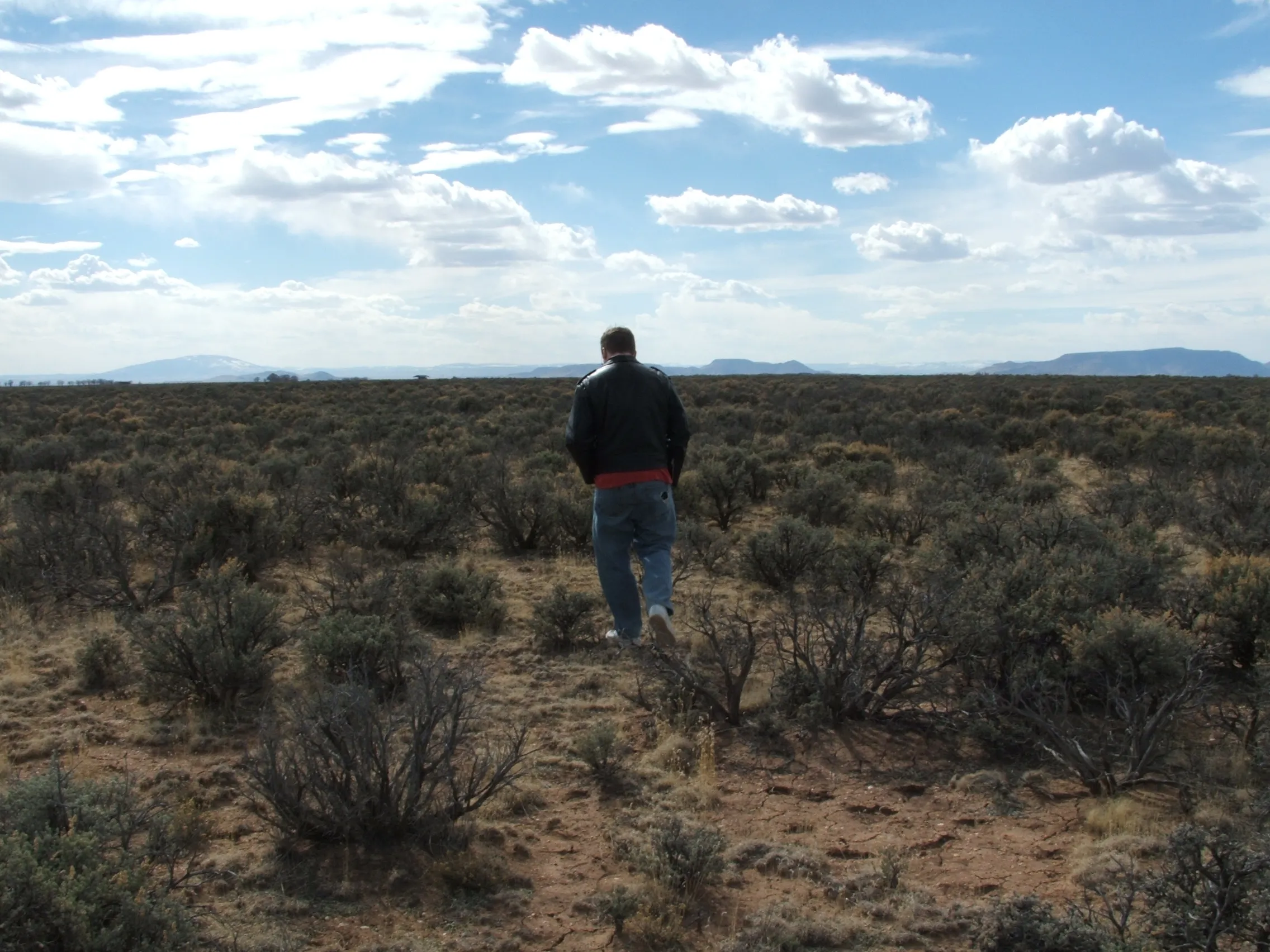
So I finally saw the movie Into the Wild last weekend.  I’d read the book a while back, and was curious how they’d make a movie out of it, but not curious enough to actually go to the theater.  (I also think it came out around the time we were in a mad rush to leave NYC, but I don’t remember.)  I’d also heard at the time that Sean Penn took many liberties with the story, and I had some worries that he may have gone a little too pretentious with the thing, so I forgot about it.  I don’t exactly remember why we decided to see it; I think it was a special deal on Amazon Prime or something.

I do like Jon Krakauer’s writing very much.  It always reminds me of Seattle, because the summer that the Into Thin Air Everest expedition happened, I had just started working at this place in Seattle where one of the dominant workplace cultures was mountain climbing.  I think all of the company founders had scaled K2 and Everest and were on the board at REI, and everyone there had high-tech backpacks and carabiner keychains and dressed in layers of goretex and had those clear plastic water bottles.  I think some folks there knew one of the guys killed in ‘96 on Everest, and I remember the Krakauer article spiking some controversy in the hallways and break rooms.  I didn’t read ITA until much later, I think the summer of 2007, but I remember the CNN news reports at the time of the events.

[2020 note: that company’s CEO was killed in an avalanche in 2016.]

The story of Christopher McCandless is certainly an interesting k-hole to fall into.  There’s a lot of stuff online, even if you don’t read the Krakauer book.  The brief summary is that this guy graduated college, and then, disenchanted by the modern world, decided to drop off the grid, start hitchhiking around the country, working odd jobs, and exploring nature.  The ultimate goal was to vanish into Alaska, live off the land with minimal equipment, and just be.  Spoiler alert: it all goes wrong, and he ends up starving to death in an abandoned bus twenty miles from civilization.

Prior to the movie, there were two primary arguments about this guy, who went by the nickname or alias “Alexander Supertramp.”  One was if he was a genius or idiot.  A lot of people think it’s a highly romantic story, this modern-day Thoreau, going against the one-percenters or whatever, and getting back to nature.  And there are a lot of outdoors types who think you’d have to be a fucking fool to go into bear country with only a .22 rifle and no solid knowledge of what the hell to do, and that this was nothing more than suicide, plain and simple.

The other argument was that in Krakauer’s book, he presented the theory that McCandless was eating the seeds of a plant that was toxic and would block absorption of nutrients, which caused him to starve.  After a scientist called bullshit on this theory, later editions of the book said the seeds may have had mold on them or something.  The alternate theory is that he died of “rabbit starvation”, which is where you eat nothing but lean meat, and your body shuts down because it can’t process protein anymore.  Or he could have just plain ol’ starved to death because he didn’t bag enough game to keep a ten-pound poodle alive.

So, the movie.  First, it’s both beautiful and haunting.  The soundtrack, by Eddie Vedder has something to do with the latter, but the film is beautifully shot, and has lots of scenes of the great outdoors, wide open mesas of the southwest and of Alaska, the kind of stuff that makes you really want to get the hell out and see it in person.  And the story, well, he had to round a lot of corners to get this to work as a movie.  He purposely left out pieces, and fictionalized some of the people Chris met to make it more of a typical Hollywood piece.  While McCandless spent his time in a bus in a mosquito-infested Alaskan swamp, they made the backdrop a little more esoteric and majestic for the film.  The Alaska shown is definitely only a subset of the Alaska I saw when I was there in 2006.  I could see why people would call bullshit on the inaccuracy of the story, but to me, it’s just a film, and I can overlook those flaws.

The part of the film I didn’t like is how McCandless was, for lack of a better term, a bit of an idiot.  I mean, they really built up this stuff about how his parents were assholes and he hated them, and his dad beat them and was married at the same time he started a family with his mom, and it was all a big sham.  That was a little too whiny for me; I don’t know what his struggle was like in real life, or if he had some mental illness issues or what.  Maybe he did, and I can sympathize with that, but the film didn’t do a convincing job for me on this front.

Also, I’m with the outdoorsmen on this one; there’s more he could have done to be prepared.  You can get a copy of the Air Force survival manual for under ten bucks at any surplus store, and just paging through my well-worn copy, I see a million things I would have done differently.  Why didn’t he try to fish?  Why didn’t he light a warning fire?  Why didn’t he look for other ways to cross rivers?  I understand that if he was starving and going nuts from lack of food, he wouldn’t think of this stuff, but it seems like in the long journey before Alaska, he would have thought more about this stuff, and read up on it.   Maybe that’s a bit of armchair quarterbacking on my part, but maybe that’s half the appeal of the story, wondering what you would’ve done differently in his situation.

My biggest question is exactly that: why is this story so compelling?  I know some people see Christopher McCandless as some modern hero, and although I don’t, I keep finding myself googling away, trying to find more information, looking at the site on google maps, reading old articles, thinking about what I’d do if I was up there.  I’m not saying I’m ready to go burn all of my money and hitchhike into the tundra with a bare minimum of gear.  But it’s a serious k-hole to fall into.  Some of it is the nostalgia of that timeframe.  All of this happened between 1990 and 1992, and I have a huge problem with continually going back to that time in my sentimentality trips.  And some of it is that desire to do something completely opposite what I do now, to trade a 30-year mortgage and a day job for a life of reading Tolstoy and gathering berries at the foot of Denali.

But who am I kidding?  I’m not exactly ready to trade in my Four Seasons bed and high-speed internet and start shitting in a trench while being attacked by mosquitos.  I mean, I’ve got 40 acres out in Colorado, and if I really wanted, I’m sure I could buy a shit bus on eBay for a couple hundred bucks and install a wood stove and shelf of paperbacks.  But two minutes into it, I’d want my damn MacBook Pro back.

Anyway, I now need to find my copy of that Air Force manual, and maybe queue up some episodes of Survivorman on the roku box.