The Wrath of Kon

Dispatches, thoughts, and miscellanea from writer Jon Konrath

Stop bath acid memories

I
save0179

n my freshman year of college, my classes were mostly at Ballantine hall, which was rumored to be built from all the money IU made off of the fluoride patent they sold to the Crest toothpaste people.  The morning stumble from Collins to Ballantine for an 8

German 100 class took maybe five or ten minutes, but I somehow decided that I’d die of exposure, so over the holiday break, I became obsessed with the idea of heated socks.  I somehow thought a pair of wool footwear impregnated with electrical coils would be the difference between Rolls Royce comfort and dying like those soccer players in the mountain plane crash who had to eat each other’s dead bodies.

I went to K-Mart back in Elkhart, and bought a pair of these magical socks in the hunting department.  They were brown with olive drab green trim on the toes, and a little plastic compartment for a C-cell battery in the top cuff.  I brought them back to school, put in a set of duracells, and within two minutes, it felt like a case of thermonuclear athlete’s foot, like the Vonnegut character that sealed his feet in clear plastic toxic waste.  And then two weeks later, it was suddenly 78 degrees outside, and people were sunbathing at the end of January.  I practiced cello outside the IMU on the bank of the Jordan river and got my picture in the school paper.  It must have been a slow news day.

That was my second cello.  I had to leave my first cello in the dorm over the holiday break. They ran the steam heaters full blast, so I locked the cello in the closet with a bucket of water, two drenched towels, and two humidifiers in the f-holes.  When I came back three weeks later, it was all bone dry, and the cello had a huge crack in it.  It was a rental, so I brought it back and exchanged it for another one.  I never really knew how to play; I just took a semester of lessons in some fit of stupidity, the same kind of spontaneous freedom that causes a person to buy a pair of heated socks at K-Mart for a five-minute walk in 38-degree weather.

I also purchased a 35mm camera that break, although I don’t think it was from K-Mart.  It was one of those fixed-focus point-and-shoot things, all plastic and manual.  I think I got maybe three rolls of film through it before the film spool broke, and I could not fix it.  I took a few good pictures of the campus, though.  And even though it had a plastic lens and no motor drive and no zoom or anything like that, it took pictures better than any camera I’d had before that.

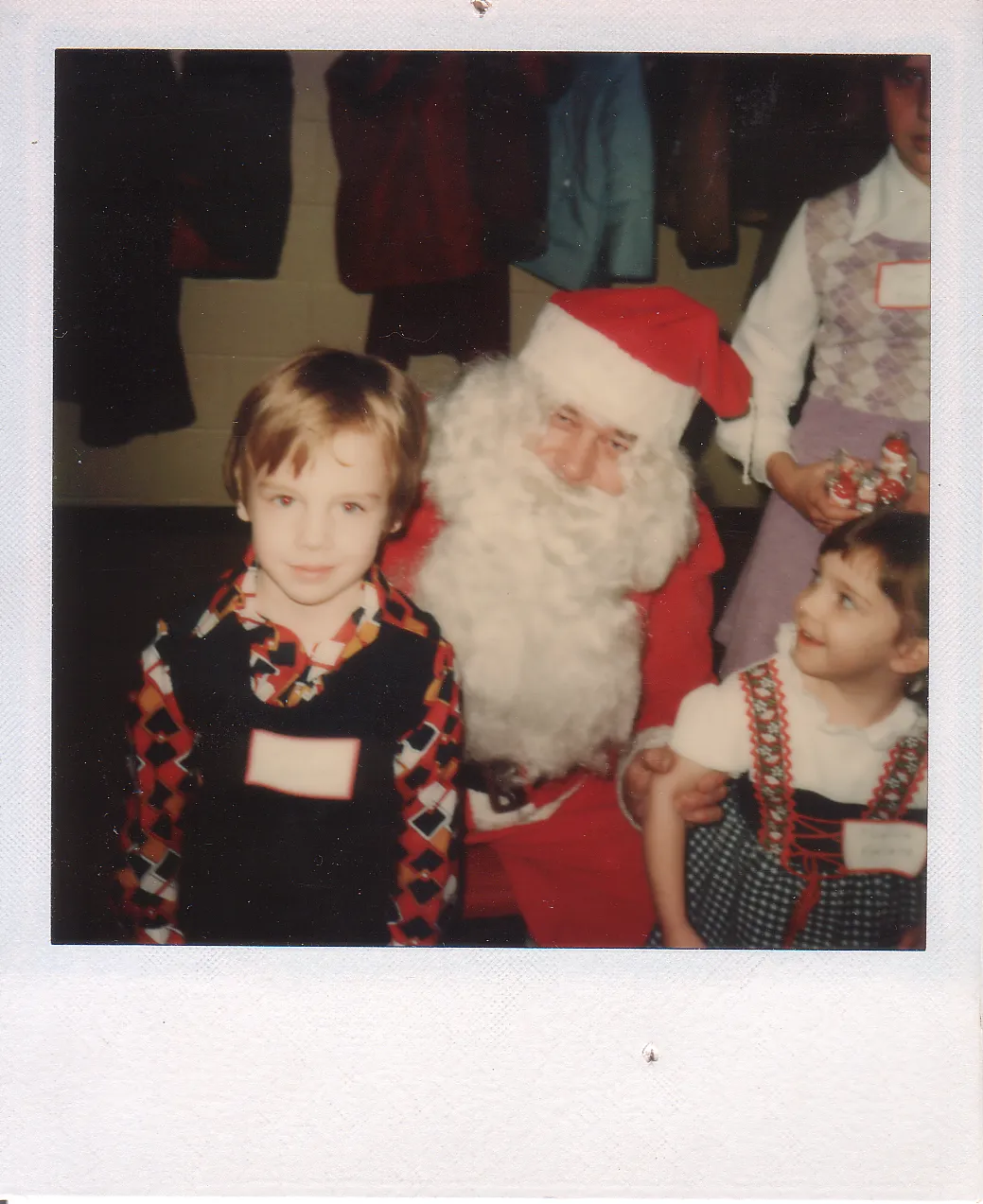
My prior photographic history resembles a list of every failed film technology invented.  My parents had a 135 camera, and then I got a 110, and we also had a Polaroid one-step, and later graduated to a disk camera.  I don’t know if they ever got one of those APS models, but I wouldn’t doubt it.  We’d take about a roll of pictures a year, and then throw all of the rolls in the junk drawer and never develop them.  On the rare occasions when a roll got processed, the pictures went in a sticky-paged album with a faux leather cover, which would then reside in this hexagonal end table in the living room, to be produced each time I was stupid enough to bring a prospective girlfriend home to meet my parents.

It’s depressing that people will soon forget the extreme frustration of living in the film age, of having to bring film to the drug store, needing to buy those flash cubes or flash strips that exploded in bright light with the faint smell of burning electronics, like igniting a dollar bill every time you pressed the shutter.  You’d worry about the film getting exposed to light and destroyed, the possibility of a door opening or a case splitting, exposing everything and fading the captured images to nothingness.  Unless you owned an expensive camera with a motor drive, you’d follow some ritual of ratcheting a thumb wheel to advance the film from one reel to another, hoping you didn’t crank it too far and miss a picture, or you’d forget to turn the wheel, and when it was time to snap the shutter, the mechanism would deny you until it was wound further.  And then you’d wait a week or a month or a year and get the prints and realize everyone had their eyes closed or you were too far away or the shot you thought was perfect didn’t frame up anything like the crappy little viewfinder convinced you it would.

I developed film once.  A girl I dated that freshman year found some old 35mm film at her parents’ house, the aforementioned spools of film in a junk drawer for decades.  Her dorm had a darkroom, and she knew someone who took photography classes or worked for the school paper or something, a guy with the knowledge of all of the various chemicals and trays and tools and red-filtered lights.  We unrolled this ancient spool while hiding out in this little closet of a lightproof room, breathing chemical fumes and watching the pictures slowly appear.  It felt like when you make the Paaz easter eggs as a kid, when you scribble on the eggs with white crayons and then dip them in the bowls of dye and watch the inverse of your writing slowly appear in color.  We watched these pictures of Toledo fade into view, images of a lake shore now covered in condos and strip malls, but then barren.  I don’t remember how the process worked, except it seemed magical to me.

I keep thinking about buying a film camera for kicks, an old East German plastic-lensed thing that hipsters use to take pictures of skateboarders and graffiti and abandoned buildings.  I know I would never use it; I almost never use my real digital camera.  But there’s something enticing about it, like any of my other craft-related obsessions I avoid because they are money drains.  I still obsessively google old camera pages, and think about Super-8 and Polaroid film.  I know I’d have to pay more per picture, and then I’d have to scan those pictures, and I have boxes of thousands of pictures I will never scan, and I’d only end up with more blurry pictures of my cats laying on the same furniture.   But the process of it all makes it hard to shake.  I should probably start by actually scanning the old pictures I do have, before I sink any money into this.
Mission

save0129

There is a level in Modern Warfare 3 called “Mission” and everybody seems to love it, because every time I’m playing and “Mission” and any other level other than “Terminal” or “Dome” comes up, everyone votes for “Mission.”  (“Dome” is one of those tiny levels where everyone shoots everyone and the maximum score limit is reached in about 122 seconds; “Terminal” is from MW2 and everybody’s memorized the map very well and knows where to stand and snipe and camp and plant claymores.)  I personally hate “Mission” and I don’t know why.

The word “Mission” reminds me of two things.  One is the song “The Mission” from the Queensryche album Operation: Mindcrime, which I pretty much memorized in 1988.  It has this weird chanting part, and one time my mom ran downstairs and told me to shut it off because it “sounded like Satanism.”  The other is The Mission, as in the neighborhood in San Francisco, which I only knew about prior to moving here because of the concept of mission-style burritos.

I don’t know what legally constitutes a mission-style burrito.  In college, there was this place on the second floor of a building on Kirkwood that made alleged mission-style burritos, which they advertised as “burritos as big as your head.”  I don’t think they were technically as big as your head in a volumetric sense.  They were potentially as long or wide as your head, but not as big as your entire skull, at least not mine.  (Of course, I have a giant head, and the biggest fitted cap you can buy at an MLB ball park barely fits me.)  I never ate there much, but a few of the people that spent all of their time at Lindley Hall used to eat there constantly, and I went a few times.

One night, I was leaving for Canada, and my roommate came home from the burritos as big as your head place as I was packing, and took a shit that filled the townhouse like a tear gas grenade thrown in your face at a protest.  We had to open the windows and it still felt like getting hit in the face with pepper spray.  I threw everything in my bag as fast as possible so we could hit the road, leaving town for another country at nine or ten at night, going to one of those stupid programming contest things where we always thought we’d smoke the other teams, but we ended up maybe finishing one of the twenty programs and wasting our time and money and effort, but at least we’d end up getting blotto in some new town.

I sat in the back of this Bronco truck, still depressed over some breakup that happened a week or two before, one of those relationships I thought was perfect and pure and forever until it got up to speed and then exploded like a car with no oil in the crankcase.  Leaving for another country with promises of exchanging funny money for many alcoholic beverages was just the thing for this kind of funk, except I knew that it never really worked.

We raced across Indiana and Michigan, hoping to outrun a snowstorm, and got to the border in Windsor some time after midnight.  The customs agent asked if we had any guns, and I yelled from the back, “WHAT DO YOU NEED?”  They still didn’t search us, and we drove into the great white north.  Hours later, we stayed at one of the worst hotels imaginable, and I slept on the floor of a closet, wooden paneling everywhere, a crying clown painting on the wall, the smell of mildew and dust mites everywhere.

I don’t think we ate any burritos in Canada.  I drank too much, mostly Molson.  We did not answer any of the problems.  I wonder if any of the people who did solve the problems ended up working on any of the Modern Warfare video games.  I don’t know.  All I do know is that I feel like a sober alcoholic at a liquor store every time I boot up that game, wasting away my hours trying to get to the next level instead of writing, or thinking of writing.  If writing were as addictive as video games, I would be Leo fucking Tolstoy at this point.  I am not.

Advice from Raymond Federman

I don’t remember when I got into Raymond Federman, but it was probably during the process of trying to look up every influence Mark Leyner mentioned in interviews.  If you haven’t read him, both Take it or Leave it and Double or Nothing are genius, and demonstrate his mastery of experimental narrative.  Both of those books influenced me greatly, and made me keep pushing to get Rumored to Exist done.

I found Federman’s email back in 1999, and dropped him a line, letting him know how much I appreciated his work.  I didn’t expect a reply, and was surprised when he sent this.  It’s probably the best advice I’ve ever been given, and I should probably print it out in 500-point type and paste it to the wall above my monitor.

From: Moinous@aol.com To: jkonrath@rumored.com Subject: Re: noodles Date: Mon, 25 Oct 1999 12:20

EDT

dear jon

in l966 in paris I was having lunch with the great samuel beckett and I told him that I had started a novel [it was double or nothing] and he said to me:

raymond if you write for money do something else

and after a moment of silence [very comfortable silence with sam] he added

and never compromise your work

I hope I have respected his advice

I now give it to you

write write and write some more and then suddenly the writing will tell you if it’s finished — di not revise - jsut write between the words above the words under the words between the lines —

most important key on your computer - delete

tell the people a random house that federman has a great new novel jsut finished but he does not ocmpromise his work therefore he is not sending it to them

thanks for your good words about my work — what read the other novels too —

where did you arrive from - which planet - and what do you do to survive —

writing is like jogging - it must become an addiction - do it everyday same place same time - except when you don;t do it

be aware that publishers are no logner interested in good writing —

more soon

federman

It's impossible to learn how to write plotless books by operating a plow

I watched an hour-long documentary with Richard Linklater a week or two ago, an interview that was done on some Austin cable TV show, which looked like one of those public access deals that they always had in Seattle in the mid-90s when I first got a TV, with a guest and a host or two sitting in front of a curtain, a grainy VHS-quality video feed with one of those title generators that did the blocky Amiga 500 looking graphics in a stripe across the bottom. Production quality non-withstanding, this was a pretty incredible interview, probably done in around 1994, mostly about his work ethic and the movie Slacker.

It talked a lot about his first film, It’s Impossible to Learn to Plow by Reading Books, which was the Stanley Kubrick film school experiment: he bought a camera and a couple of thousand dollars of film stock and started shooting, collecting footage for a year and then spending another year editing it down. And it wasn’t done as a calling card movie, which is what everyone does now: make a film like Clerks, and then shop it to studios and either get it distributed on the Sundance/indie circuit, and/or get a deal to make a real-budget picture. He did neither, except he got the experience to get ready to do Slacker. And that wasn’t a calling card movie either, although the fact that he made money on it made him instant fodder for the suits, and he parlayed it into Dazed and Confused.

Side note: I was obsessed with public access and the idea of making a film back when I was in Seattle in the mid-90s. I would tape almost anything interesting on the public access channel, and make these “cable hell” tapes which I then sent to Larry in Chicago and he would watch them in the background while studying for law school. My apartment also had a thing where you could go to a certain channel on your TV and you would see the security camera feed for the front door, so I would tape that, and then run downstairs with a sign and flash the devil horns and make a face or whatever, then run back up seven floors and stop the tape. That got old fast, but we used to love this strange chick that was on, a chubby nude model who was obsessed with Tori Amos and thought she was a painter, poet, ARTIST, whatever, and would paint her face or body with tempra paint and mime these bizarro dance numbers to obscure Kate Bush b-sides and then go on these babbling monologues about some personal drama. I did buy a video camera, but I never made a film, because I realized that filmmaking involves the herding of people and the scouting of places and the work of direction, which is probably one of my weakest abilities. That’s what I love about writing, especially now with self-publishing, because I can create entire universes on my own, and even as an extreme introvert, I don’t need to interact with other people to get shit done. (Selling books, that’s another story…)

One of the things that resonated with me about Linklater was his discussion about Slacker as a “kitchen sink” movie, how he was able to throw in absolutely anything that was in his head during that summer, any old stories or lost memes or friends of friends he found interesting. He’d read a short story by a friend and then ask to borrow one of the characters, and drop them in some other situation on the college campus town of Austin. He had this form he had to stick with, this idea of an entire day, moving from reality to reality, jumping into these individual movies of different peoples’ lives, but he could get almost anything to work within that. I like that a lot.

I think when I wrote Rumored, it became my “kitchen sink” book, because when I look back at it, there are so many little thoughts and notions that came out of email conversations and episodes in real life and stories that knocked around in my head since childhood. I had this framework, a specific form or scaffolding that I hung all of these things off of, and I struggled a lot with whether or not to stick to this format or try to remix everything into a conventional narrative. And I didn’t, although there’s a very subtle plot to the book if you read all 201 things in order, but I wanted to break that construct, and I did. But when I go back and re-read bits of it, ten years later, I notice where the pieces originated. I see a road trip I took in 1999 or a conference I attended for work or an episode where I got stuck in an airport or a recurring nightmare I had as a kid.

I don’t feel like books have to have plot, and I don’t feel like plotless books have to be unreadable. I know when people talk about plotless movies or books, first of all, that’s seen as an insult, a problem. I think people either relate it to a book that has a weak or bad plot, that plods along with no development. Or they think of the art film where a group of children with Down’s Syndrome throw ape feces at a wall covered with blank 1040 tax returns for six hours, and think, “what the fuck does this mean?” and it has to be some kind of artistic statement that you have to hypothesize that it’s a representation of the latent developmental problems of our capitalist society inflicting oppression on African countries crippled by IMF debt. Or whatever.

I think life itself is plotless, and when we transpose a segment of life (or fictional life) from the meatspace non-linear world to a linear, flat book, we use plot as a set of expectations, a contract with the reader to guarantee that we the author will provide certain events that unravel in a specific way that will make the reader continue the journey. When we write an act 1, we foreshadow what will happen in the act 2 and 3 to tell the reader that they should stick with it. There are only 29 plots or 17 plots or 3 plots or one plot, and by telling the reader that your book is going to follow a plot that they already know, you are giving them expectations on how things will unfold. There will be twists and turns, and that’s what makes things (slightly) different, but plot is what pulls a reader through the story.

I guess my problem with this is that eventually, every book will become the same book, and instead of becoming an experiment to challenge the form, you ultimately fall down this hole where your contract with the reader becomes so rigid, any deviation from it is blasphemy. And if you fall into the realm of genre writing (more on that some other time) you MUST adhere to these standards, and the more you do, the more the reader feels “rewarded”, which is asinine.

The hard part is coming up with the framework or system to write the plotless book, because you need to figure out some way to glue together all of those pieces in your kitchen sink to get to your few hundred pages of book.  And that part’s hard to explain.

Man, I need to go re-watch Slacker.

First lines from my books and stories, presented without commentary

“I pulled the VW Rabbit off the road and killed the engine.”

“You’re probably wondering why I did this.”

“I’ve always had a great interest in reference material.”

“I love Las Vegas, and I still have trouble telling people why.”

“There were riots in the streets, people gunning down cops, escaped prisoners dragging motorists out of cars stopped at intersections and smashing their brains in the pavement, Klansmen burning crosses, kids lighting bags of shit on fire and even people eating the brains of the undead.”

“I rented a room at the Vista Hotel in DC on January 18th to celebrate Marion Barry’s crack cocaine arrest with her, found an old black and white camcorder to hide in the wall, and bought enough narcotics to keep Peru in the black for months.”

“I’d do the same thing every weekend: get high on fiber, design a robot.”

“This all started back in the summer when KFC came out with that sandwich made from an entire bucket of fried chicken, two bricks of lard, and a pound of bacon.”

“Kilimanjaro is a snow-covered mountain 19,710 feet high, which makes it almost as high as I am as I write this story.”

“I snorted another line from the Oracle 11g promotional coke mirror I kept in my desk drawer, a fine row of crushed-up Claritin-D tablets rendered into a chunky dust of near-legal speed. I’d need every milligram of go-powder I could snort, shoot, or shove to get through editing this PowerPoint deck, a status report of status reports we submitted to the status committee on change management procedures currently in status.”

“I’ve never fucked anyone in a Chuck E. Cheese bathroom, I said to the anchorman from the Channel 4 News Team, a portly ghoul of a man wearing blackface and a stylish plaid suit made of velcro and tin. ”