The Wrath of Kon

Dispatches, thoughts, and miscellanea from writer Jon Konrath

LiveJournal

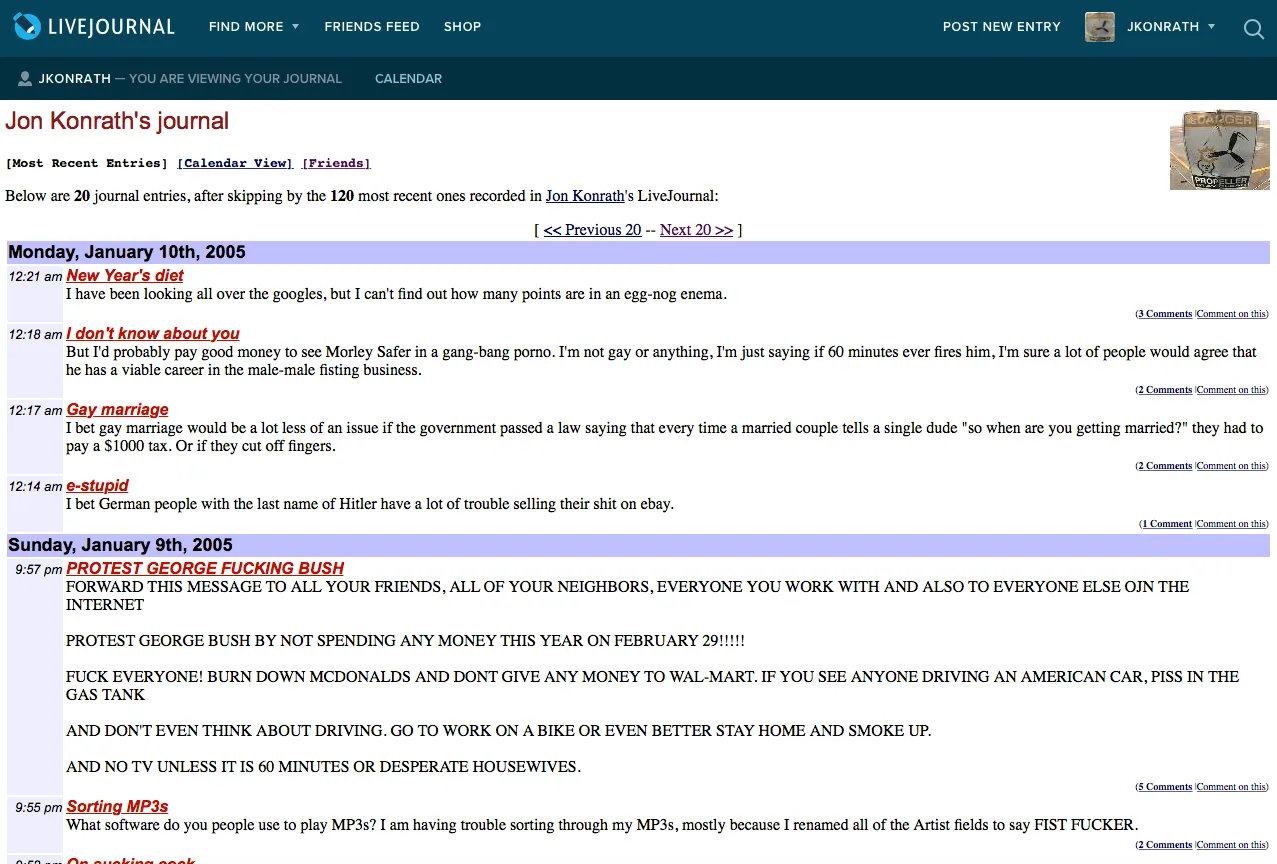
screen-shot-2017-01-14-at-10-09-35-am

In the quest to find some better way of doing all of this, I started thinking about LiveJournal. (I actually have been thinking about a lot of the mid-00s web stuff I used to use, because sitting on FaceBook all day is probably a dead end, or I feel that I’m not reading or writing enough. Like, did reading Slashdot, Fark, and an armada of blogs in Google Reader help entertain me any better than seeing the same four news stories posted a hundred times a day?)

I wasn’t a heavy LiveJournal writer; I had a fake account (username: unabomber) I started in 2000 just to comment on other peoples’ stuff, then started one as jkonrath in 2004. I’d post updates, but I had an earlier pre-WordPress iteration of this blog as my main home. But I would hit my friends feed constantly, and comment a lot.

LJ seemed to be “the place” to go to be social online for a while, like pre-MySpace, pre-Facebook, pre-Twitter. I was trying to think of exactly why though. The site’s still there, as is my account, so I poked around a bit and tried to remember. What did it offer that my blog did not? What was the draw?

Plusses:

  • It was dead simple (and free) to open an account. It was invite-only until 2003, but after that, anyone could get in.
  • Posting was not hard. It gave you a box and a subject line, and you typed and clicked “Post” and that was it.
  • There were fun little things you could add to posts, like what you were listening to, and what your mood was.
  • You had a certain number of profile pictures, and it was always fun finding new little pictures, or swapping to a different one based on your mood that day.
  • You could theme your page to some extent, changing colors and styles. Some people got really into the design of their pages, although when you’re reading your friends feed, you don’t see those customizations, and I basically didn’t give a shit about having flaming red text on a black background with pictures of wolves and fire and ninjas and shit all over.
  • Basic privacy settings could lock posts and accounts to be friends-only.
  • Communities, where permitted users could post to a feed. These were great for interests (I was in a baseball one for a while) or areas (lots of people had groups for their towns or home towns.)
  • You could (if you had a paid account) host a feed to your external blog, so the posts would show up on LJ.
  • It was locked in. You could sit and spin on your friends feed, and read all the posts (in chronological order, too) and in the mid-00s, a lot of people were posting, so there was some good conversation to be had.
  • There weren’t ads during the heyday, although that changed later.
  • It encouraged long-form posts. Or maybe people just typed more back then, before we were all programmed with horrible ADHD.
  • The feed was chronological only. No Fuckerberging of the order and appearance weighting of posts.
  • There was post commenting, and that got used a fair amount. Commenting was more streamlined than other blogs, because you had the single system for everyone, whereas it seems like every free-standing blog has a different commenting system, or they use something like Disqus, and people get all pissy about having to sign up for it. If you were using LJ, you were signed up for commenting, so it was a no-brainer.

Minuses:

  • The UX is horrible. Log in to livejournal.com and then try to find anything, and it takes ten clicks. It also started to look a bit dated and clunky going into the late 00s.
  • There was no “like.” I think that was the big killer versus Facebook. When you post on FB, there’s this little micro-validation you get in your brain when other people like your post. LJ didn’t have this, so the motivation wasn’t there. I think the little crack hit of likes is one of the main drivers for FB, and it’s also its downfall. The discovery of this gamification around the end of the 00s is the reason casual gaming now exists (well, that plus touchscreen devices with good graphics) but it’s also a big part of our dumbing-down as a culture.
  • The long-form thing meant good content, but it also may have been a reason people dropped out.
  • Images and image hosting were always an issue. You could add external links to flickr or elsewhere for your images, but the two-step process was messy. They now offer image hosting for paid accounts, but it’s a limited amount, and mostly a feature to entice people to pay. It’s nowhere near as nice as the FB interface for photo uploading.
  • No fine-grained security. You could not be friends with someone and not see their content. You could not hide a single post from your friends feed, like when you got sick of seeing the same thing pop up on every time. (I use the FB hide post constantly these days.)
  • No post sharing. This was a plus, though. Imagine FB without the ability to share stupid political posts or mom memes.
  • No (real) mobile stuff. I think they have an app, but it’s a piece of shit. So many people post on-the-go now in FB/Twitter, and LJ never had any of that. That may have been one of the reasons it focused more on long-form stuff, because everyone was sitting on a PC while composing their stuff.
  • Various business decisions slowly sank the ship. The company was sold in 2005, and then Brad Fitzpatrick left in 2007, and it was sold to some crazy Russians, who continued to run it into the ground.

Other:

  • I remember a lot of shit-storms over privacy issues, like people having to lock out exes and then said exes getting a different fake account to read their stuff, etc. Now, blocking and banning is simple in FB, but there was a lot of drama back in the day.
  • I also vaguely remember some moderation issues, with people or posts getting censored, and a bunch of outrage.

I always wonder if something could replace LJ and FB. Would some technical balance between the two work, or would some perfect storm have to happen to lure enough people to the community to make it viable? I think the biggest feature of LJ was that it had a community, and it had a critical mass of enough users to make it interesting and fun. But when that went away, so did its usefulness.

How do you create that again? I guess that’s the question every attempt at community tries to answer. I futz around with posting here, but it’s an isolated island in the middle of nowhere, with no community, no connection to the outside world. I post on Facebook, but it’s Facebook, and it is becoming a dead end. As I find Facebook more and more intolerable, I try to think of a replacement, but that lack of critical mass, of community, is the huge problem.

asides

There used to be the concept in Wordpress of an “aside” post, which was a small post with no title and a slightly different format. I guess the guts of it are still there, but there’s no formatting for it in my theme, and I’m sure if I used it, it would break something.

I think B used to use them all the time, in the heyday of mid-00s blogging. The concept of an aside is that it’s not a long, titled post. It’s just a quick status update apropos of nothing.

From the Apple dictionary:

1 a remark or passage by a character in a play that is intended to be heard by the audience but unheard by the other characters in the play.

• a remark not intended to be heard by everyone present: “Does that makehim a murderer?” whispered Alice in an aside to Fred_._

2 a remark that is not directly related to the main topic of discussion: the recipe book has little asides about the importance of home and family_._

I like the concept of asides, because I can never think of what to blog, as far as starting some giant essay about and important topic. Most days, it’s just the weather, etc. And I used to write only about that stuff, like during my lunch hour, twenty years ago when this all started. But then it evolved into having to write these huge essays, which leads to performance anxiety and self-censorship, which leads to me not blogging for months.

Also, I think asides were a thing when twitter and facebook were not. I could deposit my bitching about how UPS fucked me over again on my social media account. But then it is disconnected and forgotten, not part of this repository.

OK I’ll post this and then figure out if I need to format them differently, and maybe keep posting more of them.

V/A

Various items of note:

First, I made the last payment on my car. Toyota sent me a bunch of paperwork, and then a free-and-clear title came from the state. This is a 2014 Prius C that I got almost exactly three years ago. I stretched out the three-year loan because they gave me 0% financing, so no reason to pay it off early. That leaves my house as my only debt, and that won’t be paid off any time soon, although we did just round a corner on the number in the leftmost column of the balance, if that makes any sense.

This car still feels mostly new to me, because I barely drive it. It’s three years old, and I have not cracked 9000 miles yet. Aside from work (50 miles) and a trip to Davis (70 miles), the only long trip it’s taken is the 120-mile drive I took to Castle AFB last year. There’s a door ding and a few scratches on the driver side, and it could use a detail, but it’s otherwise in newish condition. I will probably keep it as long as possible, or until I have to start commuting to work again. If I had to go back to driving a hundred miles a day again, I’d probably upgrade to a model with more adjustable seats, and a backup camera. Otherwise, I’ll keep going on this one, especially since the new Prius looks pretty stupid.

I also don’t want to upgrade my laptop, and the 500GB drive was getting full, so I got an external from Santa and moved all of my photos off my machine. That gave me back about 150GB, so I’ve got some breathing room. I really don’t want to go to the new touchbar Mac, and I don’t want to pay four grand for the pleasure of doing it. Sarah just had to upgrade her 2009 MBP and take the hit price-wise. I’m curious how that works out, as far as the lack of ports and so forth.

I do need to upgrade my iPad at some point — it is the 2012-era iPad 4, which still gets the latest OS, but is getting flaky. Also my smart cover is disintegrating, and I can’t justify hunting down a new one just to use until the actual hardware croaks. It’s a bad time to upgrade, though; there are rumors that March will see an entirely new line.

And there’s the question about whether or not it’s even worth it to stay in the Apple ecosystem or jump ship. But I interact with Windows enough at the day job to know I can’t go there. And I would have to ditch Scrivener and find a new writing workflow, and that isn’t happening. I do hope Apple gets their shit straight though.

The weather here is still horrible. Cold, rainy, dark. Walking every day has been a real challenge. The weather also has been reminding me heavily of when I was in Seattle, especially the last winter or so. Seattle was beautiful from April-October, and I somehow powered through the first winter without major problems. But the second year was brutal. I don’t know how I managed to survive four winters there without taking a vacation or investing in a full-spectrum light.

So for whatever reason, there’s a weird nostalgia callback from the gray skies overhead. It makes me think of Seattle, which makes me think about people from Seattle, and jobs in Seattle, and all the various things I fucked up while I lived there. So that’s not good.

(Grammar tip: gray versus grey. GrAy with an A for America; GrEy with an E for England.)

2016

I hate these posts. I hate January 1 and everything about it: the new year/new me shit, the pressure to change yourself into something else overnight, and the fear of taking a brand new, unscratched and unblemished year and driving it into the ditch by eating 16,000 calories of Burger King for lunch.

I did a few things in 2016, so here’s the list:

I released three things in 2016: a zine (Mandatory Laxative #14), a book (Vol. 13), and a joke picture book for The Same Picture of Jon Konrath Every Day.

I had two interviews published last year (here and here) and had parts of Vol.13 appear in Horror Sleaze Trash and Tall Tales With Short Cocks Vol 5. Paragraph Line was mostly dormant in 2016, but aside from my book, we also released John Sheppard’s Explosive Decompression, which is definitely worth a read.

I bought a new guitar as a birthday gift to myself, a Fender FSR Strat. I started taking lessons this fall, but I’m still a total beginner. No real goals here, just keeping at it until I can play barre chords without 4 of 6 strings buzzing.

I took an Arduino class at The Crucible this spring, and it was fun trying to remember electronics stuff from 30 years ago. I didn’t build anything substantial or keep with it and do more research, but it was interesting to do that.

I went to London in May, and took a short trip to Nashville and Memphis in August. Both were decent. I got a new camera before London, and feel like I’m not using it enough. I was also supposed to go to Nicaragua, but ended up cancelling because of work.

The exercise slashline:

  • 3,031,167 steps
  • 5900 floors
  • 1,430.72 miles
  • 915,742 calories


It was a frustrating year with writing, with politics, and with my mood in general. The midlife crisis stuff that hit hard in 2015 hasn’t gone away. I need to do something about that. Until then, I’ll waste more time on memes, and try to figure out this guitar thing.

You?

City of Gold (2015)

City of Gold is a documentary about Pulitzer Prize-winning food critic Jonathan Gold. I’m ambivalent about the current spate of foodie-oriented TV and movies, but this was less of that and more about an interesting and quirky artist, and the real main character was the city of Los Angeles.

One of the main focus points is how Gold is the champion of the off-the-beaten-path restaurants, largely immigrant-focused. It’s a healthy counterpoint to the current post-election culture that has swallowed the news cycle, and the doc shows several examples of how he championed a hole-in-the-wall restaurant and made their business explode. An example was Meals by Genet, a restaurant in Little Ethiopia on Fairfax run by Genet Agonafer. She fled Ethiopia for LA with her young son, and struggled through the usual low-pay food service jobs. Her son, through her support, eventually grew up, went through medical school, and became a doctor. When the space on Fairfax opened, he maxed out every credit card he could find to get her restaurant going. When Gold reviewed it, she could not cook fast enough to handle all the new traffic, and now she’s flourishing because of his nod on the 101 Best Restaurants list he publishes.

There are several stories like this, where he writes about his favorite Thai food, taco trucks, Korean places, and works the Pico strip, eating at every small ethnic restaurant along its length. And that’s why I say LA is the main star here. I’m unapologetically a massive fan of Los Angeles, and wish I would have spent more time than the brief half-year I lived there in 2008. There’s some city planning porn in the doc explaining how LA has multiple city centers, and grows outward from each one. Many people — mostly those who have never spent any time there — decry this sprawl. But it’s a feature, not a bug. It means different parts of the city blossom and grow to provide different experiences for a widely diverse population.

Sure, that sprawl means unending chain restaurants. You’ll find at least 150 McDonald’s chains in LA county. But it means there are so many spaces for weird, eccentric, or authentic food. This is one of the big surprises of the city, and shown well in the film. There are big Zagat-reviewed fancy places in LA, which are all stuck in the 90s. But you can roll into a mini-mall in El Segundo and find mind-blowing food from any country or region of the world, sitting next to a cash-for-gold place.

Gold writes for the LA Times, but the movie shows his ascension through the ranks. He started at the LA Weekly as a proofreader back in the early 80s, when he was studying cello at UCLA. He moved up to music editor, then got into food. There are so many interesting intersecting paths here; he’s got the connections to the food criticism world, and you see Robert Sietsema, Calvin Trillin, Ruth Reichl, and so on. But he’s also a regular on KCRW. He was a champion of the early LA gangsta rap scene, spending time with Snoop Dogg in the studio while he recorded his first album. He played with the post-punk band Overman. He was around for the early 80s punk scene with X and the Germs. And it seems like he’s had a thumb in every little food scene within LA, from the old Jewish delis (he actually worked in Spielberg’s mom’s deli back in college) to food trucks to everything else.

One of the things I liked about the film was showing Gold, how he lived in a house filled with books on every horizontal surface, his close relationship with wife Laurie Ochoa (now entertainment editor at the Times) and his struggles with writer’s block, even though he still publishes 150,000 words a year. He’s a jovial looking guy, with long hair and always with a smile on his face, and it’s humorous to see him pecking at his Macbook at the kitchen table, then wandering off to pick up some random book and not get to a review his editor wanted yesterday. We’ve all been there, but I think the rewarding thing was to see him struggle with it and then at the last second crank out such engrossing and descriptive criticism.

The only sore spot with this film is it really, really made me want to go back to LA. Watching those long pan shots of the strip malls and restaurants of West Hollywood and Koreatown and Culver City and Sawtelle gave me such overwhelming nostalgia for the place. There are things I like about Northern California, but we don’t have city centers like that. We have downtowns surrounded by bedroom communities, and it’s just not the same. Yeah, the traffic sucks, but the traffic here sucks too, and we don’t have 350 days of sunshine a year and such an overwhelming food scene. I really wish I was back, to drive down Pico and look at everything, even if I do just end up at Norm’s at three in the morning, eating pancakes. Great film.