 So, I’m now officially, according to the FAA, a remote pilot, with an sUAS rating. I just passed my Part 107 exam and got my license in the mail yesterday. I’d had a Temporary Airman Certificate since last month, but I now have the real FAA card in my wallet.
Flying drones in controlled airspace involves a few hurdles, depending on what you’re doing. The FAA is not keen on a few pounds of plastic and metal getting ingested into a 737’s engine on takeoff, so they’ve established rules you’re supposed to follow, and the technology forces the issue a bit. Drones that weigh more than 250g now require something called Remote ID, which broadcasts the drone’s location, altitude, and speed, plus the operator’s position. And drones have to be registered by the FAA, which requires the operator to take a 20-some question multiple-choice test online.
If you do that, you can fly recreationally, which means you can’t perform any commercial missions, like making real estate videos or shooting a movie or anything else. This also (arguably) includes posting content on monetized social media platforms, although this is a gray area. Most people do this anyway, but there was a high-profile case in 2020 where someone was fined $200,000 for repeatedly breaking this rule. They were a high-profile influencer, and were also flying recklessly and breaking a bunch of other rules, but still.
There are a bunch of other rules, of course. You can’t fly above 400 feet AGL; you can’t fly in low visibility; you have limitations based on the controlled airspace above you; you are the lowest level of right-of-way in the sky; and so on. But the biggest one is intent. And I didn’t plan on getting a job doing aerial building inspections, but the whole thing is a challenge, and I’ve always thought I should study and take the Part 107 exam ever since I first flew a drone in 2020. So…
I bought a couple of books on Amazon a while back, and thumbed through them but never committed to studying anything. And after I finished my MSML degree in 2023, I bought an online course at pilotinstitute.com with hopes of completing all the video lessons and then taking the test, and of course that didn’t happen. I’d barely even been flying since 2023, and had a total lack of inertia on any of this.
Back in October, I started flipping through one of the test prep books one night, and decided I needed to just force the issue. I went to the FAA web site, looked up how to register for the Part 107 exam, and booked a date ten days later. Now I’d have to force myself to study, or lose the $175 fee.
The FAA’s Part 107 exam is a 60-question multiple-choice test that takes two hours, and you’re required to score 70% or higher. The test encompasses about a dozen different areas of knowledge, from airspace regulations to reading maps to weather systems knowledge to emergency procedures to those little signs on the side of the runway that tell your pilot where that taxiways are at an airport. The test is in some ways a subset of the Part 61 exam you take as a private pilot, and for both, you study from the Pilot’s Handbook of Aeronautical Knowledge, a 522-page behemoth of a manual that covers all of this and more.
The funny part about the Part 107 test is there’s a lot of stuff you’re tested on that doesn’t entirely apply to drones. For example, you’ll need to know about radio communications, but you can’t transmit and don’t need to announce your actions over the radio. You need to learn all about airport operations, but you for the most part can’t operate at an airport. You need to know all about weather and how to decrypt a METAR report, but the bottom line is you’re probably going to fire up an app to take a glance at the forecast, and if it’s anything but nice outside, you won’t fly. A lot you need to study won’t apply to you when flying drones, but I guess if you have an intellectual curiosity around this, it’s interesting to read about it.
There’s a whole cottage industry of classes, videos, books, and web sites on passing the 107, many of them somewhat dubious, and all of them highly variable depending on how you learn. Here’s basically how I studied:
- The Pilot Institute course was great, but incredibly detailed, and it felt like it would take me months to watch all the videos. I worked on that, but seriously, it’s like 322 videos and quizzes, and I think I finished 40% of them.
- I also watched some YouTube videos that were like an hour long and a total overview. These varied greatly in quality. I won’t link to specific examples, but they’re out there.
- I think I read five or six different books, plus the PHAK, the FAA test supplement book, and the FAA’s Remote Pilot Study Guide. The ASA Test Board guide was the one most helpful to me, and it also gave me a set of practice tests online which were helpful.
- https://free-faa-exam.kingschools.com/drone-pilot is the most helpful practice test site. You can pick how many questions and which of the six big categories they are from. What I did after a week or so of deep study was to take 20 questions a day, then write down every single thing I missed and go back and research them.
- I also created a note in Apple Notes that was basically an abbreviated list of everything on the test, including various mnemonics and things I had to be careful to remember. (I.e. the controlled airspace classes are Above, Busy, Crowded, Dinky, Everything else, and Go for it.) I looked at these notes constantly, any time I had my phone out.
- Although I don’t 100% trust it, ChatGPT was pretty good at answering basic questions or listing information on the test. Like if I had some meteorological question about cloud formation or I wanted an explanation of a symbol on a chart, it was pretty good at giving me an answer.
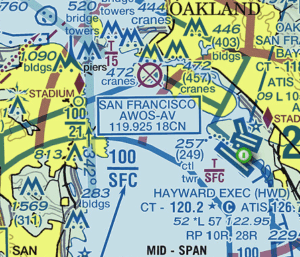
- Another random tip: when you take the test, they give you a book called the Airman Knowledge Testing Supplement for Sport Pilot, Recreational Pilot, Remote Pilot, and Private Pilot. It’s a bunch of examples and diagrams, so on the test, they can ask “On Figure 20 Sectional Chart Excerpt, what is…” You can buy or download the book on your own. There is a legend at the front of the book which basically describes every item that appears on a sectional chart. I was trying to memorize all of these symbols and lines. You don’t have to; just look them up.
I continued on this, but during my first week, Squeak died, and that threw off the whole thing. Also, I was taking these practice tests and kept getting hung up on questions, especially ones that required a lot of memorization. I pushed out my exam date by two weeks, and kept going on my study.
There’s a small maze of logins and applications you have to do to take the test. You create an IACRA login. You apply for an FTN number. You create a PSI login. You apply for a test date. You pay for the test. I think there was a login.gov step in there. All of these sites are different than the FAA site where you register a drone, the third-party site where you took that 20-question TRUST test for recreational flying, or the FAA site where you request flight authorization in controlled airspace via LAANC. All of these web sites look like a DMV web site from 1997. Bookmark everything, take notes on what logins you used where, and don’t do what I do and use two different emails. Also, check your spam folder regularly, because all of these confirmations get flagged as spam.
I finally took the test early on a Saturday morning. It was at a nondescript four-story office building out by what used to be Candlestick Park. It looked like a typical office park thrown down in the early 80s on the peninsula during that particular tech boom, and the inside lobby definitely had that vibe. I sat in my car and did some last-second cramming on my phone before I went inside. I wish I could have taken pictures, but I was not allowed to even bring in my phone.
The security situation was bizarre. No phone, no watch, no coat, no jacket. I had to take off my hooded sweatshirt, empty all my pockets, put everything in a locker. They checked my glasses, patted me down, checked underneath the cuffs of my pants, and did everything but made me disrobe. I was allowed to bring specific things in; they gave me a copy of the testing supplement and a pencil. I was allowed to bring in a four-function calculator, a magnifying glass, and a clear magnifying ruler. I didn’t know if those rules were from 1974 or if I really needed that stuff, but why not.
This was a third-party test site, and I guess I assumed it was only pilot testing, but I guess they do all sorts of secure exams, like for pharmacists and TSA workers and whatever else. I think I was the only one taking a pilot’s test, because I was the only person with the test supplement and an armful of rulers and calculators and junk. They brought me in to a room of study carols, each with a computer. The test fired up on there, and it was a typical DMV-style online exam thing, with the worst interface imaginable. It also had an insane number of pre-test things you had to accept and calibrate and click OK on, the worst LMS setup imaginable. After what seemed like 20 minutes of prep, I started on my questions.
The test questions were pretty much like the practice tests. Actually, some of the questions were exactly like the ones on the practice test. I read through them carefully, to make sure they didn’t add a “not” or something and change an answer. The other anomaly is you get a few “test” questions that don’t count, like maybe they are trying out a new question. And one of these specifically was wrong. It asked a question about an airport on a sectional, and that airport was completely not on the map; it was a map for a totally different part of the country. On any question, you could report a problem, so I put that in and hoped I wasn’t just looking at it wrong.
I had two hours to take the test, but I swear they were far easier than the practice tests I took. I think it took me 20 or 30 minutes to go through all 60-some questions, so I went back to the start and examined every question a second time. Then I finally submitted everything, and got up and left. In the reception room, I handed over my stuff, and the attendant went through this big spiel about how if I had any issues I could go to the FAA site and blah blah blah and all I’m thinking is DID I PASS. Finally, he handed me a piece of paper and I looked at it: 93%. I did.
Of course, here comes the fun part. You aren’t immediately handed a license like you’re at the DMV. You are given an exam ID, and you have to go back to the IACRA site and submit an 8710-13 with the 7-digit FTN and 17-digit exam ID. Then you get a TSA background check. Then it goes to the FAA. Then after processing you can log into the IACRA and get a temporary license until they mail you. Problem was: the government was shut down. The FAA was (sort of) keeping flights in the air, but nobody was in the office, so I had no idea how long any of this would take.
That IACRA stuff worked, but I sat and waited on the TSA thing. I could officially fly 107 flights, but it took a total of five weeks end-to-end until I actually had a license.
In the meantime, I ended up buying another drone, the DJI Mavic Air 3S. I had to re-register my old drone and the new one so they had hull numbers I could use for 107 flights. That’s all automated, and wasn’t a problem.
Anyway, no idea what’s next, except I can post video now. I’ve got a YouTube playlist that I’ll start using, and I am posting some pictures and videos in the usual places. Should be fun. Of course, all of this isn’t writing, and I need to get back to that.