The Wrath of Kon

Dispatches, thoughts, and miscellanea from writer Jon Konrath

2023

Bangalore

bangalore

I’m back in India. I’ve been here since last Saturday, and will be leaving tomorrow, so it’s a shorter trip than last time. This was very last-minute and I did not have much time to plan, so I didn’t do anything exciting. Just work.

The trip out was long, as usual. I went through Singapore this time, and was able to get an upgrade to premium economy, although that doesn’t get you much. I was in an aisle in the bulkhead row, which meant nobody reclining their seat in my face, but it also meant the TV was far away, and I had no place to put my bag. The flight was just shy of 16 hours. Then I had a super quick layover and caught a five-hour flight to India. I think I slept two or three hours on the Singapore leg, and maybe an hour going to India. That meant I left my house in an Uber at 7

AM Friday and checked into my hotel in Bangalore at just before midnight on Saturday.

I think this trip was less overwhelming than June’s visit. I knew what to expect, had a vague idea of the terrain, and my schedule was packed with nothing but work. I got this hotel that’s about 2km from work and maybe 1km from where we were having this off-site, so that was fine. I now know you can get from anywhere to anywhere in an Uber for like a dollar. And walking is fine, too.

Every day I would walk to work. Like I said, it’s maybe a mile each way, but it takes about 45 minutes, and you have to follow a convoluted route with your head on a swivel. Traffic is bad, the random motorcycles are worse, and pedestrians have no right of way. And sidewalks can be somewhat random, or simply end in an open trench.

I tried to be somewhat zen about my walks, look for things I normally don’t see, find things that give me joy. Here’s a list of what I liked:

  • There are so many different types of buildings. It’s not just a bunch of perfectly optimized 5-over-1 construction or a sea of ranch houses all built during the same housing boom. Some buildings have more than four sides, shoehorned into odd spaces. Some have very European lines, but some have arched windows or Jharokha windows or pyramidal roofs. Some houses look like they were built last year and some look a century old. It’s amazing to see them all butted against each other.
  • Part of my walk twists through some narrow alleys going behind rows of five-story buildings. There are small slits of light where you see the sky, criss-crossed with random wires and cables from power and internet. I don’t know why I like seeing that - it reminds me of parts of Berkeley or even Bloomington, where student buildings were randomly assembled next to each other.
  • Bangalore has so many trees. When I stay off the ring roads and take side streets, there are smaller streets that feel almost like they are going through a tunnel of green. Mountain ebony, Indian Elm, and cork trees line the city streets, with thick trunks jutting from the sidewalk. And there are amazing flowering trees. I’ll be walking along a main road and see an Indian laburnum with bright yellow flowers or an African tulip tree dotted with red-orange petals.
  • I love the randomness. You can walk past an all-glass aerospace building, then there’s an empty field with a cow eating grass in it, then there’s a retina surgery center, then there’s a shop rebuilding motorcycle engines in the street. It makes it hard to just like go to the suburb with all the grocery stores or fast food places. Everything is everywhere.
  • People draw chalk mandalas on the sidewalks in front of their house. I know nothing about the ritual or significance, but there’s something I like about it. I like spotting them as I walk through alleys and streets.
  • There was one night I was walking home from the off-site to the hotel through the EGL tech park. This was after spending all day in the air conditioning, and it was dark out, and the air was dropping from 90 to 70 degrees rapidly, and it gave me the strangest sense memory of the summer nights back in Bloomington in 1992, of walking in the cool darkness to the fountain at midnight after a day of triple-digit temperatures. I’m thirty years and half a world away, and absolutely everything is different. But I still felt that feeling for a minute, and it was amazing.

Anyway. Done with work. Leaving India tomorrow morning and taking a quick vacation for four nights over here. More updates on that soon.
Zine(s)

xenocide

I published another zine last week. It’s a bit of a throwaway thing, an experiment, an attempt to get back to writing. I deliberately did not make this something I would try to sell or distribute. I wanted to focus solely on writing and producing something that would take my focus and time. If my writing was running and this was a couch-to-marathon thing, this zine was like getting off the couch and walking around the block. And it worked well.

I like making zines. I think one of my biggest distractions with writing is focusing too much on what sells, what people want, what’s expected of a book. Also, working on a book takes forever and I don’t get feedback until sometimes years after I write something. Making zines just for the sake of making zines alleviates both of these. Back when I first got free access to photocopiers at my corporate job in 1995, I started Air in the Paragraph Line so I could copy dumb stories and mail them for free to a dozen or two friends. I didn’t care about the layout or the format or anything else, because I wasn’t trying to get stuff in Barnes and Noble. At the apex of this, I was putting out a zine every month, and I loved doing that. I would drop off a big box of envelopes at the PO, and within a week, people were emailing me, telling me what they liked.

Another reason I love zines is they are tactile, physical objects. There’s something about getting a zine in the mail, opening the envelope, holding the little booklet in your hands. There’s a certain joy in paginating a stack of copied pages into individual bodies, folding them in half, stapling them, counting up the number you made, stacking them up and getting them ready to stuff into envelopes. I’ve messed with e-zines and posting PDFs and whatnot, and it’s just not the same. Creating a newletter on Substack or writing a blog like this is its own thing. Reading a physical book is another. And it’s even better when you’re holding an object that you know the author held, folded, stapled, ran their fingers over the spine. It’s a direct connection between author and reader.

So, back on the horse. I couldn’t find my long-arm stapler, but I did find my (fake) bone folder to fold pages in half. I did the layout in Apple Pages this time, laid it out in portrait and pasted in a bunch of crazy graphics as backgrounds and asides, mostly screenshots taken from badly scanned PDFs on the FBI’s FOIA page, things about UFOs and cattle mutilations and how to build fallout shelters and perform tracheotomies on the battlefield. I spent a lot of time messing around with that stuff and it was a lot of fun. It reminded me of the time me and Ray messed around in Photoshop 1.0 when it first came out, in the Mac lab in the Fine Arts building at IU. They had these Mac IIfx machines (“wicked fast!”) loaded up with an insane amount of RAM, dual monitors, color printers, drawing tablets, Sytek drives, and everything else. We spent a few hours just chopping up Anne Geddes pictures of babies, and it was an overwhelming amount of joy just working on nothing, playing and having fun.

Some of the writing in this zine was old stuff from automatic writing going back to 2016. I think one of the pieces was something cut from Atmospheres in 2014 during the final edits. The actual writing was more of an afterthought. 5000-some words, 20 pages, double-sided and folded in half. I’m not selling these; maybe if I do a few more (and that’s the plan), I will bundle them up in a book. That’s not the point. It’s not about selling it. Hell, my name isn’t even on the front cover. It’s just about creating.


Pro tip: I don’t know when this happened, but Adobe made it much easier to print stuff like this. I used to have a labored process of laying out folded-in-half booklets, where the first landscape page for a 20-page zine would have page 20 and page 1, and the flipside would have page 2 and page 19, and so on. Huge pain. Now I can make a PDF that’s in portrait orientation, pages 1-20 in that order. Acrobat will turn them sideways, shrink them down, and paginate them so it’s 20-1, 2-19, 18-3, etc.

There’s a trick to this, though. If you shrink down 8.5x11 pages, the trim will be all off. So anyway, here’s what I did. (Note that this assumes you have a real printer to print the master.)

  1. When you do your initial layout, make a custom page size with no margins. File > Page Setup, I made one called “half-letter” that was 7.14 by 11 inches. (My math may be slightly off there.)
  2. Write the zine. Make sure your number of pages are a multiple of four.
  3. Print to PDF, double-sided and make sure scaling is shut off.
  4. Open the PDF in Adobe Acrobat Reader (not Preview.app or some other knockoff PDF reader.)
  5. File > Print.
  6. In Page Sizing & Handling, select Booklet.
  7. I think all the default settings will be right. You can flip through the pages in the preview to the right, although the preview sometimes looks junky. (For me, I had Booklet subset on “both sides” and Binding as “left.”

My right margin on odd pages was a bit truncated, so maybe that’s my math. Also I could not figure out how to print to PDF with this feature. https://github.com/rodyager/RWTS-PDFwriter might do this for you, but I haven’t tried it.

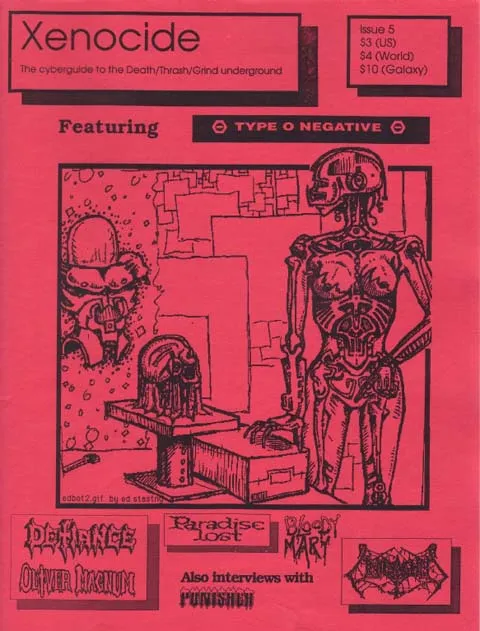
Oh, and if you’re on a Mac, Apple Pages has a mode called Page Layout mode. Instead of working like MS Word (ugh) it behaves more like Pagemaker used to, where you put in text flows and hook them together and resize them, and it shows at the end of a flow if there’s more text and you need to add another column or box or resize things. Back in 1993, I did Xenocide 5 in Aldus Pagemaker 4.0, which was the gold standard for desktop publishing back then, and was absolutely amazing in a world where a lot of people in the labs where I worked were still on the cyan-screened Wordperfect 5.1 for DOS. It’s a great memory to be back to juggling colums and placing images behind them.


Also, programming note that this page is back, with a list of everything I’ve written. It has the awkward issue that many of the things on there are not currently published. I’m working on it. But I’m currently at the start of another writing project which I can’t talk about, but I’m excited to start actually writing again. I’m off the couch, but I’m still walking.

Oh, and if you read this far and you didn’t get a zine, drop a line and send me your address. I’ve only got a couple left, but if not this, I’ll send the next one.

Aquarius+

aquarius-plus

When I was a kid, my first computer was the Mattel Aquarius. This machine was an odd little footnote in computing history, a quick experiment in Mattel’s history to break into the home computer market. This computer came out in 1983 and was quickly killed off in a few months because of poor sales. It had little promotion from Mattel and zero third-party support, and the remaining units were quickly blown out by liquidators as the video game crash was happening and Mattel Electronics abandoned hardware, then software development.

I’ve written a bit about this before, but to recap, the Aquarius was like the Yugo of computers. It had its charms, but the deficits were not good. It was a Z80-based machine, clocked at 3.5MHz, which isn’t bad. (A Z80 is arguably 2-3 times slower than a 6502; the 6510-based C64 was clocked at ~1MHz, so about the same.) But it only had 4K of RAM, and by the time you booted, you had just over 1K of free memory. The included BASIC was okay but not great. The keyboard was a rubber chicklet 48-key thing that was like typing on an 80s TV remote, and didn’t even have a space bar. Graphics were barely a thing, and it had a 40x24 character screen. There was a cartridge port, and then a cassette and printer port that were undocumented, with printers and tape decks being largely impossible to find. A couple dozen games were released on cartridge. There was also a mini-expander, a thing hanging off the cartridge port that let you use a memory expander (also impossible to find) with a cartridge at the same time, plus added joystick ports and a second sound chip. The joysticks were Intellivision-style “disk” controllers, with no side buttons at all, just six rubber keys in a keypad.

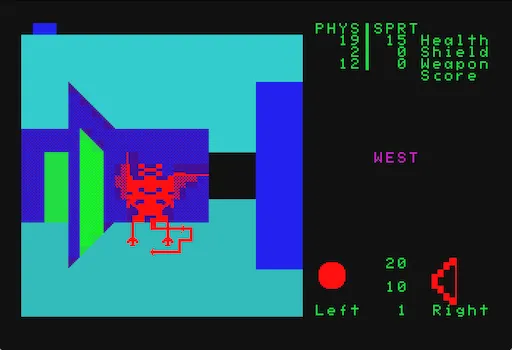
I got an Aquarius bundle at a Kay-Bee toys in January of 1984 for my 13th birthday. The $99 bundle came with a computer, the mini-expander and two controllers, and four games: AD&D Treasure of Tarmin, Tron Deadly Discs, Snafu, and Night Stalker. And as bad as the computer was, I played the hell out of those games, and spent untold hours typing in BASIC programs on the rubber keys, keeping the machine powered up because I had no way to save them. The D&D game was particularly good for the time, a first-person dungeon crawl game with crude graphics but great turn-based combat, 99 levels to navigate (allegedly), and addictive find-the-weapons-and-treasure gameplay, as you tried to find the King Dragon and win the whole thing.

I spent that summer mind-melding with that machine. This is unfathomable to kids now, but my school had like two Apple ][ computers that were impossible to get time on, and I wanted to work on a computer so much, I would spend study hall writing games and programs on paper. Having my own computer, as anemic as it was, felt like a miracle to me, and I’d spend all day trying to write games on it. I also wished I could go to California and hunt down the mystical tape deck or the rumored disk-based master expansion that never happened. My next birthday was a jump up to the C-64, and I have no idea when my original Aquarius got offloaded at a parental garage sale. But there’s still a lot of nostalgia for that old machine.


So, 39 years later…

Like most retro machines, the Aquarius has a crew of die-hard followers who have been trying to hunt down surviving gear, tweak the most out of it with new games and software, and extend the system with new technology. A group of these enthusiasts decided to do a “reboot” of the Aquarius, since the rights have been long abandoned and the remaining hardware is aging and vanishing.

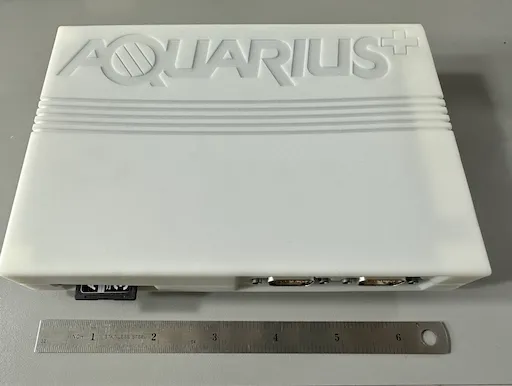
The result: The Aquarius+. (https://github.com/fvdhoef/aquarius-plus) The machine is very interesting:

* Backwards-compatible with the original system * Z80-based * 512K RAM (!!) * An ESP32 and an FPGA to support all the other fun stuff below * Wi-Fi and bluetooth * A USB connector for a real keyboard * A totally reworked video system with VGA video output * An SD card slot * Two three-voice sound chips * Everything on a single board with modern components you can buy new, in a slick-looking case about the size of a thick paperback book. * The whole thing is pretty affordable, especially in the world where eBay vultures who have driven up prices on every retro system out there.

What is really interesting is that everything is being developed in GitHub. You can look at all the source code, suggest changes, help develop it, and see everything documented. And that not only includes the ROM and firmware, but the actual hardware and even the case. Anyone with some skill at ordering custom boards and 3D printing could make their own Aquarius+. Or you can buy one from the couple of people making small runs of the machines.

I can’t emphasize enough how cool it is that all the docs and information are in GitHub. So a technical writer who is used to working in Markdown on GitHub (me) can easily make corrections. But also, back in 1983 I would have killed to get any information on this system. Compute! magazine was a treasure trove of type-in programs for literally every home computer except the Aquarius back in the day. Now, it’s super easy to share your programs or find other ones to try out and modify. No more leaving on the computer all night and then having my parents shut it off because I was wasting electricity.

My old cartridges are long gone, but the new system does have a connector for them. That said, about every cartridge ever released (and a whole lot of new homebrew ones) are available as ROM files you can easily throw on an SD card and load.

The SD card situation is a game-changer, too. First of all, the smallest SD card you can find in the back of a junk drawer can hold every Aquarius program that ever has or will exist. (Seriously, the tiny stepped-on image at the top of this post is 15% bigger than every released Aquarius cartridge combined.) I always dreamed of a way to save my programs, or get more software, or even get the cable to use a tape drive on my old machine. (And having had a tape drive for the C-64, this was a horrible experience, but still better than nothing.) Anyway, I now have a way to quickly load and save things, and easily trade them with the world.

Speaking of programming, aside from being able to see what others are doing in BASIC or assembly, there are a couple of other additions. First, I finally have access to the elusive Extended BASIC cartridge that was unobtanium back in the day. Second, there is active development on an improved BASIC. But also, there’s a C SDK, which makes it super easy to write and compile C into executables. And it’s also cool (and weird) that I’ve got all this in Visual Studio Code, the modern IDE I use at my day job. And no more rubber keys!


Once I stumbled into the dev group, I cloned the git repo, and was astounded at everything all in one place. But what was more amazing is that they had a full-fledged emulator I could run on my Mac. After installing a couple of things, I was able to build it, and I was sitting at the Ok prompt of an aqua-colored 40x24 screen. I did a quick 10 print "hello" and loaded up a few games, and all was well. I also wrote a quick printf("hello\n"); in C, compiled it, and ran it in the emulator. Cool.

I contributed some quick docs for Mac developers and picked around a bit more before I left for Poland. The emulator was cool, but I really needed the real thing. Luckily, I got in touch with Sean Harrington, who was building a bunch of units. In short order, I had a tracking number, then I had a package in the mail with serial number 15 of the Aquarius+!


aquarius-plus-case

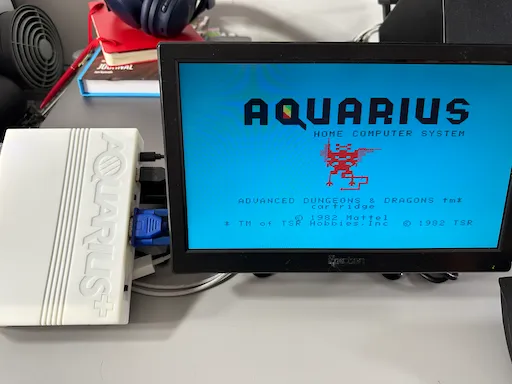
First things first: I somehow don’t have a real VGA monitor anymore. Every flat screen in this house has been updated and upgraded multiple times since WFH started, and the d-shaped 15-pin connector I’ve been using since the 90s has gone the way of the dodo. I have this tiny monitor I use to debug broken systems, and I used that for a minute until I could get a VGA to HDMI converter.

The ESP32 is a bit persnickety about the keyboard and joystick. I ended up picking up a twenty-dollar Cherry tenkeyless and the latest XBox controller, and with those three things and a USB power source, was able to boot up with no problems.

It is really weird to be sitting at the workstation where I work and write every day with the screen being the computer I had almost 40 years ago. It’s even more strange to be at the BASIC prompt of an Aquarius with a real keyboard and an actual space bar. Of course the first thing I did was fire up the AD&D game.

tarmin

OK, the graphics are not that impressive here. Most things are drawn using custom graphics symbols or ASCII characters. But this game is still fun. Once again, weird to see this on my 32-inch 4K screen and control the game with the latest XBox controller instead of the weird little disc joystick thing. (There are ports for those if you happen to still have one.) But there’s like honest jump-scare action when you’re hopping around the dungeon and all of a sudden have a dragon in front of you hammering away with fireballs in your face.

The amazing thing with this new machine is how well it integrates with 2023. For example, you run a little program to configure the machine, and it enables you to point it to your local Wi-Fi network. Okay, you won’t be browsing the web on this thing (yet?) but you enter a command and the machine will go to GitHub, pull the latest firmware, and install it for you, which is amazing. The machine also works as a WebDAV server so you can push files to the SD card. It’s also got a REST API so you can  push files, enter remote typing to the console, or update the firmware. (I don’t talk about my day job here, but I’m sort of familiar with APIs…)

Anyway, I wish I had as much time to play with this as I did back in 1983, because I still have a million ideas in my head. How can I write a web browser? How do I get that text adventure game going? What about a micro lisp interpreter? That space war game still needs to be written. Working at a startup and having a mortgage is a bit different than summer vacation with nothing to do when I was 13. But I know C. All the docs are here. I’m done with grad school now. I’m looking forward to keep busy with this little thing.

Poland

krakow

I went to Kraków, Poland a couple of weeks ago. And I don’t know why, but I absolutely have not been able to jot down any thoughts on it. Maybe it was because the trip was so quick. Maybe my plans were so haphazard. Or maybe it was such a lopsided trip, with a heavy event in the middle and a bunch of dumb stuff on either side.

OK, here are some random thoughts:

  • SFO to Frankfurt to Krakow. I left Saturday night, spend four hours in Germany, ended up in Poland on Sunday night.
  • They named the airport after the Pope. They are really Catholic there. Really, really Catholic.
  • I stayed in the old town part of Krakow, in a ridiculously nice Hilton. The old town area looked like a Universal Studios backlot of a European city. Walking around at night was roughly as safe as walking in EPCOT center in the afternoon.
  • There was a pierogi place a block from the hotel and I ended up going there three times.
  • I went to this Galleria mall to buy a shirt for a formal dinner. It was the first time I’ve been to a mall since maybe Iceland. Totally uninterested. It sort of bothered me. So, that’s over.
  • Bailey was asking me every hour if I’d gotten kielbasa yet, so I went to some restaurant that I think was just called “kielbasa” and ordered a sampler platter. They brought out a platter for an entire basketball team, probably twelve pounds of meat, plus a loaf of bread, two salads, soups, pickles, and 17 other things. That broke me, and I skipped the food tour the next day because I could not deal.
  • I also went to some fancy foodie 9-course dinner, which was okay but not that inspired.
  • Went to Auschwitz. I can’t even write about this because it was so horrific and the whole thing is so politically charged. It was an incredibly heavy experience, and everyone should go.
  • I took this absurd tour of Nowa Huta, the old communist planned community built around the Lenin steel works. A guy dressed like a 90s chav showed up in a tiny Lada Niva car and acted like a Sacha Baron Cohen character. Seeing the old steel worker town was interesting, and it’s not terribly gentrified (yet).
  • I went to the aviation museum, which is one of the biggest in Europe. They had a ridiculous number of MiGs and other Soviet combat aircraft, at least two dozen. I think they had more MiG 21s next to each other than I’d ever seen at all other museums combined.
  • My flight out of Krakow left at 6am Saturday. Spent more time in Frankfurt, then landed in SFO at like 3pm.
  • Great trip, but way too short. I didn’t hit any museums, or the palace, or the salt mines. I also didn’t spent much time out of town. I feel like I could have easily spent another week here.

Wasn’t terribly happy with my pics, but I’ll go through them eventually. (I still haven’t posted pictures from Denver, Stockholm, or Iceland, so this may take a bit.)

AI, writing books automatically

Screen-Shot-2014-08-21-at-6.42.16-AM

I have complicated and conflicting thoughts about AI. On one hand, everyone in my industry won’t shut up about it. On the other hand, I think it means I have between three and seven years before my profession is completely obsolete. And spinning the numbers, I think I need about ten solid years at my current salary to retire.

A few years ago, I read about how MLB was using some special software that could be fed a box score and a machine-readable database of statistics and spit out a human-readable narrative article summarizing the game. It would pepper the article with various factoids, slap in a stock photo, and you’d have a ready-for-web article to pull in traffic and SEO. When I saw this, I realized software documentation was not far behind. We’ve used tools like JavaDoc for decades to pull comments out of code and extrude a set of generated documentation. The next step is to spit out more conversational blog posts about a software product. That is either already happening or about to happen. But that’s work, and I don’t want to talk about work.

As far as self-publishing is concerned, it seems the current arguments are all about AI artwork for covers. I’ve only vaguely messed with DALL-E and nothing I’ve ever gotten out of it looked like book cover-quality, or maybe I’m too picky. There’s question about where the source material comes from, etc etc. I have no real opinion on this, except I wouldn’t use it because it looks like garbage. That said, I wouldn’t pay someone a ton of money for a cover and hope it would magically boost my book sales. Any time I’ve paid more than zero for a book cover, I haven’t recouped my costs. But my books are horrible/I’m not a good marketer/whatever. Anyway.


Three takeaways on AI, at least for the moment. Bear with me.

First, I think AI can be a useful tool for doing monotonous things, organization, or other busy work. I’ve forever wished that Scrivener had hooks to run AppleScript, or maybe had a REST API, so I could eventually write some useful tools for dumb stuff that could easily be done in AI. For example, I’d like to feed all of my writing into an LLM and then be able to write a paragraph and ask the AI “did I already write this?” because it happens constantly that I come up with some great idea and it turns out it was in a short story I published in 2006. It would also be great for things more advanced than a spell check, like looking at a story I just turned from first to third person and finding all the stuff that’s wrong. It would also be useful for things like feeding a thousand blog posts into it and having it add keywords to all of them.

All of these are good tools, but I have no time to think through how to write them. And my second point is there are a lot of tools springing up, but we’re in the gold rush era where a lot of fly-by-night businesses are popping up with the word AI in their product, and every existing product is working on how they’re going to duct-tape AI on the side. And all the usual complications come up here: tools are half-baked, and don’t exactly do what you want, and won’t output text in the right way, and steal your data, and have some scammy freemium model, and think asking for fifty bucks a month is totally fine even thought two dozen things an hour all think it’s totally fine if they also charge you fifty bucks etc etc etc. Most of these companies will vanish in six months, maybe along with your data. And the big problem with this is the same problem I have with mind map software or outline software or note-taking software: I could spend all day every day in decision paralysis with these tools that do maybe 47% of what I want but not everything I want. Or I could just write.


The third thing, which is a big one, is that there’s this debate on if these things can write fiction, and people feed things into ChatGPT and ask it to write a poem about Barbie just like Emily Dickinson or whatever. Some of these are marginally impressive, but I’m not convinced. It seems like this is more of a parlor trick, and not really effective for creative writing.

I think writing will end up seeing a reaction similar to what happened when photography was invented. Portrait painting was essentially democratized and the art form basically destroyed, as anyone could sit down for a photograph. And Romanticist and Neoclassical painting fell out of favor, styles that were dependent on highly realistic painting.

What happened was that Impressionism suddenly appeared. Painting traded fine detail for the exploration of capture or representation of movement in a scene. The idea of realistic detail was gone; instead of the capture of fixed images like any camera could do, it focused on giving up detail and looked into different representations of color or light. I’m not an art historian and I’m leaving a lot out of this description, but the gist here is that one thing Impressionists were thinking about is what they could do on canvas that a camera couldn’t do on a silver plate.

The next step beyond that was modern art, which decided to completely question what was art and what rules applied. There’s way too much history to capture this in a paragraph or two, but the general idea is that artists started finding ways to turn inward and attempt to express feelings and emotions and capture them in medium that was entirely not photorealistic. Instead of using a picture to evoke the actual details captured, it used it to evoke a mood or an idea.

The thought here is that artists at the turn of the 20th century saw that portraiture was obsolete, so they moved on to something cameras couldn’t do. Is that what’s next for writers?


So I’ve been screwing around with ChatGPT, using it to write summaries of books. It’s very good at this when it knows about the book. There’s a danger here: people write unique summaries for optimal SEO and store rankings, and pretty soon, everyone’s going to be writing absolutely identical book summaries, which is totally going to break SEO. This will become more and more weaponized, and the race to the bottom will continue on that.

Anyway, I asked ChatGPT to write a summary of my last book, The Failure Cascade. It wrote a well-formed and very convincing summary, but it was not at all for the book I wrote. However, the plot was very interesting, at least for a conventional linear “straight” book.

This made me wonder: where was it getting this plot? Did it have some cookie-cutter set of twenty book plots and it would mad-lib in a few things to make it look unique? Or was I reading a lightly retouched plot from a 1987 book by J.G. Ballard that I’d forgotten about or never read? My first thought was to steal this plot wholesale and start beating an outline and writing chunks. But I quickly decided nope, bad idea.

Fast-forward to this weekend, and I see an ad for this writing tool that offers to use AI to punch up outlines and brainstorm and make it super easy to “write” a book. (I won’t mention it by name, because I don’t want to get into it with them.)

So, I got a trial account. It started with a brain dump box, where I would enter my loose ideas. I pasted in the aforementioned book summary. It then wanted me to enter a genre, so I put “post-modern apocalyptic, bleak.”

It then wanted to determine a writing style, so I pasted in about a thousand words of the unpublished Atmospheres 2 manuscript. It chewed away for a moment, and it spit this out:

First-person, past tense. Sarcastic and cynical tone with informal vocabulary. Vivid and descriptive language, slow pacing, grotesque imagery. Reflects poverty, desperation, and decay in contemporary America.

OK, fair enough. I then had it generate a synopsis, a character list, and a chapter-by-chapter summary. The synopsis was a seven-paragraph thing and looked okay. The character list: okay, I guess.

The summary was five acts, nineteen chapters. It was radically formulaic, and each chapter was labeled something like “Rising Tension” or “All is Lost” or whatever Save the Cat-ism was needed at that point. The outline was not horrible, but it was so formulaic, it reminded me of like a Marvel movie totally written by committee.

I then told it to get started on the first chapter. It first broke out the three-sentence summary of the chapter into 19 beats. I then clicked the next button and it churned away and wrote the 3500 words of the first chapter.

The writing - the actual prose - absolutely horrific. I didn’t expect it to be like my writing, but it was amazingly bad. Stuff like:

“Jim,” Laura’s voice cracked as she stumbled over a charred piece of wood. “Do you think it’s always going to be like this?”


“Like what?” I replied, sarcasm dripping from my words like acid. “Hell on earth? Probably.”

The thing is - the writing was horrible, on like an eighth-grade level of wooden. But I think like 90% of the self-published Kindle genre page-turners I’ve read for five minutes and then deleted were about like this.

I went to generate chapter two, and I was out of coins or stars or tokens or whatever magic beans it used, and it wanted a credit card. Nope, the experiment ended for me.

I think my takeaway with this is that this tool might be good for generating a formulaic outline. And it would be great for dumping out extremely predictable Kindle dreck. Start with a good series bible, get a decent cover artist, and write your next dozen detective murder mystery books with ease. I guess this is great if you like that kind of book. Maybe not great if you spend a lot of time and make all your money writing this kind of book.

This type of tool is currently useless for writing anything expressionist or experimental. And as I look for a direction to go with my writing, it’s evident that I should be going in the exact opposite direction of genre fiction, and do things that absolutely couldn’t be done by an AI. Right?