The Wrath of Kon

Dispatches, thoughts, and miscellanea from writer Jon Konrath

2011

10 things I learned from the Lemmy documentary

motorhead

I’ve been a fan of the band Motörhead for over 25 years now.  When I was a freshman in high school, I used to watch the British comedy show The Young Ones on MTV, when they used to show it late Sunday nights, and one week, this weird metal band came on that sounded cool as hell.  I asked my friend Ray about it, and he told me their lead singer Lemmy was god, and then proceeded to make me a dub of the No Remorse double album collection, which I promptly burned into my brain with roughly 40,000 repeat listens over the next few months.  Over the years, I’ve collected their albums, and although I’m not as militant about it as Ray, they’ve been one of the bands in a constant rotation in the player.

I heard about this documentary, simply called Lemmy, also the stage name of one Ian Kilmister.  He’s been the one constant member of the band since 1975, singing, playing bass, and writing songs.  I didn’t rush to the theater to see it, but I filed away a mental note to look for it when it came through on NetFlix or whatever, and it popped up on cable recently, so I DVRed it and got a chance to watch it last night.

I had mixed feelings about the movie.  It was executed well, and wasn’t just a typical rehash of everything I already knew about the guy, which was a huge plus.  But it was also somewhat depressing, because it showed this human side of the legend, and it was a somewhat sad scene of this guy who’s instantly recognizable, but ultimately alone.  I could write more about that, but I’d rather summarize the movie by mentioning the new things I learned that were shown by Greg Olliver and Wes Orshoski’s work.  Here goes.

1) Lemmy lives in a shithole

This is the most popular takeaway from the movie.  Most people think rock stars live in giant mansions, and that is reinforced by all of the reality TV showing guys like Ozzy in giant 29-bedroom castles with indoor basketball courts and gold-plated crappers.  In reality, Lemmy’s lived in this completely shitty two-bedroom apartment in West Hollywood for over twenty years, apparently never cleaning it during that time period.

Now, I’m not expecting him to rent some huge penthouse like P. Diddy would hang out in, with chrome-plated everything and an indoor swimming pool.  But seriously, when I lived in LA, my apartment was at least seven orders of magnitude nicer than this place.  It’s like a scene from a Bukowski book, with the two-burner range from 1947 and a metal sink that’s been painted white a thousand times since World War II.  The outside courtyard is not bad looking, but it’s that generic two-story apartment building you see all over Los Angeles, the kind that looks like a motel built in the 1950s and never renovated.

All of you who have lived in New York City are probably a step ahead of me on this one, by asking, “well, how much is he paying, though?”  LA is rent-controlled, meaning his rent can only go up 6% a year.  He mentioned he’s paying about $900 a month in rent for a two-bedroom, which isn’t bad for LA.  (A quick google shows that the average 2011 rent for an apartment that size is around $1700.  I paid more than that in 2008, but my old apartment compared to Lemmy’s is about like comparing the Bellagio to one of those downtown Vegas motels where you shoot a snuff film.)  Of course, if the stories are true that he drinks a fifth of Jack Daniel’s a day, he’s probably spending a grand a month on booze.

2) Lemmy is a hoarder

The shocking part of the footage of Lemmy’s apartment is that every square inch is filled with Stuff.  There’s the usual rock start stuff, like gold records, trophies, and plaques, but there are also tons of Motörhead items, like records, posters, license plates, stickers, action figures, and pretty much any other thing carrying his personal brand.  There’s also wall-to-wall randomness, video tapes and albums that are completely unrelated to him.  And this isn’t one of those OCD collections where everything is perfectly lined up on identical racks, in dust-proof, airtight mylar bags.  There’s stuff strewn around like a crime scene, things stacked on top of other things, shit everywhere.

One complication is that Lemmy’s not being whisked to gigs in hermetically sealed limousines with a team of bodyguards and handlers; he’ll talk to pretty much anyone who comes up to him, sign anything, and is infinitely approachable.  And he has legions of loyal fans.  That means he’s got people at every show giving him paintings and figurines and demo tapes and macrame Ace of Spades murals.  And he seems to hang onto all of this stuff, which is somewhat endearing, although at some point, I would have either rented a storage unit or opened a Motörhead-themed bar with all of the stuff in glass cases.  The man is in serious need of an archivist.

3) Lemmy is into a lot of non-metal music

The movie starts with Lemmy going to Amoeba Records (I used to go there!) in search of the mono version of the Beatles box set.  (And he’s correct: fuck the stereo mix; get the real deal.)  He talks about seeing the Beatles back when he was a teen in Liverpool, and also discusses his love of Little Richard during a couple of different conversations.  (Billy Bob Thornton and Dave Grohl, in two different bits, talk about meeting LR, and Lemmy enjoys those stories immensely.)

He also plays in a band called The Head Cat, which is a rockabilly supergroup with Slim Jim Phantom of the Stray Cats.  It is seriously surreal to see Lemmy, the guy usually belting out songs like “Killed by Death” and “Deaf Forever” knocking out the Carl Perkins song “Matchbox” while a bunch of old people dance at some random casino in upstate Wisconsin.  (Go here to listen to some of this.)

Henry Rollins (seriously, there are so many god damn appearances by people in this movie!) sums up the whole thing by mentioning that Lemmy was around before there was rock and roll; he grew up listening to Rosemary Clooney records, and then one day, these four kids from Liverpool and this hip-swaying dude from Memphis blew the doors wide open.  And it’s true that the best music ever is the first music you hear, the stuff you lock into when you’re a teenager, and for him, that isn’t the Sex Pistols or Elvis Costello or Velvet Underground; it’s Buddy Holly and Eddie Cochran and Johnny Cash.  I really dug the hell out of Lemmy being so into the classics like that; it shows that he loves music, and he’s not just into this to be another SKU number in a database.

4) Lemmy has diabetes

The movie shows Lemmy drinking, smoking, and eating fried foods.  It starts with a scene of him meticulously slicing potatoes into fries (he probably calls them chips) and deep frying them in a pan.  It doesn’t show him doing drugs, but implies that he does.  And then in a later scene, he’s taking some pills in a recording studio, and when the producer asks if they’re drugs or vitamins, he says they are medications for diabetes and blood pressure.

This shows the odd paradox that he’s like Keith Richards and Ozzy in the sense that he’s spent the last 50 years shoveling down all things bad for your body, with almost no tangible effect on his longevity or ability to churn out a new album every year and play in 200-some odd cities.  But it shows the twist to this, the human side, of a guy who’s well past the halfway mark and will someday soon be staring down the grim reaper.

This also conjures up strange images of Lemmy at a doctor’s office, paging through a years-old People magazine, waiting for an internist, who then asks him all of the typical questions about diet and exercise.  My health is not at Charles Atlas levels,  and I can’t go to a foot doctor about a hangnail without getting a prescription for Lipitor and a scathing 40-minute lecture about how I’m supposed to exercise 9 hours a day and eat less than 9 grams of fat a month.  I can’t imagine the dressing-down he must get every time he comes in to get his scripts refilled.

5) Lemmy practically lives at the Rainbow

One of the other reasons Lemmy’s got the shithole apartment is that it’s stumbling distance from the Rainbow Bar on the Sunset Strip.  And apparently, he’s always there, sitting at the bar playing one of those video trivia machines.  The Rainbow is a big rock hangout, and has been forever.  And you always hear about how back in the day, it was stylish for these non-music Hollywood types to make their token “I’m a bad boy” appearance there.  But you know how some dive bars always have that one creepy old guy that sits at the bar and stares at the wall for dozens of hours at a time, eating peanuts and nursing beer after beer?  Well, at the Rainbow, that guy is Lemmy.

6) Lemmy has a kid

He’s probably got more than one kid, but the movie features Paul Inder, who is his adult son.  He mentions that Paul’s mom Patricia was some kind of groupie who had dated John Lennon before she knew Lemmy, which is a pretty odd connection.

What’s strange is how close Lemmy appears to his son.  When he’s asked what his most valued thing in the apartment is, he says it’s Paul.  Although Lemmy apparently had never seen the kid for the first six years of his life, the two seem like the best of friends now.

7) Lemmy is obsessed with gambling

There’s a scene showing Lemmy parked at a slot machine, and someone talking about how he’d sit in front of the one-armed bandit all day, compulsively pulling the lever, over and over.  In fact, it’s rumored that he got the name Lemmy because he was always asking people “Lemme have a fiver” to pay off his gambling debts.

It’s a bit of a recurring theme; he’s either hunched over a gambling machine or a trivia game or a video game system at several points in the film.  It makes me think he’s got one of those OCD personalities where he gets locked into stuff like this and can’t put it down.  I sure hope he doesn’t get an iPhone with Angry Birds installed, or we may never see another new Motörhead album again.

8) Lemmy’s stepdad was a football player

I don’t think this was mentioned in the movie, but I was cruising wikipedia as I was watching and saw this.  His dad was an RAF chaplain and split when he was three months old, and he was largely raised by his mom and grandparents.  But when he was ten, his mom remarried to George Willis, who played soccer (football) for a decade or so in the 40s and 50s.

9) Lemmy roadied for Jimi Hendrix

He actually used to live with bassist Noel Redding, and roadied for the Experience back when they were London-based, in 1967-1968.  He tells a story about how he used to score drugs for Jimi, and he would take acid daily.

The story of him being a roadie also shows how much he loved music back as a teen.  When he couldn’t be the one making or playing the music, he was just has happy lugging gear for the people who did.

(Also not mentioned: Lemmy was also a roadie for The Nice, which was Keith Emerson’s band that was the forerunner to ELP.)

10) Lemmy is obsessed with Axe body spray

Maybe obsessed is a strong word, but there are multiple times that show him dousing himself with the stuff.  And it’s not just any cologne spray — the film is careful to display that it is specifically Axe body spray, the spray of the douches.  I’d expect the guys in Maroon 5 or Nickelback or something to be frequent users, but not Lemmy. He seems like the kind of guy who maybe uses some Old Spice (one of the original scents, not the new trendy crap), or just goes around reeking to high hell.  I’d expect him to smell like stale Marlboros, burned motor oil, and old leather, not Intense Phoenix or some shit.

Overall, this was an interesting movie.  I mean, the day-to-day stuff was a good look at the man’s life; the endless line of celebrities fawning over him got a little old, but emphasized the point of his importance in the metal world.  But like I said, it ultimately saddened me to some degree.  It made me hope he’s happy with what he does, because he’s not reaping huge financial or material rewards, and although he’s got a certain amount of respect and admiration, it’s not like he’s going to cross over and become known for anything other than being what he is.
The pros and cons of storage

IMG_0651

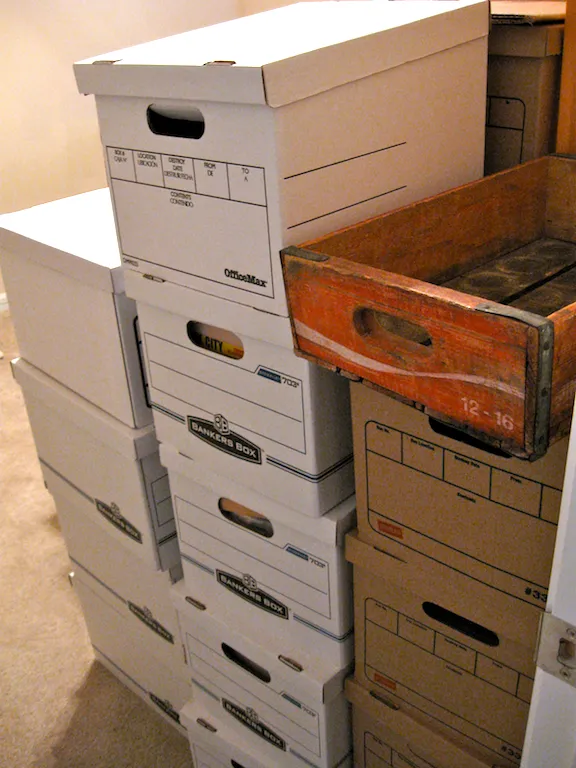
I went to my storage locker the other day, to drop off one of those plastic tupperware bins filled with old 8-bit computer pieces and a half-dozen MiniDisc players in varying states of decay.  I have this locker that’s about 4 by 8 feet and maybe five feet high, on the top floor of an ancient warehouse in our neighborhood, the kind of place that always reminds me of that scene in Indiana Jones where they file away the Ark of the Covenant in a crate in the secret government warehouse.  It has this smell to the place that reminds me of the smell deep within any large military watercraft, which I can’t really identify and is probably either the scent of infinite coats of lead paint or some government-strength rodenticide, either of which is probably eating away my brain as we speak.

Nobody I knew had storage spaces when I grew up.  That’s because everyone in Indiana had a basement and an attic, and both of those filled up with the overflow of holiday decorations and second refrigerators and unplayed board games and excess patio furniture.  If you lived in a trailer or in a house with a slab foundation, you’d get one of those Wal-Mart 10x8 metal sheds.  While I knew nobody in my childhood that itemized their taxes and needed to keep ten years of receipts in boxes, I knew plenty of borderline hoarders who absolutely needed to keep every limited-edition Long John Silver’s Joe Versus the Volcano collector’s cup, patiently awaiting the eventual invention of eBay to justify holding onto all of this crap.

Since graduating high school, I’ve moved 15 times, with four of those being cross-country or across a good chunk of the country.  Each time, my collection of various memorabilia gets compressed and rehashed, and I change my mind about just how important it is to keep zines I haven’t read since 1994 or printouts of rough drafts of books I’ve long ago published.  But from each era, some pieces still remain, and when I shift through these boxes and bins, there’s a pattern, like an archaeologist digging through layers of an old swamp to find fossils of a certain epoch.  I used to keep these crates in a closet or spare room, but when we moved to this open plan loft condo, I don’t have an area for this crap, which is why I rented the storage unit.

The main advantage to keeping this stuff off-site is it’s much harder for me to revisit it.  I have an entire internet’s worth of distractions to keep me from writing; having boxes of old high school journals and letters from college is pure danger for my work ethic.  I can easily open any of these boxes and waste infinite amounts of time getting nostalgic about some past period.  Now, I have to drive my car there during business hours, remember my code to get into the building (I always forget it, and have to look it up on my phone), and climb four flights of stairs in a non-air-conditioned building, which is enough of a deterrent that I only get over there a few times a year.

I generally think two things when I look at all of this old crap.  One, I have a lot of letters and I used to write and receive a ton of paper mail.  I don’t know the last time I got an actual piece of paper mail other than a bill, a greeting card, or some piece of paper spam because some douche got the public record of everyone who paid property tax in Oakland and blasted out a form letter disguised as a tax document.  It’s odd to think that people used to communicate through messages written on paper, and that this has been entirely replaced by electrons blasted across fiber optic cables.  I try not to dig through these too much, because it’s hard for me to read just one letter without reading all 8,732 letters I have in this plastic bin, and that gets depressing fast, especially knowing that at some point in maybe 1997 or 1998, this form of communication completely dried up for me.

The other thing is I have this container of old photos, and I always wish I would have taken more or better photos way back when.  Back in the days of film cameras, I’d maybe shoot a few 24-exposure rolls a year, because of the cost of film and developing.  There’s also the issue that I can see pictures now right after I take them, so I take way more of them, and if I screw one up, I can retake another one.  With film, if my finger was over the lens or the light wasn’t right, I wouldn’t know it for weeks or months.

When I was writing Summer Rain, I would have killed for a few dozen 1992-era photos of the Bloomington campus, or my old house on Mitchell Street, or some of the people I wrote about.  But I didn’t even own a camera then.  I have a couple of shots of the house as I was moving out, in 1993.  And I shot a few rolls of film that summer, some stuff of me and Ray at the Milwaukee Metalfest, and me and Tom screwing around at Ox Bow Park.  I think I have a handful of pictures I took at the start of the summer of 1992, probably with my mom’s camera, but that’s it.  I’ve taken more pictures in the last week with my phone than I did in that entire year.

A recent internet find that really pained me about this was at How to Be a Retronaut, which was a photo essay on a bunch of shopping malls in 1990.  Oh man, that set of pictures brings back so many memories of that era, of when I used to work in a mall back then.  It’s so strange that 1990 does not seem that long ago to me, but when you look at these pictures, some of it seems so distant and so different.  I don’t want to go back to 1990, but I wish I had bought or borrowed or stolen a nice SLR camera and passed as many rolls of 35mm as possible through the gates and taken pictures of every square inch of the Concord Mall and Scottsdale Mall and every other place I wasted time as a kid.  Of course, if I did, I’d be burning hours and weeks and months of time trying to scan and crop and upload all of this crap to the web, and it still would not be enough.

Well, before I start trolling eBay motors looking for 1974-1977 Camaros, I should end this.

Thoughts on a random picture: The Turismo

I have a million pictures in iPhoto.  (Really, 18,035 as of this morning.)  I will never use them for anything, but I spend a lot of time looking at them, dredging up nostalgia that never makes it onto these pages.  So I thought I’d visit that a bit.

turismo

This is a picture I took in 1991.  I scanned a bunch of pictures in from film back in 2006.  Looking back, I’m not happy with the quality of the scans, and I’m also not happy with how few pictures I took back in the day.  The former I might be able to solve with a long trail of tears involving a thousand-dollar scanner, a few months of my life, and a pallet of compressed air cans, which would probably land me on some TSA watch list for potential huffers.  The latter, well, digital cameras were not around in the 80s and 90s, so I have to deal with what I have.

I returned to Elkhart after my freshman year, broke, flunking out, and with this crazy idea that going to IU at South Bend would somehow boost my GPA and save me tons of money.  A year later, I found neither of these to be the case, and I spent huge amounts of energy trying to escape Elkhart like a large spacecraft tries to escape the orbital pull of the Earth.  But in the summer of 1990, I went back to living in my parents’ basement, and driving a 1976 Camaro with a V-8 that pulled down a gallon of gas every 7 or 8 miles wasn’t going to hack it for a 50-mile-a-day commute, because gas was some outrageous price like 88 cents a gallon.

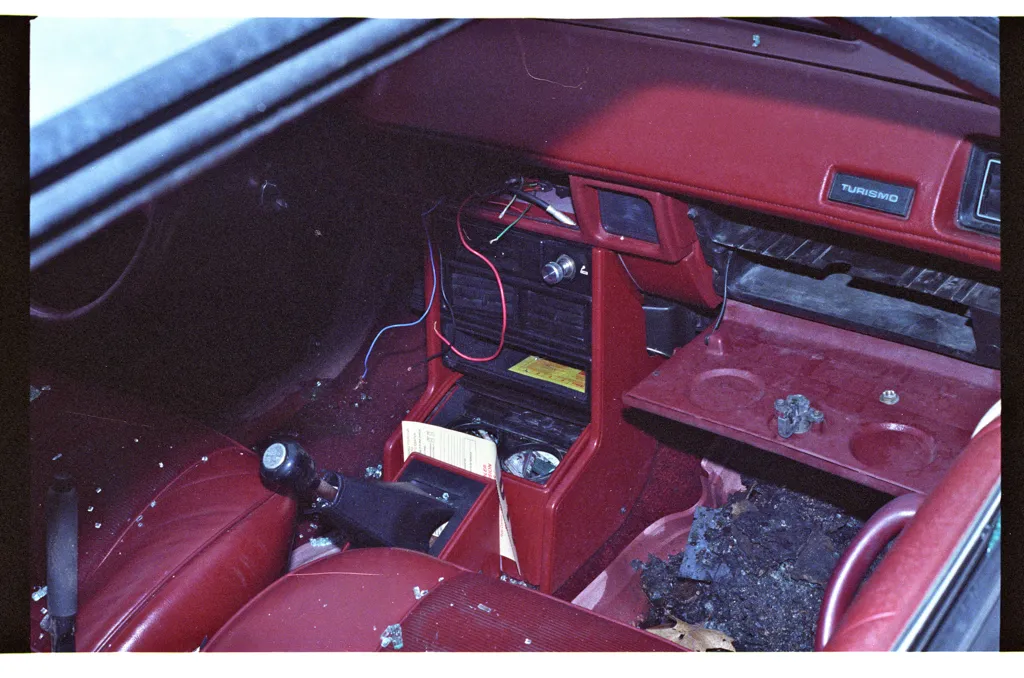
I ended up buying this 1984 Turismo for $1200, and at the time, it seemed like a nice car.  I mean, it wasn’t painted in primer, it had an exhaust, it ran, and there weren’t holes in the floor.  The car was only six years old, and the bright burgundy interior almost looked futuristic, if any Chrysler product from the mid-80s could look futuristic.  It was also a stick-shift, a five-speed, and pretty much the worst car in the world would be at least 50% better if it had a manual transmission.

I remember Tom Sample being blown away by the grey hatchback the first time I came over to pick him up.  He was astounded by how nice it looked, and how he now had a passenger window he could roll down to yell at pedestrians.  (You can’t un-duct-tape a sheet of plastic while driving.)  Right before school started, we took a shakedown cruise to Chicago, driving the back roads instead of the toll road to save $2.20, listening to Helloween on the Krako tape deck (which was subsequently stolen the next day.  Elkhart - great place to raise a family!)  We both missed the old Camaro, which I’d sold for $200, because we spent many days and nights wandering aimlessly around northern Indiana, memorizing old Metallica and Black Flag and doing everything and nothing while searching to find some — something that we never found, but it was one of those “journey is the destination” sorts of things that, 25 years later, we still wish we could relive.

I pretty much lived in that car all fall.  I mean, I didn’t sleep in it like 20% of the foreclosed nation currently is doing, but I’d drive to campus and back every day, which ate about two hours of my days and nights.  I’d leave early in the morning to get to my 9

Calculus M215 class, stay all day, and usually work at night in the computer lab, driving home in the darkness.  I’d eat two, sometimes three meals a day in the car, from the morning’s bagels, to a lunch packed in one of those stupid insulated lunch bags, to a late-night stop at McDonald’s or Subway on Lincolnway East.

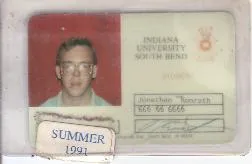
iusb-id

The fall semester was this conflicted state internally, this wish I was still in Bloomington or in some big city like Chicago.  I still clung onto my identity, at least in a virtual sense, by telnetting across a slow 2400 bps sytek line that connected me to my IU accounts downstate, where I’d email and bitnet with old friends, and read usenet and dick around on FORUM and try to keep the dream alive of someday returning to the main campus.  And I’d cruise around the streets of South Bend on breaks between classes, wishing the city was something bigger or more profound.  There’s a few blocks downtown, a brief blurb of a metropolis with glass and chrome buildings that almost made me feel like I wasn’t in the great farmlands of nothingness.  I’d go to the Notre Dame campus and walk past the Touchdown Jesus library and the huge halls of science and learning and wish I was back on a real college campus that wasn’t just a bunch of housewives on the forever plan, auditing a class a year in hopes of someday moving from junior administrative assistant to senior administrative assistant at their insurance sales office or trailer factory.

And this was at a miserable time in America, which is always greatly magnified in cities with nothing but a manufacturing base like Elkhart.  The economy was in the toilet, and nobody was buying RVs, which is all they produced in that city.  So there were “will work for food” signs on every corner, laid off baby boomers and oldsters struggling at cashier jobs at Burger King, and more and more businesses closing or posting signs they weren’t hiring.  It was nowhere near as bad as Elkhart is now, but it was definitely one of the famine states in the city’s feast or famine cycle.  We were also going into a war, or one of those excuses for a war that would become all too familiar in later years.  The Hummer was produced in Mishawaka at the AM General plant.  They didn’t sell the civilian version yet, but they were producing mass numbers for the impending saber-rattling.  Every morning when I drove in to school, I’d see HMMWVs driving from the plant to the train yard in Elkhart, to get transported to whatever military depot would eventually ship them out to Saudi Arabia.  It was a surreal site, driving down US-33 and passing a column of 50 identical M998s, painted in desert camo, like something out of Red Dawn.

I put many miles on the car, although I didn’t know how many, because the speedometer/odometer was broken.  That was my first clue at how badly I’d been swindled.  Some stupid hillbilly replaced the Plymouth 4-cylinder with a 2.2 from a completely different Chrysler, and when none of the emissions or wiring or cabling pieces matched up, he didn’t install them.  As the summer turned into fall and the cold weather crept up on us, it became harder and harder to start the car in the morning, because all of the various chokes and baffles and vacuum tubes that enable a carbureted engine to start in cold weather were missing.  I bought the Chilton’s guide and spent many hours buying pieces from the junk yard, trying to Macgyver the emissions control junk so the car would run properly, but was never completely successful.

Then came the clutch debacle.  One Friday night, me and Becky (the girl who followed me back to Elkhart, which is another story or book entirely) loaded up the car and headed to Bloomington.  We stopped at the McDonald’s by Concord Mall on the way out, and when I went to downshift from fourth to first and make the left turn into the parking lot, I found the shifter did not work at all; it dangled loose and I was stuck in fourth gear.  I drove home in fourth by revving the engine up to 6000 and inching out the clutch pedal a millimeter at a time, and by the time I got home, the clutch was fucked, burned into nothingness.  I found that the redneck genius mechanic had attached the shifter linkage with rubber bands, and it had popped off.  I fixed that (better rubber bands) and tried driving the car with 95% of the clutch gone and got stranded about a mile from IUSB, then spent $500 at AAMCO for a new clutch.

Things failed one by one on the car as fall turned to winter.  I had to replace the battery. The brake lights would blow out every week, requiring me to replace fuses constantly.  The brakes got a little weird, and there was some weird rolling sound in the front suspension, like maybe a bad bearing or something.  Then the heater stopped working.  Indiana in December and January is not a good sans-heater state, and I’d have to bundle up in multiple coats and then put a big blanket over me for the drive in.  The heater almost worked, putting out enough lukewarm air to barely get the car above freezing within 20 minutes, but it was far from ideal.

I went to Bloomington over spring break, by myself.  Their classes were in session when we weren’t, and I had some bullshit excuse, like that I had to register for classes for the fall.  I had an awesome time, hung out with a lot of people, stayed with my old roommate Kirk at Collins, and put a lot of faces to usernames.  I had Becky’s car, and she had mine for the week.  One night I called to check on things, and she told me she had some problem with the car, that it died and would not start, so she got it towed to a Sears and they gave her this huge laundry list of problems, like that it needed a new radiator and an exhaust part and a bunch of other crap.  She felt bad about “killing” the car and got a bunch of work done on it, but I had mixed feelings about the whole thing.  I had this strong emotional attachment to the Turismo, but it was also well past the point where junking the car and buying another would be much cheaper than fixing it.

I reluctantly returned to Elkhart, and got the Turismo back.  It was much quieter and I finally had a heater (just in time for winter to be over), but on the first voyage to and from school, the radiator broke, literally ten yards from my driveway, pouring hot antifreeze everywhere.  The car spent another week in the shop to re-do the repairs, and I got it back on a Thursday, for my lazy Friday commute to school.  IUSB didn’t have Friday classes, or maybe they were just a half day, but I’d work all day, and every other week, I’d get one of those cream and crimson pieces of paper for $6.60 an hour times 20 or 30 hours, and I’d have to get there early to cash it and then run to Orbit records and buy whatever Thrash metal tapes Ray told me to buy.

That Friday, I hit Orbit, then drove home for a usual Friday night: renting videos, eating junk food, doing nothing until Monday.  I remember listening to this band called Xentrix, some forgettable Thrash metal band from the nylon case full of tapes sitting in the passenger seat.  I remember it just started raining, so I flipped on the lights and the wipers.  And I remember just as I got into Elkhart, taking the left turn from Mishawaka Road to the Concord Mall, right before home, the car stalled as I was going through the intersection.  I kicked in the clutch, turned the key, and the engine spun and spun without starting as I coasted.  Then I saw smoke pouring through the vents of the car, and the wipers stopped.  I knew I was fucked.

I coasted the car into the Martin’s parking lot, and by then, smoke was pouring from the front end.  I went to pop open the hood, and burned my hand on the hot metal of the car.  People started gathering, and I told someone to call 911.  A grocery store bagger showed up with a huge fire extinguisher, and we proceeded to shoot the white foam through the cracks of the hood and front grille, which did nothing.  I knew where this was going and started throwing things out of the passenger compartment, all of the tapes and floppy disks and books and papers, and then gave the stereo a good pull and jerked it loose from the dash.

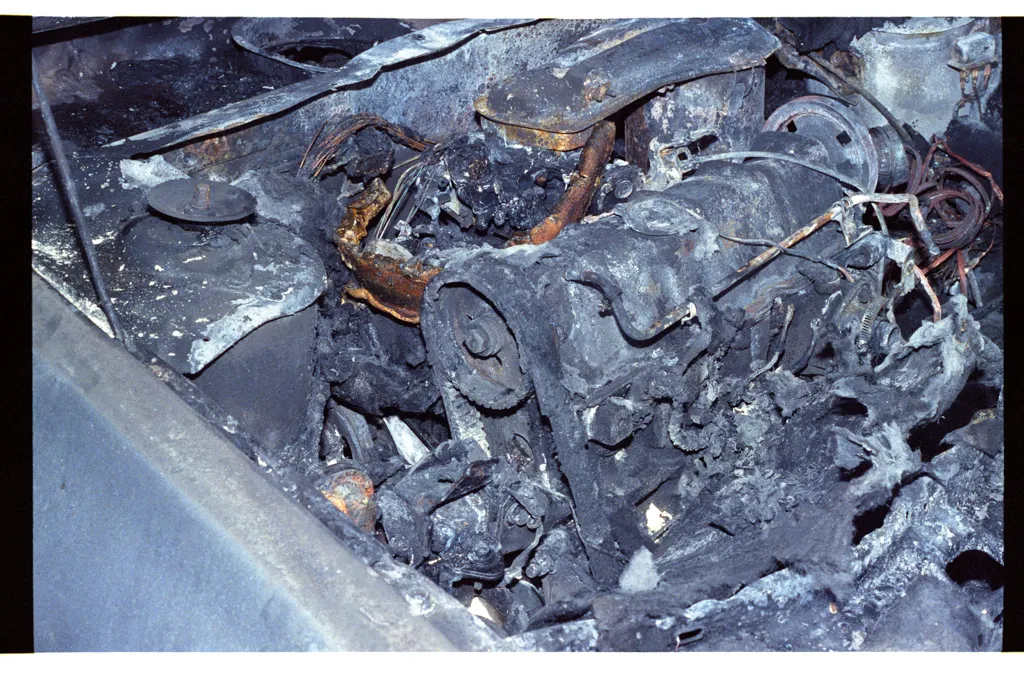
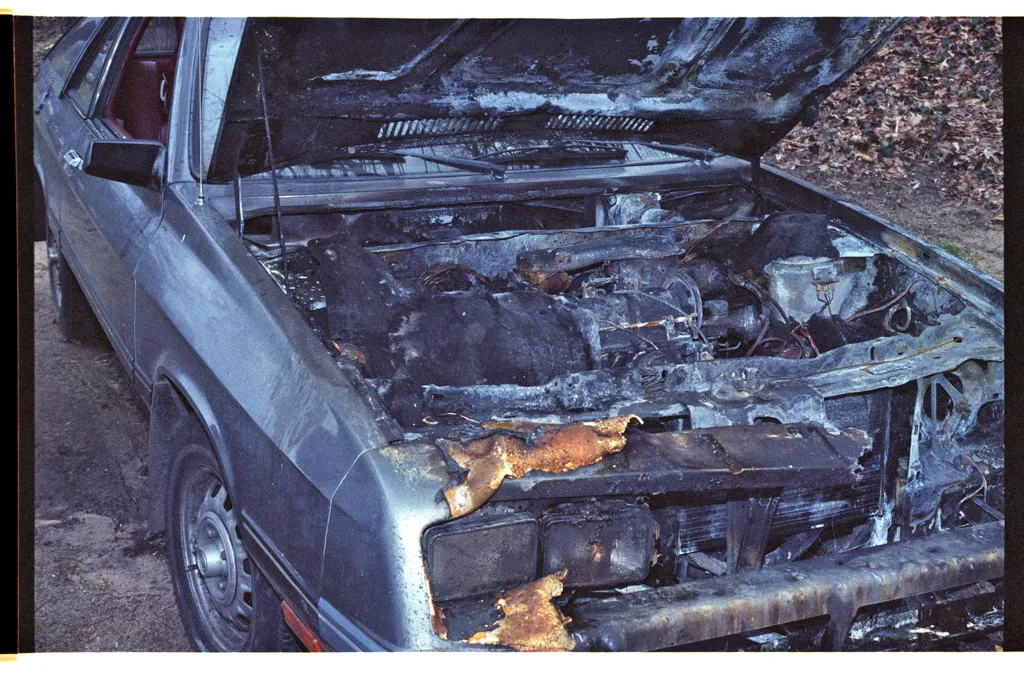
By this time, the car looked like a plane crash, billowing a column of black smoke into the air.  I heard sirens, which is always ominous when you realize the sirens are for you.  A cop, parked a dozen yards away, told me to wait in his car, and tried to clear everyone away, anticipating an explosion.  From the cop car, I saw flames through the firewall of the passenger compartment, consuming the interior.  The firefighters, dressed in full turnout gear, worked fast.  They closed the doors, smashed the windows with axes, and dumped a swimming pool full of water into the engine compartment and interior.  Becky and my sister were at the grocery store, and came over to look at the idiot with the burning car and then saw it was me.  I wish I would have told one of them to run in, get a disposable camera, and take a picture of the disaster.

Someone called a tow truck, and they flat-bedded the remains to my mom’s house.  I arrived with a burned hand, wheezing from extinguisher dust, black with soot, smashed safety glass in my shoes, and crashing from the aftereffect of the massive adrenalin rush you get when you walk away from a burning wreck of a car.

turismo2

turismo3

The next morning, I took these pictures, with Becky’s 35mm.  I have no idea what caused the fire, but the engine had actually melted, it got so hot.    The interior was drenched, coated with soot and the carpet melted and burned, peppered with pieces of the greenish shattered safety glass everywhere.  I actually got the aforementioned junkyard to buy the whole mess for $50, and within a week or two, got a diesel VW Rabbit for $500.  Finished the semester with a 0.67 GPA, broke up with Becky, spent a summer working second shift and then taking 8 AM summer school classes, and managed to get the hell out of town and back to Bloomington that fall.

City Lights Run

IMG_5187

On Memorial Day, we decided to run into “the city,” although I hate sounding like one of those bridge and tunnel types that refer to San Francisco as “the city,” because I happen to actually live in A city, but not THE city.  (More annoying than this: the show So You Think You Can Dance recently held auditions at the Paramount Theater here in Oakland, this big, old-timey, restored grand theater, and in every narrative and establishing shot, they went on about “The San Francisco Auditions,” and showed b-roll footage of the Golden Gate and trolley cars and whatnot.  It would not have killed them to actually say they were in Oakland, especially when you’re a bunch of white-bread TV execs trying to look “urban.”  Anyway.)

So the goal of the trip was to go to City Lights, which I have not been back to in a long time.  And in thinking back, it turns out it was 15 years ago, to the month, since my first visit to San Francisco, and my trip there.  I wrote about this elsewhere, in an old issue of AITPL, and the basic rundown is that I was in San Jose for this trade show, working at my first job in Seattle, and I had pretty much an entire day off , and no plans whatsoever.  I loved being in California, loved the weather and the smell of the air and the sunshine, but schlepping around a convention center in a stupid logo-ed polo shirt, handing out CD-ROMs (remember those?) and software to people during the not-yet-burst internet bubble wasn’t exactly the way to see the Bay Area.  Walking back to my hotel, I realized they had a little rent-a-car desk off the main lobby.  Then I realized I was now 25 and had an Amex gold card in my wallet, which meant I could, for the first time, rent a car.  20 minutes later, I’m jetting north on the 101, headed for this city I barely knew, only a rental car map in hand, no GPS, no addresses, no plans, no google on a phone, just a vague idea that the center of the Beat universe was somewhere on Columbus street.

I have no idea how I found the place back then, but I did, and I was in the very same building where Ginsberg read Howl, where Bukowski’s short story collections were published, where every Beat poet wannabe aspired to be shelved.  It’s not a huge store, and back then, it wasn’t that overwhelming.  I mean, you’ve got this Kerouac street outside of it, and So I Married an Axe Murderer, a movie me and Simms and gang memorized in the mid-90s starts and ends in that alley.  But in 1996, there were plenty of great book stores around; I think there were a half-dozen great stores the same size or bigger within five miles of my old Seattle apartment.  I did buy an issue of Cometbus, the first I’d ever read, and wished I had the cash and luggage space to buy a dozen other things.

I figured the city would be jam-packed with tourist types, but after we crossed the perpetually-under-construction Bay Bridge and its doppelganger 21st-century twin, traffic was spectacularly light.  After cutting through a completely vacant financial district, we found a street parking space on a hilly part of Columbus, something I’d only expect to see after a total nuclear holocaust.  Of course, there was no indication as to the meter situation on the holiday, so we risked it, and of course got a ticket.  But still, it’s the thought of a street parking space for free that counts.

I remember eating at some eclectic fusion-y diner restaurant with toys spray-painted gold and glued to the walls, maybe called Icon back in 1996, and I’m sure that’s long gone.  We ended up at some odd 70-year-old sandwich shop for lunch, a place covered with Pittsburgh Steelers stuff.  The sandwiches were made with both fries and coleslaw on the sandwich, which I did not really like, but they did have some awesome onion rings.  This was, unfortunately, one of those carb-heavy meals I can’t really deal with anymore, and within an hour, I was pretty much ready for sleep.

We went to City Lights, and it looked remarkably like it did back in 1996, and probably like 1966, except for maybe the computer registers, and swap out all of the purple-type mimeographed zines for photocopied ones.  It looked smaller than I remembered, but the selection was still astounding, and I instantly found a few dozen things I wanted to buy. There is the issue, however, that I’m running out of storage room, and I’ve got a queue of at least a dozen books on the to-read pile already.  But who cares.  When they film my episode of Intervention, I’m going to have a couch full of family members and that bitchy old lady counselor yelling at me about my private library hoarding, and I’m fine with that.

But my general attitude on the beats is somewhat varied now.  In 1996, I was just recovering from the near-terminal case of student poverty, and dropping every spare dollar I could find on building my book collection.  I still didn’t have the complete collection of any of my favorites: Bukowski, Kerouac, Henry Miller, Burroughs.  Now, I’ve got most of their bibliographies on the shelves.  Some of them have estates that are still trickling out the occasional volume pieced together from scraps, or re-re-releases of “complete” works that would require me to re-buy yet another copy of a favorite book.  On the other hand, there are a lot of biographies and scholarly deconstruction books coming out as more generations find out about and study these original tomes.

The big problem is, I’m trying to avoid writing like these guys, and that generally means avoiding reading them.  I always love to go back and re-read On the Road, but within 50 pages, I’m either thinking about some grand road trip, or trying to re-spin pieces of my own past into some epic novel, and I eventually hit a wall there, thinking that either my own life is too boring, or I don’t find it within my wheelhouse to do something like that.  It’s not entirely my style, and I’d rather be writing something more bizarre.  But I do like to dip back into the stuff every now and again.

I ended up buying a copy of Raymond Federman’s last book, and two newer issues of Cometbus, which are now sitting on the pile.  We ambled out and drove around the city a bit more, and I still don’t entirely feel like I live here, but I feel an urgent need to consume as much of this as I can, because every time I leave a city, I realize how much I didn’t do there.

And even though City Lights was one of many book stores back in 1996, now it’s one of few.  There are zero book stores in West Oakland, and exactly one within a five-mile radius of my house, a Barnes and Noble which will probably shutter in the next two years.  There’s a healthy number out in San Francisco, but they’ve become rare.  I buy a lot of stuff online, so I’m responsible for their death, but I do miss the energy given off by large rooms of new books, and love a place that’s more than just clip-on book lights and mass numbers of covers-out Twilight and Eat Pray Davinci Girl in the Dragon Tattoo books.

The Agony of Defeat

train-wreck

I’m so depressed about the baseball season right now.  The Rockies have catastrophically failed in almost every aspect, and I don’t foresee it getting much better any time soon.  And if they had a bad start, and continued a slump through May, that would be one thing.  But they were leading the division — they were leading all of baseball for a while.  And now I think they’d have serious problems taking on most AAA baseball teams.

Some facts and numbers:

  • The “ace” pitcher, Ubaldo Jimenez, does not have a single win.  Since he started the all-star game last year, he is 4-12.
  • Jorge De La Rosa, arguably the team’s best pitcher, tore his UCL completely and will be out for the rest of the season.
  • The ace of 2008 and 2009, Aaron Cook, hasn’t thrown a single pitch this year in the major leagues.  He fell apart last year (6-8) and then broke a toe, then messed up his shoulder, then slammed his hand in a door and broke his finger during spring training.
  • Closer Huston Street has given up 5 home runs in his last 8 outings.
  • There’s essentially nobody at 3rd base, and they just fired 2nd baseman Jose Lopez.
  • There are no longer any left-handed pitchers starting.  They have only one lefty in the bullpen.
  • They’ve gone from first to third in the division.  Depending on how the Dodgers do this weekend and how they do against the Dodgers in their upcoming series, they could very easily drop to 4th.
  • Tonight they are starting a pitcher who has never pitched about the AA level in the minors against the team that has the most run production in all of baseball, in a hitter’s park.
  • The team is 7-18 in May, and will most likely finish the month with 20 losses.
  • There are a million other statistics you can look at to make this even more depressing.  (Stolen bases?  0 for 3 in 11 games?)
  • Oh yeah, and the other day, a fan trying to slide down the railing in a stairway out by center field fell 20 feet and smashed his head in, and died the next day in the hospital.  Not only is this horrible for the fan and his family, but I’m sure it’s not helping a) the sagging attendance figures; b) the funk over the team; and c) the team’s finances, because I’m sure the guy’s family will sue the hell out of them because the safety rail didn’t have a safety rail.

It’s gotten so bad that I finally, after last night’s total clusterfuck of a 10-3 loss, deleted the MLB At Bat app from my phone.  Half of me thinks that they will eventually have to come back and start winning games again.  Half of me thinks it will only get worse, and it’s only a matter of time before Todd Helton gets his annual back injury and Tulo gets his yearly leg pull and Aaron Cook comes back from the DL and starts pitching like a batter’s high school coach at the home run derby.  I haven’t gone to any games this year, and I have no desire to drop a thousand dollars on a long weekend to Denver to watch them lose two or three games to the Nationals, or pay $100 for tickets to watch them get demolished in a sea of orange over at AT&T Park.

And it’s still May.  There’s still four months of this.

It’s so hard for me to give up on this, it has become so intertwined with my life.  I mean, I think about the time I spent in Denver and how much I liked it there, and how I loved going to games there.  Granted, I was not 100% happy there; I didn’t have a job for a good chunk of that summer, and I didn’t get much writing done during that era.  But I only remember the good stuff, and it’s odd how memory works that way, how I can smell a certain kind of suntan lotion and immediately think of the times I would slather on that SPF-80 and roast out in the 331 section during a day game.  I sit in my car that I bought back in Colorado and think of all of the times I listened to 850 KOA while driving up and down I-25, trying to keep up with the end of that 2007 season.  Even my iPhone - I think about all of the games I’ve watched on that stupid little app in the last couple of seasons, all of the time I’ve spent trying to follow this team while I was thousands of miles away.

We go to the movies almost every weekend, and it’s become this ritual, how I would get out of a show and flip on the phone and check the score.  And that’s the gotcha to all of this, the way those different disparate sensory inputs all twist themselves together: the wood trim on the mall we go to, the theater’s bright red carpets, the smell of the popcorn, the taste of the same Reese’s Pieces I always get, the design of the little icons on the screen, the feel of the phone in my hand, the look of the uniforms on the pictures in the news recap of the game.  It all fits together in such a perfect storm of pieces, that just taking out my phone now and looking at the hole in the icon screen where the app used to be makes me depressed.

I should channel all of this energy into writing.  And I’m trying to write, but I’m thinking about it too much right now.  And that’s the problem with both writing and baseball: thinking about it is your worst enemy.  If you’re standing 60 feet and six inches from a batter up on a pitcher’s mound, and all you can think about is the number of losses behind you and the ability of that batter and his stats versus your kind of pitching, you have lost.  If you stare at a blank page and think about how much you need to write and what you need to get done and how you need to get that next winning book out there, you will lock up completely.

Could be worse.  I could also be a football fan, and staring down that huge disaster of a lawsuit that’s probably going to derail their next season.  The more I think about sports, the more I miss the days when I hated all of them.