The Wrath of Kon

Dispatches, thoughts, and miscellanea from writer Jon Konrath

Tag: writing

Sanjay Gupta and Jack Kevorkian went to the same medical school

  • I hate end-of-year lists. I didn’t even know it was 2014 for half of the year, and I can’t remember what I wrote, read, bought, or otherwise did. I published two books, and worked on two others, but you probably already know that.
  • I fell down a brief Jack Kevorkian k-hole the other day, probably because I spent too much time at the airport. I really want a copy of his jazz album. It always fascinates me when someone famous for one thing has a side-passion in something completely different.
  • This isn’t a good example, but I always found it interesting how prior to his career in blowing shit up, Ted Kazczynski was a math prodigy, and published several academic papers, mostly about boundary functions.
  • Both Kevorkian and Kazczynski went to University of Michigan.  (Not at the same time.)
  • I went to the same school as Jim Jones, Meg Cabot, and Joe Buck. (Jones was obviously before my time. Cabot lived in my dorm, I think, but I never knew her. I refuse to discuss Joe Buck.)
  • I went to Wisconsin for the holiday. I got sick. It did not snow. I’m still sick.
  • I guess a new year’s resolution, even though I hate them, is to not get sick anymore. This would probably involve jogging or something, and maybe not eating at Taco Bell four times a week.
  • A k-hole I plan to fall down, when I get off the DayQuil/NyQuil roller coaster, is Oulipo, and Raymond Queneau’s movement on constrained writing. He did this thing called A Hundred Thousand Billion Poems, which is like a paper version of those random headline generators, but from 1961. I don’t know any French, and I have no idea what I’m talking about, but it’s a good rabbit hole to fall down, maybe.
  • I have some fascination with constrained writing only because I wrote a ton of stuff just like Atmospheres, and then after the audio book and having to re-read it a dozen times, got really sick of that kind of writing, and thought I needed to write another book where the prose was much more simple. I don’t know what rules I would follow, other than to make it less manic, and maybe stop drinking Red Bull.
  • I was futzing with this app called Hemingway, which calculates the grade level of your writing and points out passive voice and stuff that’s hard to read. Most of the stuff I wrote in Atmospheres is way above the 12th grade level. I think I should just write books of lists at the 3rd grade level.
  • Not to be confused with The Hemingwrite, which is a hipster digital typewriter for about $400, and a kickstarter, which means you probably won’t get it until 2027.
  • I am about 4 for 17 on kickstarters, and just got in the mail this stupid pet camera I must have ordered in like 2011. It showed up right after we got back from vacation, so it’s sort of useless.
  • In 13 minutes, I get to take another dose of DayQuil. I’m pretty happy about that.
  • Other vague resolutions that aren’t are the usual: write more, ignore the news, lose weight, hail satan, etc. You?

Interactive fiction versus games

I’ve been thinking a lot about interactive fiction, trying to find good examples online and learn how to turn existing books into games, or write new hybrid game/books, and it’s made me consider the definition of the two.

First, I’ve been playing with this tool called Twine. It reminds me a lot of the old Hypercard, which is sadly gone. Twine essentially lets you create an interactive game by creating a bunch of little boxes or cards in its interface (they call them Passages) and then connecting them together. It uses a wiki-like syntax for creating the links. You can also use a collection of macros to do basic if/then logic and set/get variables, or you can use straight JavaScript to do more. When you’re all done authoring, it spits out the target in HTML, which you can easily host wherever.

I’d previously looked at another tool called Inform, which produces a compiled output that can run on a z-machine. Back in the Infocom days of Zork and other programs, they used the z-machine format for text-based games. Now, you can get a z-machine interpreter for just about any platform (including phones) and can play old games like Zork, or a multitude of other games that have since been authored.  (Although playing a game that involves a lot of typing is not that great on a touchscreen phone.)  For me, Inform was a bit of a dead end, because hosting a z-machine game on the web isn’t that intuitive (there are applets and whatnot, but it’s a huge pain and a slightly clunky end-user experience) and learning how to develop something in Inform has a massive learning curve.

As I thought about this, there were a bunch of different types of games or fictions possible with these tools. And in trying to differentiate them, I started thinking about them along three (or four) different axes.

First, there’s the content-per-page axis. Think of a conventional book: it’s got chapters, which vary in size, but are usually a few or a few dozen pages long. In a paper book, where you’re deeply immersed, that’s an okay chunking of the content. Contrast that with a game like Zork, and you’ve got maybe a sentence of content at once. You aren’t thrown long passages of paragraph after paragraph; you are presented with maybe a sentence or two between commands.  (If you don’t remember, here’s a video.)  On a web-based piece of Interactive Fiction, there’s going to be a sweet spot between those two. You want the person to be immersed into what you’re doing, but you don’t want to present them with ten thousand words of scrolling.

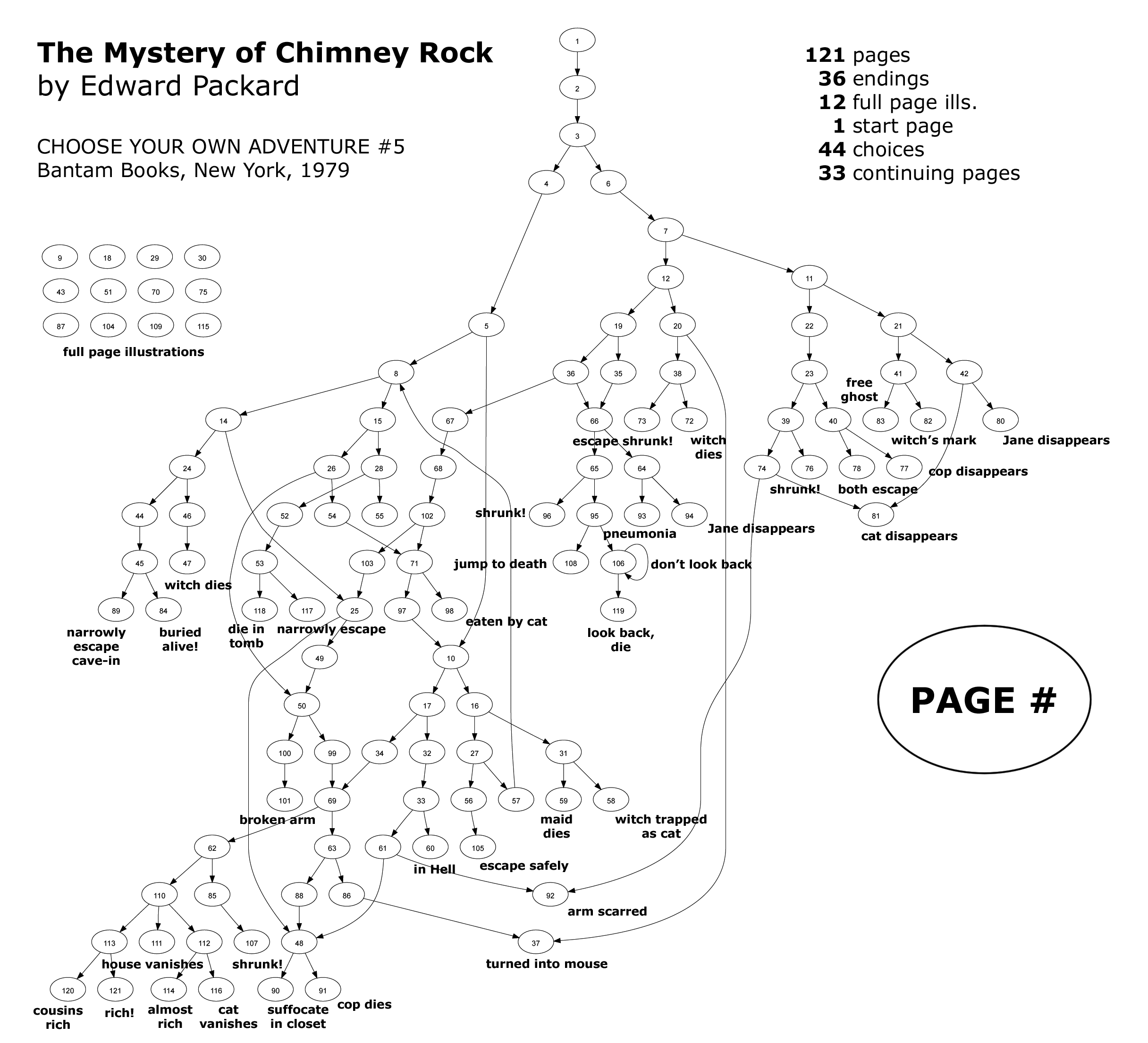
Second, there’s the linearity axis.  A conventional paper novel is completely linear: chapter 1, chapter 2, and so on. A choose-your-own-adventure book is a typically a tree structure - here is a great example of one. There’s no real outer bound on this axis, except that you can get more and more insane with the number of nodes, choices, choices per node, and endings. And you can loop. Go dig up an old C343 computer science book and read up on depth and breadth for more info. But there’s going to be a sweet spot there, too. The old Bantam Books CyoA books were bound by their published length, about 120-140 some pages. On the web, there’s no such limitation, aside from the reader’s patience.

(Also a note on linearity: just because a book isn’t having you make choices, doesn’t mean it’s not further down the linearity axis. Even the most rudimentary plotted books are sometimes jumping between the main story and a B story. Fiction can start at the end and work backwards, or jump around, even within a linear book. And things like footnotes and endnotes give you the ability to “jump” to the side for a moment to give you some side info. And you’ve got stuff like Nabokov’s Pale Fire or Cortzar’s Hopscotch, which make Zork look almost linear.)

Third, there’s the game logic axis. Printed novels have no game logic; there are no variables, no javascript, no programming. A game like Zork has a ton of game logic: you have inventory, there are combat rules, things happen at random times, and so on. A dungeon crawler text adventure could be entirely dynamic, spitting out a new map every time you came.

There’s also potentially a fourth axis, which is the presentation level. Books are text, maybe some images.  You could add in more styling, graphics, sound, video, and so on.  If you want to go whole-hog, consider a printed book versus the presentation in a Grand Theft Auto game.

All of this has me pondering what to do for a book like this. The simplest thing would be to take one of my linear novels, like Summer Rain, and make it web-based; a web page per print page, and maybe add in some pretty pictures. That’s pretty boring, and useless - you could just go download the Kindle version. The next level would be taking something like Rumored and arranging it in a tree-like structure, with wiki links between the nodes. That could be interesting. It also makes me think about going in the opposite direction, writing a book that’s interconnected in a web-based structure, and then flattening it into a linear print book. I kinda-sorta did that with The Necrokonicon, which went from wiki to print.  All of the hotlinked words were bolded in print, indicating you could manually page over to that topic.

A project I started messing with was the idea of a game based on a book, something with game logic built into it. I started writing a Twine mashup of Summer Rain and the Necrokonicon. You wake up in a boarding house room in Bloomington in 1992, and then you wander around the sandbox of campus, almost GTA-like, getting dressed and walking to Lindley hall to log into a VAX computer, find people to hang out with, spend your few dollars getting something to eat on Kirkwood.  This was a fun project to start, but exhausting. I needed a solid set of stories to tree up within this large matrix of the campus topics, like people you would need to meet or tasks you would need to accomplish, and I ran out of steam on that.  I also wasn’t finding the right balance on axis 1, unsure of how much text to put on each page. It was a fun distraction, but within a few days, I barely had my house and the few blocks around it mapped out; I could easily burn a thousand hours trying to world-build the thing, and that wouldn’t even get into the story.

I’ve got to get back to other writing, but I do want to do something with this at some point.

Unreliable narrators and autobiographical fiction

This Lena Dunham book has been huge in the memetic ten-second news cycle lately.  I haven’t read it, but the gist of the argument is that her autobiographical(-ish) book has some stuff in it about how she used to share a bed with her sister and various things may have happened (or not, whatever.) There’s a group of people who want to see her hung from a lamppost, and another who are defending her and saying that it’s normal behavior and/or they’re just jealous of her success and/or they don’t get how this could be fiction or an unreliable narrator situation.

I won’t get into my opinion on Dunham, because who cares.  But this demonstrates what I find an interesting flaw in the creative nonfiction genre.  Some people will take everything you say as face value, and even if you write an extremely exact, factual, researched and cited account of a situation, you will still have people tear it apart and give you shit about it. That gives you no latitude to be creative. If I were writing autobiographical fiction and I glossed over some event or fact or tried to frame things so I didn’t look like an asshole or looked worse off than I really was or whatever else, eventually someone is going to come forward and nitpick your work.

Was Lena Dunham adding in this stuff because her work is creative nonfiction and she’s free to be an unreliable narrator for the sake of art?  Maybe, I don’t know. But if she’s going to do that, she’s going to get people who don’t get it and freak the fuck out.  It’s one of the reasons I don’t like writing creative nonfiction anymore.  Any time I write a story about college or childhood and then fictionalize it by changing places and backgrounds and morphing together characters and altering sequences for the sake of storytelling, I always get some genius from the past who shows up and says “HEY MY CAR IN 1988 DIDN’T HAVE FOUR SPEAKERS IT ONLY HAD TWO.”

It’s just like how there’s always some asshole who’s got to reply to my one-line jokes on Facebook by closely analyzing it like I’m writing a peer-reviewed paper on nuclear physics.  It’s a goddamn joke.  Yes, I know that a duck can’t walk into a bar because all doors on commercial spaces open outward and the duck would need fingers to pull open the door.  That’s not the point - go do something more constructive, like telling kids there isn’t a Santa Claus.

What’s odd is that James Frey seemed to have the opposite trouble as Dunham about ten years ago.  He wrote a creative nonfiction book, which was pitched and sold as a straight biography, and then got torn apart because his crazy tales weren’t true.  I think at the time the Frey stuff happened, I thought he was a fraud and the whole thing was phony, but now in retrospect, I like the idea. I think if I did write a “nonfiction” book, I’d purposely make it outlandishly fake, and talk about my time in Japan studying to be a ninja, or how I do heart surgery on the side.

It’s almost bordering on Hunter Thompson’s Gonzo journalism.  And in the same sense, there’s been this whole cottage industry of picking apart HST’s life to prove what is and isn’t true.  (Same with Bukowski, same with Burroughs, and with a million others.)  But that’s the genius and the art of it: it’s all fake. Nothing is true; everything is permitted.  Good luck to Dunham explaining this to her humorless detractors, but it’s something to keep in mind when writing.

Scrivener Tips, Redux

I am in the midst of production work for my next book, and this is the time I always learn new things about Scrivener.  Here are some random bits of info.  If this makes no sense to you, don’t worry; I’m mostly documenting this so that a year from now, I’ll google it again and find it here.  BTW all of this is in the latest version on the Mac.

Using a Code character style in Kindle output

Need to have a monospace font code style that shows up in your final Kindle output?

  1. Surround your text with the HTML <code> tag.  Like this

Screen-Shot-2014-08-20-at-2.19.40-PM

  1. Select the text, and select Format > Formatting > Preserve Formatting.  Your text gets surrounded by a little blue dotted outline.
  2. When you compile your book, under Compilation Options, select HTML Settings,  and under HTML, select Treat “Preserve Formatting” blocks as raw HTML.

Making first paragraphs in a chapter or section not indented

  1. When compiling, under Compilation Options, select Formatting.
  2. This gets a little squirrely, because it depends on how you break up your documents/scrivs/folders.  For this project, I had a scriv per chapter, and within them, I had blank lines for sections (where you’d normally have * * * or something in a print book.)  In that situation, select the Section Type of Level 1+ with just one document (the bottom item).
  3. Click Options.
  4. Select Remove first paragraph indents and the relevant option.  I used After empty lines and centered text, but yours might be something else.
  5. You might have to do this for different Section Type levels, depending on your structure.

My About the Author chapter is showing up as Chapter 32 in the Kindle TOC

  1. Make sure your scriv for the chapter has a properly-cased and human-readable title, like “About the Author” and not “WTF FFUUUCKCK FIX ME”.
  2. Under Compilation Options, go to Title Adjustments.
  3. There is a thing labeled Do not add title prefix or suffix to documents:.  It has a little gear next to it.  It’s not very OSX-ish and super easy to miss. Click the gear.
  4. Select the documents you want to not name “Chapter x”
  5. Click outside of this pop-up to close it, like on the dialog underneath it.  (It has no close button. I told you it was a junky piece of UI.)

I imported a Scrivener-generated Word doc into Pages and when I try to have different head/foot/page numbers in a section, it freaks out and I think my computer is possessed by Satan

Scrivener probably put a page break instead of a section break between a couple of chapters, and now the Pages “use previous section” heading/footing setting behaves wrong. Change the page breaks to section breaks.

Also, if you don’t use section breaks between chapters and your chapters start on even pages of your book, stop doing that.

The spell check isn’t catching things

That’s because it’s horrible.  You might want to check your spelling and grammar in another program.

Hope these help someone, or at least help me in six months when I do this again.

My Writing Process, 2014 Edition

Okay, so there’s this thing going around, a #MyWritingProcessTour thing, and you know how these memes work - someone nominates you to answer a bunch of questions, you nominate a few other people to do the same, and so on.  I’ve written a lot about process here, and I talked about it in an interview last year, but the tools always slightly change, and so does the writing structure, so maybe it’s a good time to visit the topic again.

I was nominated by Sam Snoek-Brown - go check out his answers there, and also take a look at his latest chapbook, Box Cutters, over on Amazon.  Okay, on to the questions.

What Am I Working On?

I just published Atmospheres in the beginning of March, and I should be publicizing that, but that didn’t work out and I fell into a deep post-partum depression, like I always do.  I stumbled with writing something similar, which started to catch, but it’s hard to plod forward on a book that’s essentially the same as one you just wrote that didn’t sell.  (And I know this isn’t about how many books I sell, but it wouldn’t be bad if a few people actually read them.)

Anyway, I sat around the house watching old movies and taking notes.  Even though I’ve burned a lot of cycles writing about how books don’t need plot and we’re all fucked because plot is a crutch for dumb readers and eventually all novelists will be doing nothing more than writing the book equivalent of stupid half-hour sitcoms, I still have this sick desire to write a well-crafted, heavily-plotted novel.  About once a year, I get this bug stuck in my ass and come up with a half-baked idea and start writing it and then flame out after 50,000 words, a solid Act 1, a broken Act 2, and 17 words of an outline of an Act 3.

(I don’t know what the desire is on doing this.  I think part of it is that I get so much shit for writing “plotless” books, as if that’s a pejorative term, and I think it isn’t.  But every time I get that, I feel like writing a heavily plotted book as a big fuck-you to show that I can do it, and then I’d write another ten books that didn’t do this.  Because I can; it’s just I feel like I’m not pushing the envelope when I do.)

Well, right now I have an 80%-baked idea, and just started work on it, and have a much more solid outline and the first 10,000 on it.  That’s about all I can say about it right now, but if it still has momentum in a month, it could be good.

How Does My Work Differ From Others of its Genre?

I don’t really fit into any particular genre, so I don’t know how to answer this.  I can probably answer by saying why my work doesn’t fit into specific genres or communities, and that would define the differences in my writing.  So:

  • I don’t write genre fiction, so I don’t write high-concept stuff that can easily be pitched.
  • I feel like most experimental writing is an academic study in form, and not necessarily written to be entertaining. While I think that kind of writing is important, I’m not an academic, and I write to entertain, so I think the readability level is much higher in my work.
  • I’m often called an absurdist, but there’s a fine line between satirists and absurdism (i.e. Vonnegut, Heller, Tom Robbins, etc.) and I think when people think of absurdism, they’re really thinking satire. I think more of the Dada and surrealism movements in art, but the word surrealism has been overloaded and destroyed in modern culture to the point of meaningless, and I think any time someone sees something weird or freaky or psychedelic, they call it surreal, (i.e. locking a bunch of has-been celebrities in a house and making a reality TV show is “surreal” now.)
  • I’m often lumped into the Bizarro fiction world, but I haven’t published anything with Eraserhead or their imprints, which is the difference between bizarro and Bizarro.  I also feel like at this point, half of bizarro is horror fiction with a certain Troma-esque sense of humor, or it’s a very set form of “let’s take Adventures of Huckleberry Finn, and make Tom Sawyer a talking anthropomorphic penis, and it’s set in Nazi Germany” and that’s that.  There are exceptions to the rule, but I’ve never fell into the groove with that, and I don’t write horror.

Why Do I Write What I Do?

I wrote a big post called Why I Write, which partially answers this.  If I were to riff on this for a minute, I’d give the stock answer of “I write what I would want to read” which is a bit of a cop-out, but is true. I mean, when I read or re-read a classic book like Naked Lunch or a more contemporary one like any of Mark Leyner’s stuff, I always think “I really like this — who is writing more stuff like this?” and the answer is nobody.  So, that’s what I need to write.

How Does My Writing Process Work?

Okay, here is the rundown, 2014 edition.

First, I write here and write on Facebook and twitter, and those don’t really feed into my actual writing; they are just distractions.  I also keep a personal journal, handwritten in little moleskine books, and I try to write in that every single day, but it’s mostly just about day-to-day happenings and not about writing, except maybe how much I did or did not do.

I use a MacBook Pro, iPhone, and iPad, and I use the Notes app to keep track of ideas or write down things as they happen in the wild, like little phrases or title ideas or things to research later.  These sync across all of the devices, and I currently sync them through Gmail, which means in theory I can access them even if I’m somehow away from all three things but still at a computer.  (I might research how to change this to iCloud, because every time I rely on a Google service for something, they decide to cancel it.)

I use Scrivener for everything.  So I have a big Scrivener catch-all project that contains nothing but bits and pieces, leftovers from published books and ideas for characters and lists of random objects and places and little phrases I want somebody to say at some point and title ideas.  It’s basically a hoarder’s house of words.  Every month or so, I scoop out the running Notes file of ideas and drop it in there.  When I have time, I sometimes move the pieces into the proper places, and if I was smart, I’d do that religiously.  But I’m not.  I am about 17% confident that the best ideas float back out of the scratch project when I skim it looking for things to rip off in a current project.  And I’m learning that not every idea that comes out of my head is golden and 90% of them should probably die.  But that’s always a struggle.

For writing plotted stuff: I will probably go into this in greater detail after the book is done.  But I’m using a program called Scapple, which is by the same company as Scrivener, and it’s a sort of mind mapping thing.  You draw little circles on a big blank canvas and put text in them and connect them together and shuffle them around.  Once you get the order correct, you can either export it into OPML, or just drag and drop it into Scrivener.

Scrivener uses this concept of scrivenings, which are little chunks of text.  You can view all of the scrivs sequentially, like a big, flat file.  You can then create folders and a hierarchy and move them all around and give each one a cute title and have them be your chapters or parts of chapters or scenes or whatever.  You can also switch to an outline mode, or to an index card mode, that uses a different piece of text per scriv (a short description) so you can plot your story and move things around.  It’s confusing until you get the hang of it, and then you never want to go back.

For plotted stuff, I moved the Scapple map I plotted out and dropped it into Scrivener, where each little scene bubble became a scriv.  Then I organized things by Act and got the order all correct, and started writing from page one, sequentially.  When I get done, I can shoot the whole thing out in .DOC format or whatever.  I use Apple Pages instead of Word for layout, because I hate word.  And Scrivener is able to output eBooks pretty much perfectly, so that’s what I do.

When I do the more non-linear writing, I typically have a project and I free-write every day, 500 or 1000 words.  When I wrote Atmospheres, I would listen to the Sleep album Dopesmoker all the way through every day, and write, with my only rule being that I couldn’t write about not writing. I mix in pieces that are in that scratch project, and I later cut out bits and pieces and split things up.  Sometimes, I’ll write for a given day, and I’ll split out a single paragraph or even sentence from that entry, and create a new scriv from it, maybe gluing in pieces from another one, and eventually fill it out until it’s a longer piece.  It’s like songwriting, collecting riffs and eventually gluing them together and smoothing them out until something larger appears.  This takes forever, but it would take longer if I was doing it in another program.

I usually have a hair-brained scheme involving color tags on the project outline that determines what’s part-done and what’s almost-done and what needs a total redo.  I also set up a NO folder outside the project and start chucking things into it that I can’t look at anymore.  Eventually it comes down to PDFs that are printed and red-penned and mailed to readers for comments.

Okay, I’m supposed to tag a bunch of people here to answer the same questions.  I have not asked any of them to do it, so they probably won’t but here you go: