The Wrath of Kon

Dispatches, thoughts, and miscellanea from writer Jon Konrath

Tag: obsolete-technology

The age of adapters

IMG_4371

Two disparate conversations got intermingled in my head this week. One was a long discussion about the days of AM radio and only AM radio in cars, and the other was a day where multiple people asked about various dongle issues, USB-C vs. USB3 vs. Thunderbolt or Thunderbird or whatever the hell Apple calls USB-C now. Anyway, both of these things make me think of how in general, we’re so adapter-free now, and can generally shoot music and videos and photos straight through the air at each other, at the cloud, at machines like TVs and printers and coffee machines. I promise this isn’t the usual “these damn kids don’t know what it’s like to hunt for the right DB-9 to DB-25 RS232 cable” old man rant, but these two things made me think of the ubiquity of adapters in the seventies and eighties as the landscape of tech rapidly changed.


Example one: car stereos. For decades, the standard was AM radio, and that’s it. In the US, the AOR FM stations started their reign in the late 60s, but it wasn’t until 1978 that there were more FM stations than AM, and a lot of them were simulcast stations of the same programming. I think by the time I was sentient enough to have my own radio and listen to my own music, the top-40 stations in my area were FM, but FM radios were still an upgrade option for most cars back then.

I remember my former stepdad had an old Buick, maybe a 71 or 72, and it had the stock AM radio. But he’d upgraded this for the bold new future of AOR programming by buying a little Radio Shack box, a Realistic FM tuner. It sat below the all-metal skull-crusher dashboard of this giant beast of a car, somehow spliced into the old wiring, so it would pump high-fidelity FM stereo sound into a single three-inch paper speaker. Seems like it would have been easier to rip out the stock radio and slap in a Krako tape deck with an AM/FM tuner, but maybe that cost an extra ten dollars. Also, leaving in the old radio wouldn’t lower the value of the vintage $500 vehicle, I guess.

Another big thing was that in the late sixties/early seventies, nobody could decide on what physical media format was the king of mobile applications. Spoiler alert: the cassette won, and there were suddenly millions of vehicles on the road that couldn’t play them. One “adapter” approach was to go to Radio Shack or K-Mart and pick up an under-dash tape player, much like the external FM tuner, and wire that up so you could play your Barry Manilow cassettes through your stock sound system.

What I always found funny, although I never saw one in person (I did read a lot of Radio Shack and JC Whitney catalogs as a kid, so I knew of them) were the 8-Track to cassette adapters. If you were an early adopter of the bigger and quickly obsoleted tape system, you could buy a plug-in adapter, which looked like a really long 8-Track tape, but the part that stuck out of the dash had a cassette player mounted horizontally in it.

(For a quick look at all of these options, take a gander at this 1976 Radio Shack catalog.)

I never really bought into this adapter madness — I either went to the junk yard and bought a tape deck out of a junked car for twenty bucks, or just brought a jambox and put it in the passenger seat. But that was when I was still spry enough to crawl around under the dashboard of a subcompact. Maybe I’d think differently now that my back is out, who knows.


Much later, the cassette was dethroned from the top of the heap of the physical media world, and then the argument resurfaced on how you get your various iPods and DiscMans and whatever to talk to your tape-only car stereo.

The very first time I bought a portable CD player in 1992, it actually shipped with the solution in the box: a little fake cassette with a cord dangling out of it that plugged in the headphone jack of the CD player. I used a system like this for years, first for that CD player, but later for the MiniDisc and iPod. I didn’t have a car during the heyday of in-car CD players in the early 00s, but I rented cars quite a bit on vacation. And of course, I’d always forget that damn adapter and would have to buy another one for twice as much at an airport. So I have a big collection of those things in storage somewhere.

There was also a much worse adapter for cars that didn’t have tape decks. It was basically a Mr. Microphone but it took the signal from a headphone cable and broadcast it over channel 88.1 with like a milliwatt of power, so you could tune in a car radio and magically listen to your CDs.

I got stuck with one of these when I was Hawaii in 2003. It was basically like this scene in Spinal Tap. I’d be driving around the island, happily listening to an album on MiniDisc, and I’d zip by some volcano park or whatever the hell that would blast out weather advisories at a million megawatts on the same exact channel as the adapter, interrupting my song for the next few minutes. I finally gave up and bought a Skynard CD at a gas station and listened to that for the rest of the trip.


The adapter thing was also big in the beginning of personal computers. Both Atari and Mattel had popular game systems, and then Apple and Commodore came out with home computers. The popular thinking of parents at that time was that kids needed to learn about computers so that by like 1995 when paper was obsolete and the world was run by artificially-intelligent mainframes, the kids would be able to get good jobs to afford flying cars and robot butlers. So why buy a gaming system and later buy a home computer, when you could take your existing gaming system and magically turn it into a home computer with a plug-in box like that FM radio tuner?

Atari had a few different approaches. They came out with a BASIC cartridge, which was laughably bad, given it could only use 64 characters of memory for programs, and you had to type in programs with gamepads. Next they tried to release the Atari Graduate for the 2600/VCS gaming console. It plugged into the cartridge port and had a membrane keyboard that sat on top of the 2600, adding 8K of RAM and the ability to hook up peripherals like a tape deck, a modem, and a printer. This was supposed to be a $79 add-on, but never shipped because (allegedly) of some arguments between Atari management and the third-party team developing it. There was also a third-party thing called the CompuMate that shipped, but didn’t take the world by storm, probably because you can’t do much with a 10x12 character screen.

Mattel was a bit more infamous about this, because they promised a computer add-on and never delivered, which got the FTC to slap a $10,000 a day fine on them, and lit the fire to for them to come out with anything that could legally be called a computer and dumped on a small test market at a loss, which is exactly what happened.

The Entertainment Computer System was an add-on home computer for the Intellivision, which was a small external chicklet keyboard and a box that plugged into the side of the Intellivision, and was probably 75% the size of the actual Intellivision, and had its own power supply. The thing added BASIC, 2K of RAM (but you couldn’t use all 2K for your programs), another sound chip, extra controller ports, and the interface for a cassette recorder. They also came out with an add-on synthesizer keyboard — this was the heyday of Mattel’s Synsonics instruments. The whole thing got the FTC off their backs, but didn’t entirely catch on, and then Mattel imploded a year later.

Coleco also did this with the Adam computer, which was available as a standalone or as an adapter that plugged into the ColecoVision console. I don’t know the architecture of the add-on or how well it worked, because the only things I ever heard about were the Adam’s other major shortcomings, like the gunfire-loud printer; the fact that the power supply was in the printer so when the printer died, the whole system died; and the slow cassette system built into the main unit, and a burst of EMF at start-up would nuke any tape in the drive, even though the instructions told you to put the BASIC tape in the drive when you booted.

The more interesting one was that Coleco came out with an adapter that would enable your ColecoVision to play Atari 2600 games. This wasn’t some kind of sophisticated emulator or anything; it was functionally an entire reverse-engineered Atari 2600 that hooked onto the front of the ColecoVision and used nothing more than the video connection and power from the ColecoVision. The expander has a 6507 CPU, memory, and the whole deal. You had to unplug your Coleco joysticks and plug them into the expander (or I guess buy some Atari sticks, if you wanted the same feel.) Coleco got sued by Atari about this and Atari lost.

Likewise, Mattel also had an Atari compatibility “adapter” that was also a near-complete 2600 that plugged into an Intellivision. And Atari did the same thing themselves with a near-complete Atari 2600 that plugged into the Atari 5200. These were major marketing coups in that they radically increased the other systems’ library size. The downside was they increased their libraries with really bad games. I don’t think people remember how bad Atari 2600 games were, even compared to the 5200 or Intellivision.

The whole thing is bizarre though. It reminds me of in the 1950s, the Air Force built this giant B-36 bomber, and when they decided there was no way to bolt enough guns onto the 200-ton behemoth, they thought, “hey, let’s just hang entire fighter planes on the big plane and have the best of both worlds.” (That never really worked out, BTW.)


Now we’ve solved the upgradeability problem: everything is sealed shut with glue, and when you want a better version with newer features, you throw the old one in a landfill. Sometimes I wonder if this adapter fetish of last century was some holdout to the days when a TV or a radio was a piece of furniture you kept forever and serviced with in-home repairmen, like a furnace or a car. Maybe people thought they would invest in a system and then it would slowly grow and evolve over time.

(Oddly enough, Apple embraced this for a time, and you could upgrade early Apple machines with an upgrade kit that replaced the logic board, but kept the old case. For example an Apple IIe could be upgraded to a IIgs, or a Mac 128 could be upgraded to a Mac Plus. I don’t know who did this, and you were basically replacing the entire machine but keeping the old yellowed case, so why not just pay more and get the whole thing. Maybe schools did it. I could see a school administration making a bone-headed investment like that. I bet I’m still paying off tax bonds from when my local school did this in 1977.)

I think these various false starts caused the adapter appeal to dwindle. The last one I really remember is the Sega 32X, which was a stopgap measure to put two high-speed CPUs, a GPU, and more memory onto the 16-bit Genesis, which allowed it to run… well, virtually no games, because nobody supported it. Anyway, it seems like now the thing is to own one of every console, or just run the things on your phone. People aren’t as up in arms about o “teaching computers” to kids like they did when they thought “computer technician” was a vocational skill like a cabinet maker or TV repair person. Everyone seems to know how to use a computer off the bat, or instinctively know how to move a mouse or swipe a screen. And our homes are filled with computers, whether we know it or not. The webcam sitting on my monitor probably has a CPU orders of magnitude faster than some of the mainframes I used in college. Just let the kid screw with the old iPad, and they’ll figure it out, I guess.


Anyway. Dongles: USB-C is a subset of Thunderbolt 3. They use the same size connector, but TB3 can be twice as fast and use half the power, depending on the device and the cable. That’s all. Enjoy not having to buy another device that costs 90% of your first device to play another manufacturer’s games.
COVAD-99

Ever since the COVID stuff started, I’ve had the term COVAD stuck in my head. There’s a reason for that. Let me explain.

So back in 1999, I moved to New York to freelance and write fiction and do that whole lifestyle, and it lasted about six months and I ended up at a full-time job at Juno Online that fall. Juno was that free email company, where they gave you a clunky Windows program and you got a free email address but had to look at ads in a little sidebar thing. When I got there, they also got into giving away a limited number of hours of free web browsing, or you could pay a little per month to get “unlimited” use.

At that point in time, 99.99% of internet users connected through a dial-up modem. Some dorms and campuses had ethernet; some offices, too. You could also pay a ton of money to get an ISDN connection at a screaming 128Kbps. Like most people, I used a 56K modem, which wasn’t blazing fast, but my first modem ever was 300bps, and I spent a few years of college on a 2400bps, so it didn’t seem that horrible. The busy signals were, though.

One of the first things I worked on at Juno was a new product called Juno Express. This was a Juno unlimited connection, but also included a broadband connection. Juno experimented with every type of broadband technology coming out at the turn of the century. We did trials with cable modems, satellite, microwave, various radio technologies, and something that ran through power lines to the home. But the one that stuck was DSL. And our DSL partner was called Covad Communications.

Prior to the late 90s, the only real way into a person’s house from a communication standpoint was the voice line. Modems worked by connecting to the voice line and converting digital communication into an audio signal, that screeching sound you heard when you connected a modem to the internet, if you were old enough to remember using a modem. That worked, but only up to a certain point, because of the inefficiency of cramming a wide digital signal over a relatively narrow pipe.

The Telecommunications Act of 1996 changed this. Among the other things they deregulated, they made it so that an Incumbent Local Exchange Carrier (ILEC) - the big phone companies like Bell Atlantic or Ameritech - had to allow any company the ability to share the local-loop access of the pieces of copper that tied a home to a telephone exchange. That meant a company like Covad could lease these lines and run their own digital internet service directly to your home.

Of course, the big phone companies didn’t make this easy. They dragged their feet and instituted byzantine processes for partners and did as much as possible to discourage this forced competition. Part of what made my documentation of Juno Express so messy was the complicated dance of getting the customer’s phone company and someone from Covad to both work with each other to get everything connected. Companies like Verizon weren’t going to just hand keys to Covad and say “knock yourself out.” Getting appointments was tedious, and sometimes they just wouldn’t show up, so you had to reschedule the following Covad appointment. It would take weeks and sometimes months to turn on a connection.

Once you got all of this sorted, you ended up with a DSL box in your house that had a 10 base T ethernet connection at about 768Kbps. But it was on 24 hours a day. No busy signals! And over ten times faster than a modem. Yes, my current connection is usually about 600Mbps, but just under 1Mbps was so insanely fast at that time. And not having to wait an hour to get past the busy signal at peak hours was a huge plus.

I seldom worked with anyone from Covad. But they had a sales rep who, when he was in New York, was always good for a high-end lunch. I remember getting a three-hour, all-expenses paid steak dinner for lunch at Sparks Steak House once. I think we spent thirty seconds discussing business, and it was “how’s business?/not bad/let’s get more drinks.” Other than that and the usual swag that showed up (I’m sure I had Covad mouse pads galore at the time, maybe a stress ball or some pens, too) I seldom had direct interaction with them, just deciphering their emails and adding to the docs.

When I moved into my own place in Astoria in 1999, I got DSL right after I got my keys, but I didn’t use Juno. Covad also got hooked up with Speakeasy, who I still had accounts with from my Seattle days. Speakeasy started as an internet cafe in Belltown, and I got a shell account there when I got to Seattle. For five bucks a month, I got an account on a SparcStation, the address jkonrath@speakeasy.org, and a few megs of web space. I kept that account for like ten years, but when I got to New York, they were doing dial-up access nationwide, which I used, until I got the DSL hookup. I later moved from the leased-line DSL, which used the second set of copper in my walls, to a shared-line setup, which ran on the same pair as my voice line, using DSL filters. I think that was maybe a 3Mbps connection.

I left Juno in the summer of 2001, right as they got bought by NetZero. I kept using Speakeasy/Covad until maybe 2005 when I moved in with Sarah. Oddly enough, Covad and Speakeasy were acquired and mashed together with MegaPath in a three-way merger in 2010. The Speakeasy cafe burned down in 2001. And now when you search on Covad, Google suggests Covid. So I’m not the only one confusing the two.

flu, rom-com dreams, unix history, holiday mall-walking

I think I have a bit of the flu right now. It’s the weirdest one, because I don’t have a lot of symptoms (congestion, throat, fever, etc) but I have been horribly underwater, unable to think, achy, and all I want to do is sleep. And of course this happens immediately before our Q4 deadline, when I have half a hundred things that have to ship. Last night, I slept about eleven hours, and felt like it was maybe three. I think I’m on the back half of it, and maybe if I waste the weekend sleeping, I’ll be over it.


I had this amazing yet disturbing dream - I plotted out the entire outline of a chick-flick rom-com, and it was an absolutely bulletproof story for that genre. And I remembered all of it when I woke up, and wrote it all down. It’s not a bad story idea at all if I was into that sort of thing, but I’m 80% sure it’s actually the plot of something I subliminally watched on a plane fifteen years ago. I’d have to spend a few weeks watching the entire Emily Blunt filmography to research that I wasn’t plagiarizing Richard Curtis. And what’s worse is if the thing ended up being entirely successful by ten orders of magnitude more than anything else I’ve written.


I’ve been reading UNIX: A History and a Memoir by Brian Kernighan, which has been fun. I’ve had a copy of the K&R C book since forever - I actually had the first edition, sold it to buy groceries or whatever back in 1992 or so, and then bought the second edition when I was in Seattle. Kernighan is one of the Bell Labs folks who was around when unix first came to life in the late sixties/early seventies. He wasn’t the inventor of unix, but he arguably came up with the name, and he co-wrote that definitive C programming book. Anyway, the memoir is actually half about his personal time at Bell and half the beginnings of that operating system’s development.

It’s a fun read, because it makes me think of how quickly things changed in that period. They first started hacking together their system on a PDP-7, which had something like 32K of RAM. They had to write everything in assembly language, because there wasn’t a C language yet, and there weren’t portable libraries yet, which made later moving unix to the PDP-11 an overwhelming task. A dozen years later, my Commodore 64 had double that amount of memory. Six or seven years later, the computer I first used to learn assembly language had eight times that memory, and was considered largely obsolete at that point. (The C335 class had a cast-off lab of old Atari 520 ST machines, which were maybe five years old, but felt more like fifty, compared to the NeXT and SPARC workstations everywhere in Lindley Hall. It was nice learning assembly on the Motorola 68000 though. I don’t remember the details, but the 8086 seemed bizarre in comparison. The 68K had more registers, and they were all general purpose; the x86 had a bunch of specific registers, so like some were specific pointer registers you only used in addressing. Or something. Anyway, this was thirty years ago, and I never used assembly again.) Anyway, it’s fun to read about these guys writing an OS that’s now used everywhere, on a machine that’s slower than the alarm clock sitting on my desk.

The one weird thing about that book is that Kernighan has probably sold millions of programming books over the years, mostly through Prentice-Hall, but this book was self-published on KDP. It looks okay, but it’s definitely published on KDP. It makes me wonder why he didn’t get an agent to swing him a deal and maybe get more publicity on the thing. It does seem to be highly-ranked at the moment, and I hope he does well with it, but it is curious.


Not much else. Writing has been slow because of the flu. Mall walking has been increasing as the temperatures slowly drop. (Nowhere near as bad as the midwest, though.) It’s nice to see the holiday stuff slowly start to fill the stores. Macy’s is packed with new inventory; JC Penney seems to be well-stocked. Sears is Sears. The one in Concord has a sad display of trees in the basement, and not much stock on the floor. I still find it funny that I thought of Sears as The Enemy for years when I worked at Wards, but now I feel oddly emotional when I’m in the holiday department. It reminds me a lot of being in Four Seasons over thirty years ago, putting up the fake trees and telling people that no, we did not have any Nintendos in the back room.

I have a much bigger post in me about the Wards thing. But one interesting bit I found out is that one of the guys who worked full-time in the automotive department who I always liked working with managed to stay until they locked the doors on the last day. And then, oddly enough, he jumped to Sears, and went down with the ship when they closed almost twenty years later. So that’s interesting.

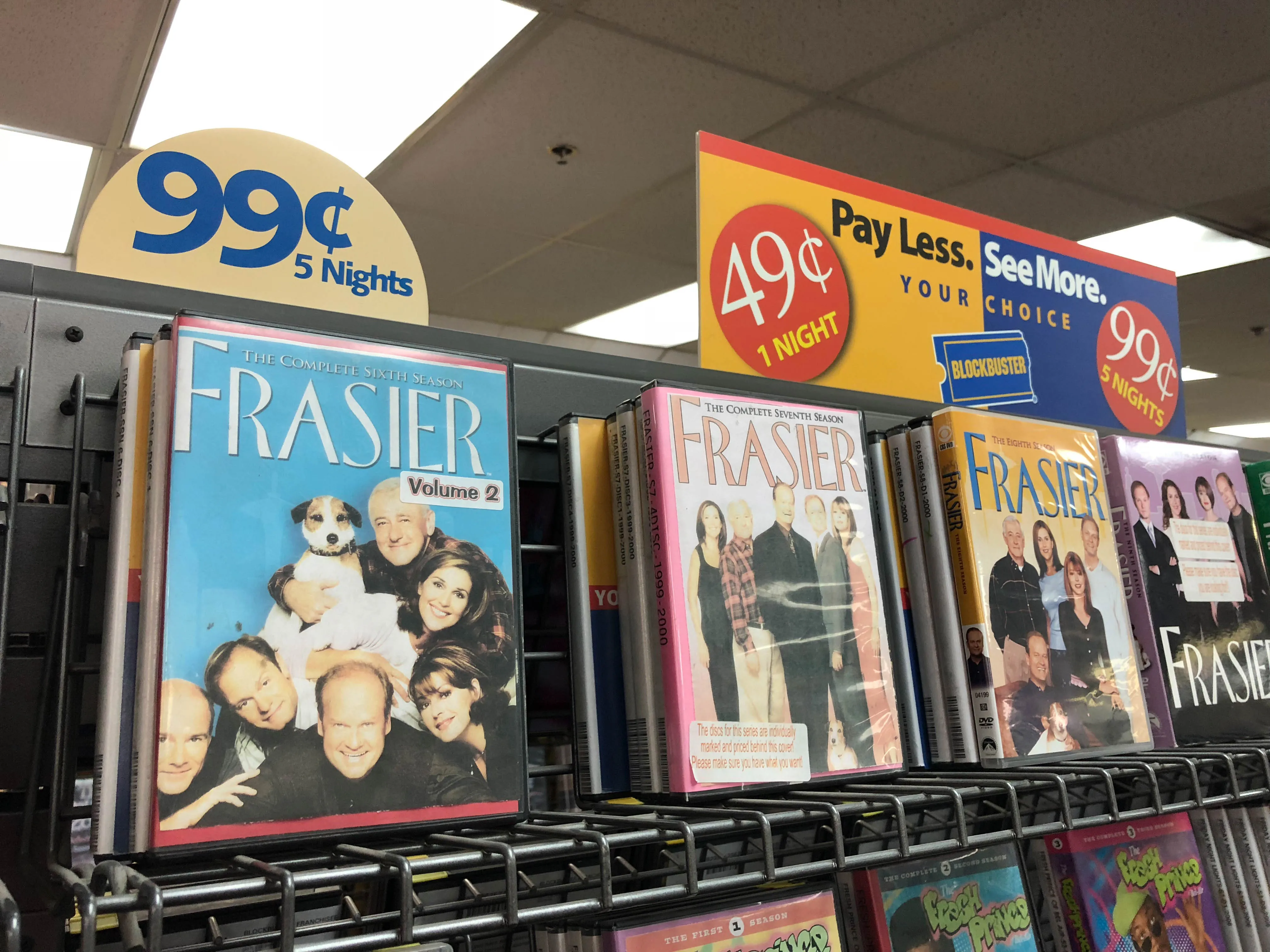
The Death of Blockbuster

IMG_7317

Here’s an interesting long read over at Retail Dive on the death of Blockbuster Video:

Who Really Killed Blockbuster?

A couple of interesting (to me) takeaways. First, I like that this article gives all the details other than just saying “Netflix, duh” because that’s not what happened. The thing that annoys the hell out of me in death-of-malls or death-of- is that they always say it’s Amazon, and it almost never is just Amazon. (I.e. venture cap choke-out run by a fervent Ayn Rand acolyte; tax scam by REIT not paying off anymore; etc.)

Like one of the factors the article mentions that most people forget: VHS tapes were damn expensive, and that was partially hidden to the consumer. Yes, you could buy a priced-to-own copy of Wayne’s World for twenty bucks during a certain limited sales cycle. But if you’ve had the good fortune of losing a copy of Apocalypse Now from a rental place, it probably cost you eighty bucks to replace it. They ran this two-tier pricing scheme for decades, and then when DVDs came out, the studios decided to go with low daily prices across the board, plus they flooded the channel at Wal-Mart and Target with cheap five-buck releases and multi-packs of their back catalog. That’s only one of the nails in the coffin, but that’s an interesting one.

The other thing, and this came up in discussion when I posted this article on FB, is that Blockbuster wasn’t that great of a place for customers anyway. There are a lot of folks nostalgic for the Nineties who were born in like 1998 and don’t remember how crappy some of it was, and Blockbuster was a good example. Like they were borderline predatory about their late fees, and good luck if you got sent to their collections department. They drove a lot of mom-and-pop rental places out of business. And their prices weren’t always great, compared to the non-chain places.

One of the things that always bugged me about Blockbuster was their family-friendly video selection. They were big on promoting mediocre big-budget movies and avoiding cult or obscure cinema. And they were incredibly vocal on not carrying anything beyond an R rating, or controversial movies. I went on a semi-boycott of Blockbuster for years because they refused to carry The Last Temptation of Christ. If you wanted obscure, it’s Not at The Block. If you need a copy of Day For Night, forget it. But they’d have plenty of copies of that new Will Smith movie.

Blockbuster was occasionally a necessary evil when I was in a small town. I really loved local rental stores that had obscure stuff, and of course you had to go to one of those places for the best horror movies. The clerks were always cool, the prices were lower, they didn’t give you as much of a hassle about membership, and sometimes you’d find weird stuff. Like there was a video place in downtown Bloomington — I wish I could remember the name. They never recycled out their old stock. Me and Larry used to go every week and find the most bizarre stuff, faded boxes that were completely forgotten. Like I remember never ever being able to find a copy of Johnny Got His Gun (probably because Metallica bought the rights to it and sat on them) and of course they had it. And I remember renting Deranged: Confessions of a Necrophile, the (bad) Canadian horror movie loosely based on Ed Gein, and it also had the short documentary Ed Gein: American Maniac slapped on the end of the VHS. It was a weird homemade doc consisting of blurry found footage, narrated by some dude in a basement recording on a Bell and Howell mono tape recorder stolen from an elementary school or something. It was awesome. (And it’s on YouTube!) You’d never, ever find that at Blockbuster.

That puts Blockbuster nostalgia in a weird place for me, much like Barnes and Noble. I’m a bit sad B&N is on the verge of shuttering, but back in the day, they were the chain to hate, because they pushed mom-and-pop stores out of business. (And deep analysis that I’m too lazy to do might show a story that independent booksellers were pushed out by someone else in the 80s/90s, like the rise of Ingram or the changes in book printing after NAFTA, or some damn thing.)

I visited one of the last Blockbusters in Anchorage a year and a half ago. (Yes it was the one with the Gladiator jockstrap. No, it wasn’t there yet when I visited.) It gave me a strange and sad feeling, not specifically because it was Blockbuster, but because it was a video store, period. It was all DVD, but wandering the aisles reminded me of the weekly exercise of going from A to Z on a Friday night to find what I’d watch.

That entire era is gone, replaced with a button on my TV remote that lets me scroll through thousands of titles. But something’s missing, with the lack of the Tarantino-esque clerk telling me what I really need to watch, and the tactile experience of pacing the aisles. We now have great convenience and instant access, but it is at a cost that’s hard to quantify, and it’s definitely felt by those who do remember.

WordPerfect for Mac

Screen-Shot-2017-11-10-at-5.05.58-PM

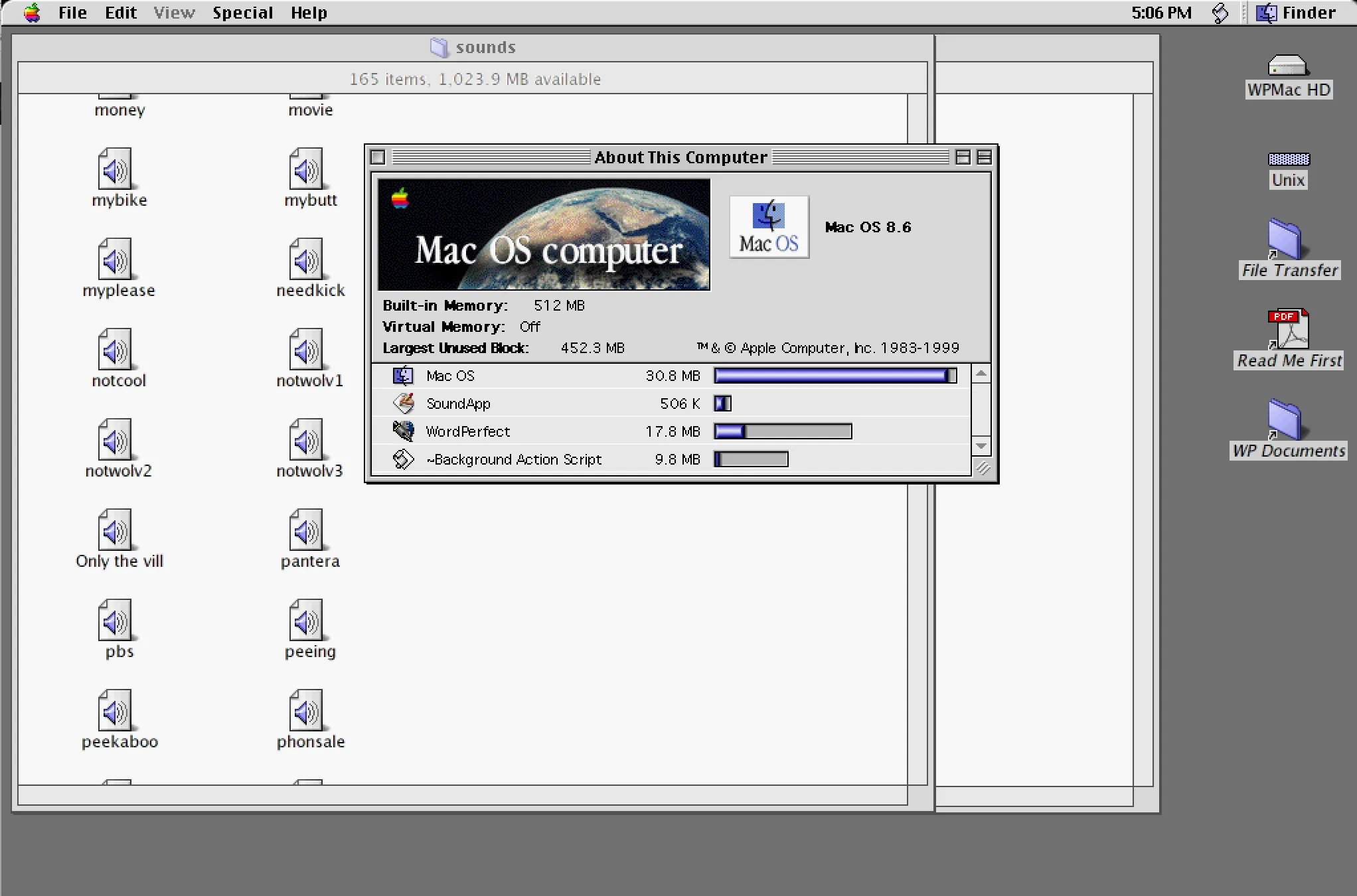
A stupid memory… I was thinking about how I used to love WordPerfect on the Classic Mac OS. It wasn’t a port of DOS WP 5.1; a different dev team wrote their own program, and the company called it WordPerfect, so it worked much faster. I always found it better than Word on the old Sys6/7 Mac.

Anyway, found this page: http://www.columbia.edu/~em36/wpdos/mac-intel.html - Someone has set up the SheepSaver PowerPC emulator to run MacOS 8.6, along with a few versions of WordPerfect. So you can download one image file, and with almost no fuss (aside from the big download) you can then run WordPerfect on a modern Intel Mac.

I was messing with this and realized I have a Stuffit archive of the Mac machine I had at my first job, 22 years ago. I’ve never been able to un-stuff it, because of the weirdness of Mac resource forks or whatever. I brought it into this emulated machine, and it instantly opened it. So I had the same set of files I had back on my Centris 660 AV in Seattle in 1996.

There wasn’t much there: the 1984 commercial in QuickTime; a bunch of QuickHelp source for the Spry Mosaic browser; some other assorted utilities, like DropPS and GraphicConverter. The fun find was I had a Sounds folder, which had a few hundred short clips of audio from Beavis and Butthead and Pulp Fiction. They were all sampled at like 10kHz; the whole folder is like 38 MB.

It reminds me of a time when Windows audio was almost nonexistent, unless you paid hundreds of bucks for a SoundBlaster, but every Mac had pretty decent audio, standard. There was a big culture of hoarding these little ten-second samples of Star Wars and RoboCop movie quotes. Like I remember hanging out with my Calculus teacher at IUSB - this must have been in late 1990. There were almost no Macs at the South Bend campus, but for some reason, he had a brand new SE/30. I went to check it out one time, and he spent half an hour playing me every sound file he had downloaded from the internet, these little clips from science fiction films, all hooked in so it would play Darth Vader when he started up or shut down his machine.

I don’t even know how to play these audio files outside of the emulator, but it works in the program. I guess now I can just go to YouTube and play the entire TV show if I want, but it’s interesting to see a snapshot of how it used to work back then. Also, the old Mac interface looks so blocky and weird now, which is hilarious.