The Wrath of Kon

Dispatches, thoughts, and miscellanea from writer Jon Konrath

Tag: nostalgia

Stop bath acid memories

I
save0179

n my freshman year of college, my classes were mostly at Ballantine hall, which was rumored to be built from all the money IU made off of the fluoride patent they sold to the Crest toothpaste people.  The morning stumble from Collins to Ballantine for an 8

German 100 class took maybe five or ten minutes, but I somehow decided that I’d die of exposure, so over the holiday break, I became obsessed with the idea of heated socks.  I somehow thought a pair of wool footwear impregnated with electrical coils would be the difference between Rolls Royce comfort and dying like those soccer players in the mountain plane crash who had to eat each other’s dead bodies.

I went to K-Mart back in Elkhart, and bought a pair of these magical socks in the hunting department.  They were brown with olive drab green trim on the toes, and a little plastic compartment for a C-cell battery in the top cuff.  I brought them back to school, put in a set of duracells, and within two minutes, it felt like a case of thermonuclear athlete’s foot, like the Vonnegut character that sealed his feet in clear plastic toxic waste.  And then two weeks later, it was suddenly 78 degrees outside, and people were sunbathing at the end of January.  I practiced cello outside the IMU on the bank of the Jordan river and got my picture in the school paper.  It must have been a slow news day.

That was my second cello.  I had to leave my first cello in the dorm over the holiday break. They ran the steam heaters full blast, so I locked the cello in the closet with a bucket of water, two drenched towels, and two humidifiers in the f-holes.  When I came back three weeks later, it was all bone dry, and the cello had a huge crack in it.  It was a rental, so I brought it back and exchanged it for another one.  I never really knew how to play; I just took a semester of lessons in some fit of stupidity, the same kind of spontaneous freedom that causes a person to buy a pair of heated socks at K-Mart for a five-minute walk in 38-degree weather.

I also purchased a 35mm camera that break, although I don’t think it was from K-Mart.  It was one of those fixed-focus point-and-shoot things, all plastic and manual.  I think I got maybe three rolls of film through it before the film spool broke, and I could not fix it.  I took a few good pictures of the campus, though.  And even though it had a plastic lens and no motor drive and no zoom or anything like that, it took pictures better than any camera I’d had before that.

My prior photographic history resembles a list of every failed film technology invented.  My parents had a 135 camera, and then I got a 110, and we also had a Polaroid one-step, and later graduated to a disk camera.  I don’t know if they ever got one of those APS models, but I wouldn’t doubt it.  We’d take about a roll of pictures a year, and then throw all of the rolls in the junk drawer and never develop them.  On the rare occasions when a roll got processed, the pictures went in a sticky-paged album with a faux leather cover, which would then reside in this hexagonal end table in the living room, to be produced each time I was stupid enough to bring a prospective girlfriend home to meet my parents.

It’s depressing that people will soon forget the extreme frustration of living in the film age, of having to bring film to the drug store, needing to buy those flash cubes or flash strips that exploded in bright light with the faint smell of burning electronics, like igniting a dollar bill every time you pressed the shutter.  You’d worry about the film getting exposed to light and destroyed, the possibility of a door opening or a case splitting, exposing everything and fading the captured images to nothingness.  Unless you owned an expensive camera with a motor drive, you’d follow some ritual of ratcheting a thumb wheel to advance the film from one reel to another, hoping you didn’t crank it too far and miss a picture, or you’d forget to turn the wheel, and when it was time to snap the shutter, the mechanism would deny you until it was wound further.  And then you’d wait a week or a month or a year and get the prints and realize everyone had their eyes closed or you were too far away or the shot you thought was perfect didn’t frame up anything like the crappy little viewfinder convinced you it would.

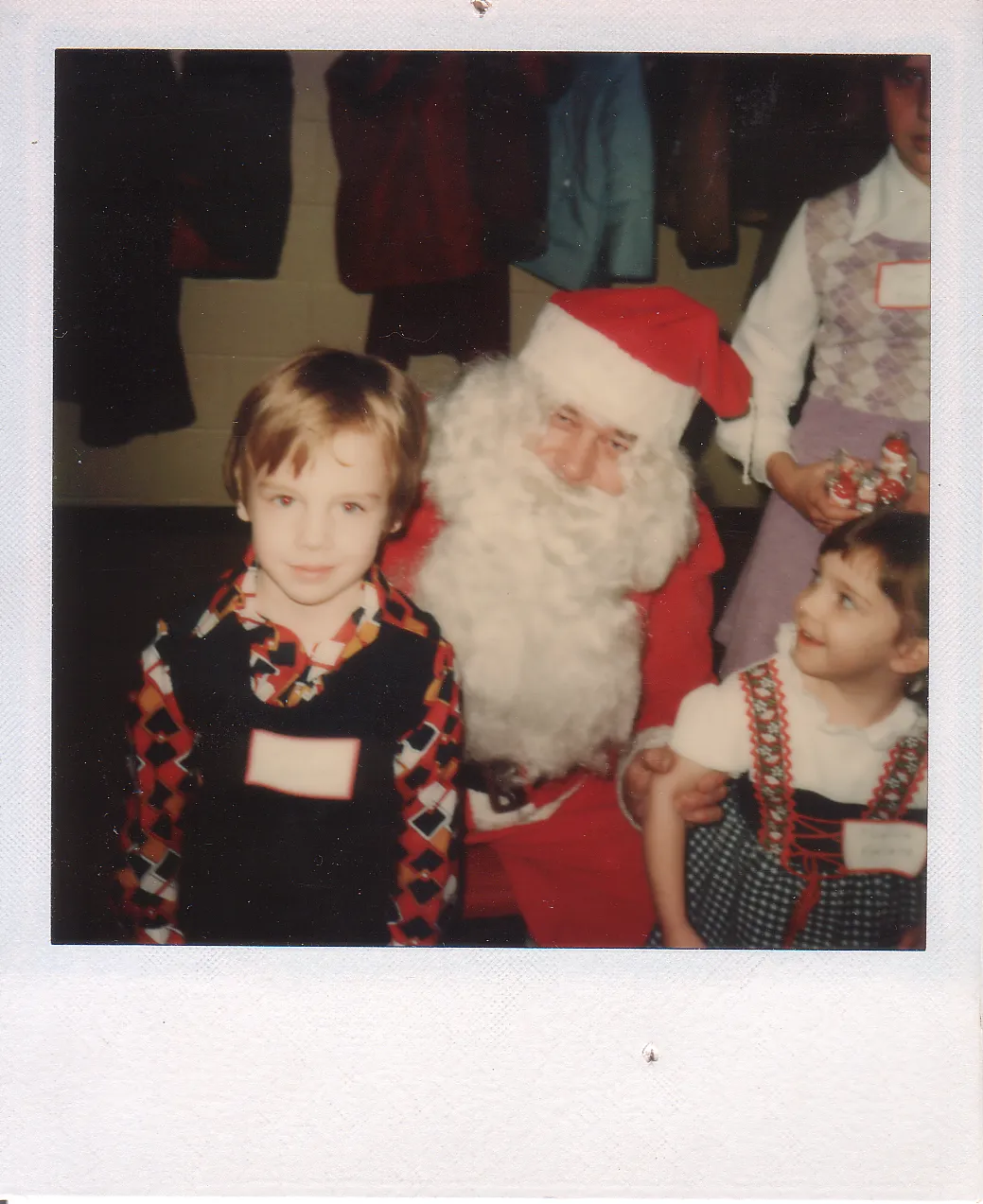
I developed film once.  A girl I dated that freshman year found some old 35mm film at her parents’ house, the aforementioned spools of film in a junk drawer for decades.  Her dorm had a darkroom, and she knew someone who took photography classes or worked for the school paper or something, a guy with the knowledge of all of the various chemicals and trays and tools and red-filtered lights.  We unrolled this ancient spool while hiding out in this little closet of a lightproof room, breathing chemical fumes and watching the pictures slowly appear.  It felt like when you make the Paaz easter eggs as a kid, when you scribble on the eggs with white crayons and then dip them in the bowls of dye and watch the inverse of your writing slowly appear in color.  We watched these pictures of Toledo fade into view, images of a lake shore now covered in condos and strip malls, but then barren.  I don’t remember how the process worked, except it seemed magical to me.

I keep thinking about buying a film camera for kicks, an old East German plastic-lensed thing that hipsters use to take pictures of skateboarders and graffiti and abandoned buildings.  I know I would never use it; I almost never use my real digital camera.  But there’s something enticing about it, like any of my other craft-related obsessions I avoid because they are money drains.  I still obsessively google old camera pages, and think about Super-8 and Polaroid film.  I know I’d have to pay more per picture, and then I’d have to scan those pictures, and I have boxes of thousands of pictures I will never scan, and I’d only end up with more blurry pictures of my cats laying on the same furniture.   But the process of it all makes it hard to shake.  I should probably start by actually scanning the old pictures I do have, before I sink any money into this.
Wonder Bread Gorging and the Ceiling Toaster Distraction

I want to mount a toaster on the ceiling.  It’s a really tall ceiling, seventeen feet or some shit like that, and there’s a thin pipe with a metal box on one end, one of those electrical boxes with four plugs on it, just staring down at me when I sit on the couch.  There’s a ceiling fan installed on the same piece of conduit, this ever-spinning thing that’s supposed to look old or antique or industrial, but it really cost something like $800 when I bought the place, which means it cost the builder 27 cents, and it’s going to cost me $14,000 by the time I make my last payment 30 years from now, except the fucking thing will be 22 years dead by then, rotting in a landfill while I make some fucker at CitiBank that much richer every month.

I stare up at this junction box, and wonder what the fuck it’s used for.  I mean, I guess if I didn’t have the ceiling fan, I’d get a big a-frame ladder and plug in one of those chain lights, the dangling ball with a bulb in it that hangs from a chain or a stay or a pull or whatever the fucking word is.  But I have this fan up there, so I can’t do that.  The cord from the light would get shredded the first time I turned on the fan, unless I creatively duct taped it and ran it down a wall.

I thought about a toaster.  I could sit on the couch and throw bread up at the ceiling.  Eventually, some of it would catch.  Then it would bake, or toast, or roast, whatever the fucking word is, and then I would put a plate under it and it would shoot a piece of toast down seventeen feet onto my plate.  I’d need to keep a catcher’s glove handy, and trap the toast so it wouldn’t ricochet away.  All of this involves a toaster with some kind of positive retention system, and careful aim, of which I have neither.

I don’t even eat toast anymore.  I used to eat it fairly often; we’d go through at least a loaf a bread a week, minus those two end pieces, “heels”, which we’d never touch, except my mom would throw the usual fit, “YOU GUYS NEED TO EAT THAT GOD DAMNED END PIECE, WHAT THE SHIT, IT’S PERFECTLY GOOD BREAD.”  Except it wasn’t.  I don’t know if I was pro-crust or anti-crust at the time, but I probably fucking hated crust when I was seven, and when you think about it, the heel of a loaf of bread is an entire side of crust.

Aside: we once visited the Wonder Bread factory, in the first grade.  It was when I lived in Edwardsburg, and I think we drove to Elkhart, although it’s possible we drove to Niles, because that’s the time of my life when I didn’t know left from right and north from south, and I assumed any drive anywhere was a drive to Elkhart, unless it was a drive to Florida or Kosovo.  Anyway, we went to the Wonder bread factory, and I now know that there are a thousand Wonder bread factories all over the country, and every different store also has its own brands, and there are regional brands, and some stores only have four kinds of bread, and others have like fifty.  But I didn’t know shit about regional brands or franchises or anything; I think I assumed that every single town had a Kroger store, and every single Kroger store contained the same damn stuff, so if you went to a Kroger in New York City, you could buy Big K cola, when of course there are no Kroger stores in Manhattan, and an Albertson’s or a Safeway or what have you is going to have different shit.  I also think I assumed that the one bakery we visited was the one place that made all of the Wonder bread in the entire country, because I had no knowledge of industrial operational scale or how hard it is to transport and ship perishables cross-country.  I just saw the big robot machines stamping out loaves of white bread, and stared in awe.

And at the end of the tour, the plant foreman or supervisor or whatever the fuck gave each of us a loaf of white bread to take home.  And I started eating that goddamn loaf of bread on the bus ride home, and it was so fresh, it tasted almost as good as eating a fresh slab of angel food cake.  (It’s also possible I was on the brink of starvation from not eating our shit school lunch.)  I must have eaten four or five slices of bread before that yellow Bluebird bus got me back to my mom’s house.  And maybe she was pissed off that I ate all of this damn bread, or maybe not, I don’t remember.  In retrospect, I think she was pissed off at everything.  Or maybe nothing.

I also remember some exercise where we all had breakfast in the first grade, like in the afternoon.  Maybe it was to teach us how important breakfast was, or it was because this was Michigan, and Kellogg’s is in Michigan, so they had an upstart cereal indoctrination program that programmed young kids into thinking they had to buy five damn boxes of cereal a week, and the same evil executives knew they’d eventually jack up the prices to seven or eight bucks a box and gradually make the boxes thinner and smaller and more full of air until eventually that $7 box of Life cereal only actually contained like twelve of those little cereal squares.  (And yes, we all believed that kid Mikey died of coke and pop rocks, or maybe it was cocaine.  We didn’t have Snopes back then.)

So everyone in the class had to vote on what cereal they wanted, and there were maybe a dozen choices, and everyone chose frankenberry or fruity pebbles or one of those cereals that’s 100% sugar and is basically a candy you’d eat at a movie theater, except you added milk and ate it with a spoon.  Nobody chose cheerios, because cheerios are basically inedible unless you added fourteen tablespoons of sugar and turned the milk into a sugary mud, which is what I had to do on a regular basis, because my mom always bought cheerios.  But on that day, I voted for frosted mini wheats.  I don’t know why.  But I think six people voted for it, including the teacher, who was some ancient woman, although ancient probably meant 24.  She seemed to agree with my choice though, saying “these are good.”

Some people had to settle for other cereals, because they lost the vote.  This one kid, I think his name was Skip, wanted some cereal we didn’t even vote on, like count chocula.  I think he did it as a write-in, and it got one vote, so no count chocula.  But on the day of the big breakfast, as the teacher poured out bowls of cereal, there was no count chocula, and Skip threw a fit, cried and bawled until tears and snot ran down his red face, screaming “I want count chocula!  I have count choclula!  I voted for count chocula!”  And the teacher tried to appease him with some boo-berry or fruity pebbles, but he wasn’t having it.  The whole thing reminded me of when someone votes for Ross Perot or some fringe libertarian.  Well, maybe not.  But I bet Skip ended up voting for Ron Paul or Ralph Nader or something.

Calculator K-Hole

smd10882

Something I sometimes do when I don’t have time to waste but still want to lock into some useless pursuit that will eat up hours is to try and find various things I owned as a kid.  The other day, I started thinking about old calculators, and went on an endless search to find some of the ones I used in high school and college.

It’s odd to even think about a time when people used calculators.  Now, when I want to figure out if an actress is 18 yet by subtracting her date of birth from the current year, I either use the calculator app on my computer or my phone.  I also have an actual four-function solar calculator I stole from my job’s office supply closet in maybe 1996, which was useful when I used to balance my checkbook, back when I actually wrote checks and couldn’t just look the crap up on my phone.  But the calculator on my iPhone is generally easier to use, and I know where it is at any given point.

I recently had a discussion with my sister about old calculators.  When we grew up, our parents had some old TI calculator, from maybe 1975, which had a hundred buttons and a flickering red LCD display and took a giant 9-volt battery.  We had no idea what TAN or SIN meant, so we’d randomly hit the buttons, trying to get the machine to print out some cool stuff.  We also had one of those Little Professor calculators, which had a face on the front of it (which always looked like an owl to me) and would print an equation like “7 + 9” and then wait for an answer, printing EEE when you entered an incorrect answer.

Calculators weren’t allowed in school for years, because when you’re supposed to be learning how to multiply single-digit numbers, a pocket calculator was as unfair as having a multiplication table in your hand, if not worse.  And then when I got to high school, this completely reversed, and some classes required you to have a calculator.  In a physics or trig class, the ability to quickly multiply and divide was a requirement, and we were suddenly allowed to use these electronic devices.

Something I never thought about, though: I was probably the first generation to have this luxury. When I was born in 1971, the first solid-state calculators were being manufactured.  In 1965, Sharp introduced the CS-10 calculator, which weighed 55 pounds and cost $2500.  By the end of the decade, they were fitting in shirt pockets (like those big Android phones “fit” in a pocket) and cost more like $500.  When I started grade school, you could probably get a good four-function calculator for $50, but minimum wage was also something like $1.60.  Prior to my generation, the only way you could “cheat” on math was maybe writing the answers down beforehand, or using a slide rule, which was probably more difficult than just memorizing stuff.  When I started high school, did they change lesson plans to accommodate the ubiquitousness of digital calculators, or did math suck that much more before then?

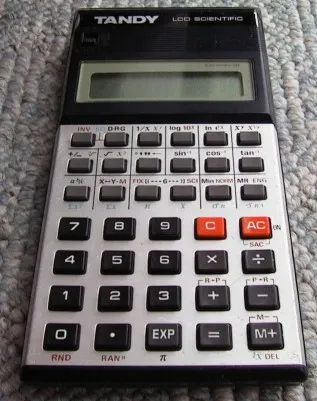
I took an electronics class in my freshman year, and we were told to buy a scientific calculator.  I don’t remember the requirements we were given, but I know it was something beyond the level of the crappy calculator you’d get for free at a Shell station with the purchase of a tank of premium.  I got a Radio Shack EC-4006, which at the time was a pretty amazing machine.  It ran on two AA batteries, and had a ten-digit display.  It could convert hex to decimal and display (some) letters on the screen, plus it handled negative numbers, trig functions, and had some amount of basic programmability.

What I remembered most about calculators back then was nobody had the same make and model.  There were dozens of different permutations of the basic calculator from TI, Casio, Radio Shack, Sharp, and lots of no-name or knockoff brands.  The cream of the crop was the HP, which were incredibly expensive and used RPN.  Someone in my class had one of these, and it looked nice, but I could never get the hang of entering all of the numbers and then entering an operator.  I also remember Ray having some high-end Radio Shack that unfolded and had the display and main keys on one side, and a set of advanced function keys in the inside lid.  Any time anybody touched it, he gave a twenty minute lecture about how you weren’t supposed to bend open the cover all the way, or it would stretch and break the microscopic conductive traces between the two halves.  (This meant that everyone would try to take his calculator when he wasn’t looking and vigorously fold open the cover as far as it would go.)  But we were all, in some sense, defined by the calculators we used and carried.  Some of us took great pride in the calculators we used, while others were ashamed of their hand-me-down crappy drugstore ripoff version that couldn’t even do exponents.

I think I kept the same calculator until my second year of college, when I replaced it with this Casio graphing calculator, the fx-7000G.  I still have that one in storage, although I don’t have batteries for it.  (It used flat watch batteries.)  That one had a 96x94 pixel screen and could be programmed in a crappy version of BASIC, although it had a whopping 422 bytes of memory.  I remember spending the Christmas of 1990 at my then-girlfriend’s parents’ place in Toledo, trying to write a chess game in BASIC on that thing, which of course was impossible, as was actually saving anything with no disk drive or printer.  My math career didn’t last much longer than that year, and I never had a good reason to carry around a graphing calculator, so I didn’t use it after that.

What’s astounding to me is how familiar the key layout of that Radio Shack calculator looks to me now.  I carried that thing around for years in my book bag, toiled away on those chicklet-style keys, and spent many a boring lecture trying to spell out 7734-derived numeric sequences that, when the display was flipped, would spell out words.  The layout of those grey and orange keys is burned into my head, and reminds me instantly of when I was hacking out story problems back in 1987.

What’s also amazing is how collectible some of the old calculators can be.  I was looking to see if I could score one of those old HP calculators on eBay, and even the most basic of the RPN scientific calculators are untouchable for under a sixty or eighty bucks.  HP, after twenty years of not releasing them, brought them back in limited editions, and you can get a brand new HP 15C for about $99.  There are scores of web sites with pictures of old eighties calculators, just like the obsolete computer museums you find online.  I don’t foresee myself doing anything more complicated than calculating interest on a loan, and it’s probably easier to use one of those online calculators for that, so I probably won’t be buying one.  But it’s neat to see that people are still into it.

Targeted Nostalgia

IMG_0079

Two unrelated things that aren’t have thrown me into a fit of nostalgia today: baseball and Target.

It was the last game of the season today, and despite the fact that the Rockies had a catastrophic time this year, I forced myself to listen, to take the pain and punishment of hearing them fail miserably. They won, despite having a skeleton crew of almost all third-string players and late-season replacements against a World Series-defending team. It got rough for an inning, and I thought it would all fall apart, but they pulled it out, and ended a dismal 2011, well below the .500 mark.

I listened to almost no games this year, because after about May, things imploded like an old Vegas casino making way for a new chrome-and-glass monstrosity. And this is the first year I didn’t see any Rockies games in person. In fact, I only went to one game all year, mostly because I can’t stand watching the Giants about as much as I can’t stand going to games at Oakland Coliseum. So there was a certain nostalgia to firing up the game audio today, the same way I feel after it’s been a long winter and I tune into that first game, hear the familiar announcers, get all of the standard commercials and station identification bumpers and little audio touchstones that bring me back to the summer I lived in Denver, pulling in the 850 KOA signal on my AM radio.

My year in Denver had two distinct eras, the first being the summer of 2007, when I worked from home for Frankov’s startup, and went to every day game I could afford at the one-block-away Coors Field. But then, almost exactly four years ago to the day, I got a job as a tech writer for this internet security firm. I didn’t know anybody in Denver, and suddenly found myself driving an hour a day to this high-tech campus, or as high-tech as the area had, at least. I was the second tech writer, and the first was totally consumed with his work, so we almost never talked. And because of the strange reporting structure, my own introverted mannerisms, and this mild disconnect between me and the work culture of the tech industry, I didn’t hang out with many people at work.

What do I mean by the work culture? I guess every place I lived had its own style or flavor of the tech industry. Seattle in the mid-90s was very Microsoft-driven; MSFT was practically printing their own money, and every company was either trying to keep up with them compensation-wise, was somehow dependent on them for their livelihoods, or was trying hard to be the exact opposite of them. New York was very Wall Street, except for that minor blip of “silicon alley” doofusism that vanished when the NASDAQ did. Silicon Valley is Silicon Valley, the gold standard of tech company behavior, no explanation needed.

But Denver had its own odd little identity. There were pockets of high tech, but it was held back by this attitude by some who thought it was still the wild damn west out there. Denver 2007 was just barely Seattle 1997 to me, and socially, it felt like one in maybe five people belonged to some outback conservative christian church with kids in a lockdown academy and a barefoot wife at home. This was the land of Promise Keepers, Ted Haggard, megachurches. I’d seen worse — I spent a dozen or so years in Indiana where the ratio was more like 5 out of 6.  But it wasn’t just the politics or religion; it was a combination of that, of age, of technical background, that made me feel like an outsider there.

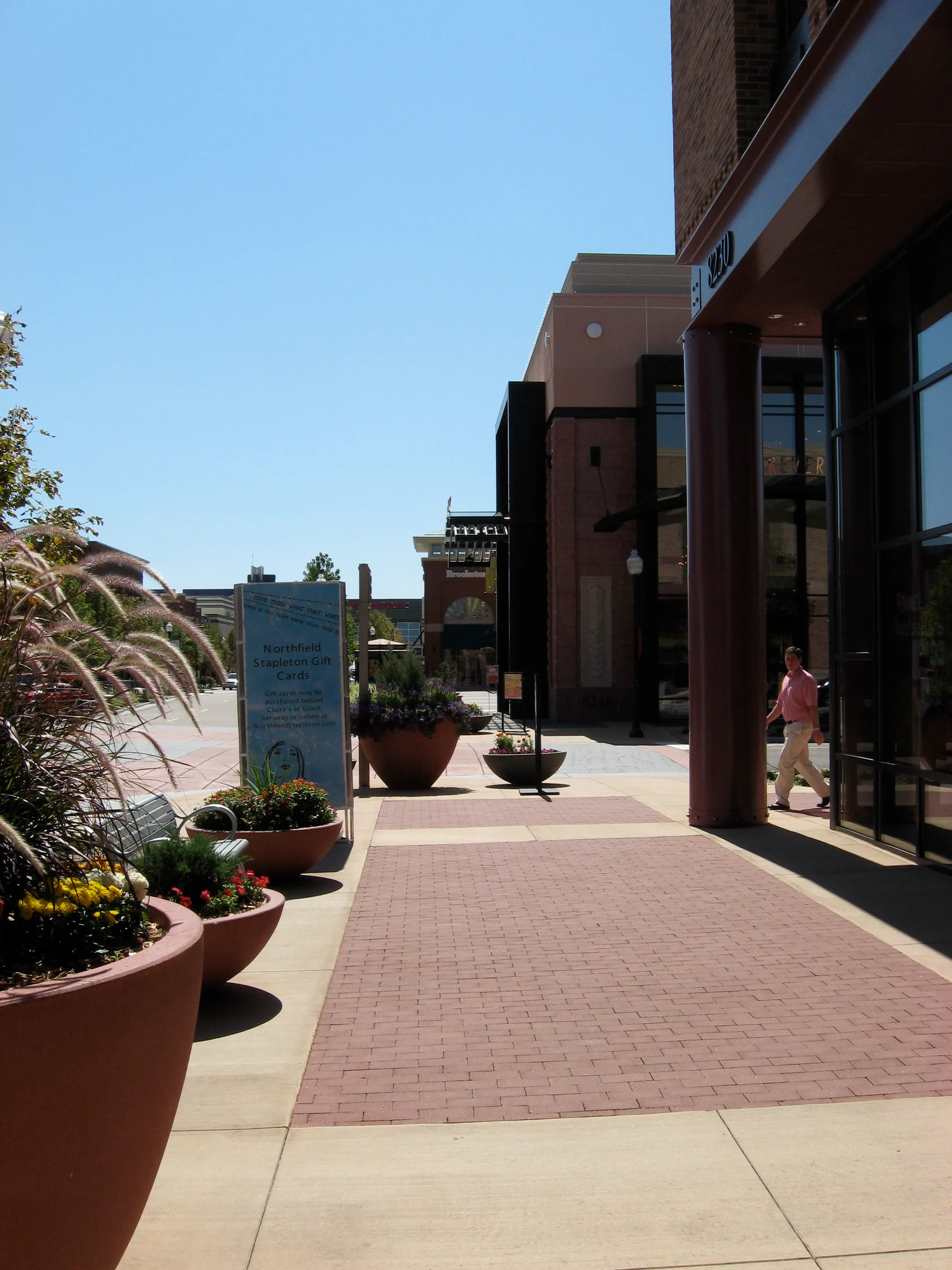
The job didn’t have a cafeteria, and we sat four people to a mega-cube with low walls, so the idea of brown-bagging didn’t appeal to me. Instead, I’d get in my brand new little car, and drive around the neighborhood until I landed at a fast food joint. The office sat on the edge of nowhere, a half hour south of Denver, an area with a few golf courses, an executive airport, and a whole lot of high mesa desert occasionally punctuated with strips of prefab big-box culture dropped on straight roads spaced apart at a mile per. Twenty years before, it was probably all barren cattle-grazing land, when an invisible SimCity player in the sky clicked and dropped all the big names down: Safeway, Chipotle, Chili’s, and Target, with a peppering of Subways and cell phone stores. From horizon to horizon, you’d see the orange-brown Colorado high plains, littered with the same exact stores I’d seen in every other place I’d lived or visited.

I’d always end up at the same two or three places, mostly Taco Bell or McDonald’s. I’d always bring a book, sit in my car, eat the same thing every day and read. The Yaris still had the new car smell and the novelty of car ownership I’d missed during my time in New York. I think I told Sarah one time about how I preferred to eat alone like this every day, and it depressed her, but I liked it. After almost a decade of being surrounded with ten thousand people in the same city block as me, it felt so nice to be absolutely alone.

It would take me five minutes to drive to Taco Bell, and ten to eat my Mexican pizza and nachos. That meant I’d had another 40 minutes to kill, until I’d need to tech write my way through the back half of the day. I’d inevitably end up at the big Super Target on Lincoln, this massive version of the familiar red department store, a two-story version with a double-decker parking lot and a grocery store welded to the side. I’d sit on the top deck of that garage, and you could see this great expanse of nothingness to the south, rolling hills and scrub brush and mountains in the distance, the ribbon of I-25 stretching from Lone Tree and vanishing on the horizon of Castle Rock. I’d go to Target for everything and nothing, to look at the twenty-dollar polo shirts and the seventeen different kinds of car air freshener, and end up with a case of Coke and some new cat toy we didn’t need.

But I mostly went to watch, to see who ends up at a Target in the middle of the day. And the answer, at this Target, was apparently nobody, because I’d only see a small trickle of stay-at-home moms, all younger than me with a gaggle of kids in tow. This wasn’t like the LA I’d know a year later, where in the middle of the day, you’d see all kinds of people and wonder who in the hell actually worked in a town like that. This reminded me of the solitude of working a day shift at the mall back in Indiana, where you’d only run into geriatrics and pediatrics. It had this certain feel to it, a feeling that I shouldn’t be there, the same feeling I had when I skipped a day of high school and saw a world I didn’t belong in.

And the visits to Target tied into that first era. Sarah worked a lot at her job, working nights, weekends, long days. And we didn’t have cable, didn’t watch TV, didn’t do much of anything outside of work except try to regroup to get ready for more work. And it seems like we spent an inordinate amount of time at the Stapleton Target, undergoing consumer therapy by experiencing the big box lanes of SKUs in a store that we didn’t get to experience in Manhattan. We’d end up with hundreds of dollars of damage in those white and red bullseyed bags, Method, Archer, Market Pantry. I’d have the next PlayStation game that would consume my off-hours in my little office, and whatever little cellophane-wrapped junk food I’d consume at my desk while listening to those games and not writing my next book. But those trips to the world outside the womb of my home office were strikingly themed by the uniformity of the Target experience. And when the first era quickly ended and the second era made me miss it, those trips to another branch of the same outlet let me briefly revisit my lost summer.

Now, four years, later, twelve hundred miles away, and 5280 feet lower, everything is different, except a daytime run to Target. They just built a new one, about a mile from my house. Now that I work from home, I’ll end up there after lunch, to pick up a case of (now diet) Coke or a box of Claritin. And it’s a different shape, a different layout, but the same experience, the same types of daytime shoppers, the same red-shirted staff and aisles of things I don’t need but will probably buy.

This nostalgia is a painful and potent drug for me, something it’s very easy for me to get lost in.  I can waste far too much time exploring the connections and bridges of a present day to the past, grasping at these raw feelings I try to replay as a time machine to a distant era or pleasant memory.  I stumble across these things, like the smell of a faded air freshener or an old receipt to a lunch from 2002 stuffed in the back of a book, and it can trigger this rush of thoughts back to that time.  And I spent 1999 wishing it was 1992, and 2008 wishing it was 1989, and now bits of 2011 wishing I could open a window to 2007 and take a quick look again.  I wonder if I’m the only person who does this, if I’ve accidentally segmented my life into these predefined periods by moving and changing jobs, or if it would be the same if I still lived on the same street in the same town where I grew up.  It’s hard to be present in now, except that I know at some point in the future, I’ll be looking back and remembering 2011 again.  And maybe the bridge will be a consumer store, or maybe it will be a kind of food or a song or the sound of an appliance or the smell and feel of an autumn breeze at the tail-end of a long summer.   But I know that it’ll happen, at some point.

And now, I’ve gotta stop doing this, and go immerse myself in the now of trying to write my next damn book.  Stay tuned.

Strange Nostalgia for Lost Electronics

I get a lot of shit for the “museum of obsolete technology” I have in our storage locker right now, the electronic toys I’m paying $30 a month to not see.  But I’ve pared down almost all of that inventory now, and it’s down to a single C-64 and 1541 drive, and a Sony Magic Link PDA that I bought on eBay and will probably never be able to connect to the internet.  I’ve given up on collecting, but I’ve still got that collector’s gene, and if I had unlimited space and unlimited budget, I’d probably spend all day and night on eBay, trying to buy back every piece of electronics I ever owned and every gadget I ever coveted, until eventually the hosts of Hoarders showed up at the house to film a two-part special on me.

I found this site a while back called Wishbook Web, and it’s extremely dangerous for me.  It’s scans of a bunch of department store catalogs, like Sears and Monkey Wards, which is great, because those things have largely been landfilled and there’s no archive of them anymore.  When I was a little kid, I would spend the entire year memorizing these catalogs, poring over the toy sections until the pages fell apart.  I guess now kids can just get on the web and go to Amazon and look this stuff up, but I would scrutinize these things like a NASA engineer trying to figure out why the latest Mars lander crashed.  Me and my sisters used to fight over who got to read each catalog, and instead of wish lists, my parents tried to institute some kind of system for us to denote what stuff we wanted that year.  It involved one of us putting boxes next to things, and the other annotating with circles, or maybe it was stars.  Anyway, I’d just mark the entire Lego section and any single thing that said Star Wars in it.  And of course, all new toys had come out before the actual holiday, and we’d have to revisit our greedy little lists based on the commercials shown during the Saturday morning cartoons.

So at least two of these catalogs came out during the prime of my childhood, and I can still tell you almost every damn thing on every page.  Going back to these again is like going back to a home town after twenty years and still being able to find your way around.  It’s also interesting to see how much the times have changed as far as copy goes, because I could write better stuff in my sleep.  Anyway, when I first found this URL, I went through every page, trying to find the stuff I used to own, and the things I really wanted but never got.

Here’s a good example of this: the stereo I had as a kid.

SearsWishbook-1983-P414-e1300558798316

When I was little, I had one of those crap record players with the removable lid and the plastic handle on the side, the kind with the speaker built into it.  My parents had a “real” stereo record player with separate speakers, but I had to listen to my read-along books and Disney records on this orange cardboard piece of shit.  When I was in maybe the 6th grade, I asked for a “real” stereo for Christmas, and I got item #2 from the picture above, taken from a Sears catalog.  And at the time, this was about as technologically advanced as the computers from Minority Report.  It had a record player AND a tape player AND a radio AND an 8-track.  Not only could I record songs off of the radio, but I could make tapes of albums.  And the speakers were separate, the kind of thing you plugged in and sat on shelves in the corners of the room.

The 8-track was a bit of an oddity; this was like the last death rattle of the failed format.  This stereo had a front-loader, and it had the program button, which jogged the tape heads sequentially across each of the four tracks of an album.  But it didn’t even have a fast-forward or rewind button.  Our family had no 8-track tapes, so we went to the Sears at Pierre Moran mall, and found them liquidating the remainder of their 8-tracks at some ridiculous price, like maybe four for a dollar.  These were all “cut-outs”, items with a groove cut in one side because they were returned or whatever, and they were pretty picked over.  I think I ended up getting a Steve Martin comedy album, a Ringo Starr solo album (I had no idea who the Beatles were, except in the most conceptual of terms), and a Jefferson Airplane album.  Much later, my mom’s second husband had a collection of a few 8-tracks, with the only notable ones being the first Cheech and Chong album, and Jethro Tull’s Thick as a Brick.  (Albums with only two side-long tracks didn’t work as well for a format where an LP was essentially divided into four; I’m not sure how they handled that.)

I had almost no budget for music, so I spent a lot of time trying to record songs off the radio, which was a maddening process.  I’d listen to U-93, the local top-40 radio station, and hope some song I liked would get played.  There were a whole slew of problems that would occur: the tape would not be queued to the very end and I’d erase some previously recorded treasure; the idiot DJ would babble on about being the 93rd caller for a set of free tickets to a monster truck rally; I wouldn’t recognize the song until 30 seconds in, and then only record half of it; the song would fade into some other stupid song I wouldn’t want, and I’d have a pristine copy of this Journey song I really wanted, except the last ten seconds would be fused to the beginning of a Toni Basil song.  (Yes, that song, which I won’t even mention by name or it will be stuck in your head forever.)  It would take me maybe a month or two of diligent listening to fill one side of a C-90 with useful tunes.

The big shortfall to this new hardware was that it only had one tape deck.  Most of the new stereos coming out had two decks: a play-only unit, and a player-recorder.  And my unit was a “closed” system, without an AUX input or any sort of input jacks.  Most of my friends would buy their albums on cassette tape, and I had no way of making copies of them.  My best hopes were either to have a friend that had a dual-tape deck who would be willing to make a dub for me, or find someone who bought everything on vinyl and would let me borrow their album.  Another problem was that I had no way of recording from the TV.  I watched an insane amount of MTV back then, and I would have given anything to capture some of their new music on cassette for repeat listens, especially since they played much cooler stuff than the behind-the-times station in my redneck Indiana town.  I remember trying to record a Genesis concert off of MTV by holding my sister’s little jambox up to the TV cabinet, which worked about as well as taking a picture of the night stars by dragging a photocopier outside and making a copy with the lid open.  (My sister later tried recording some song on MTV - that “don’t put another dime in the jukebox” song, and every time it would come on, I would yell at the dog and she’d start barking, totally screwing up the recording.)

It’s always interesting to me how we have such a tactile nostalgia for old technology like this.  Like I’ve got an old cell phone sitting on my shelf, a Windows Mobile phone I used for maybe six months before I wised up and got an iPhone.  And I hated that phone at the time, but it was my daily driver, and I used it constantly, for email, google maps, web browsing (or what approximated web browsing in a crippled version of pocket IE).  And I pick it up now, and its heft, and the feel of its keys, and the glint of its display remind me so much of that period in late 2008 and early 2009 when this thing was permanently attached to my hip.  And I get some of that when I look at pictures of old technology like this.  I remember the smell that stereo had, the new electronics smell of components heating up for the first time.  I remember the snap of the silver knobs going across their detents as I cycled through the inputs.  I remember playing with that tuning knob endlessly, trying to get a clear signal on WAOR so I could record Dr. Demento on Sunday nights.  I haven’t seen this stereo in at least 25 years, but I think if I found one at a garage sale, it would instantly transport me back to 1983 again.

Anyway, that’s my story.  Now I must go waste the rest of my writing time finding this stereo elsewhere on the web.  I’ve just found there are a ton of eBay sellers with demo videos of their wares on youtube, with many similar stereos.  Not sure which is worse, the waste of money and space hoarding this stuff, or the waste of time finding it.