The Wrath of Kon

Dispatches, thoughts, and miscellanea from writer Jon Konrath

My New Book, Sleep Has No Master, Is Now Available
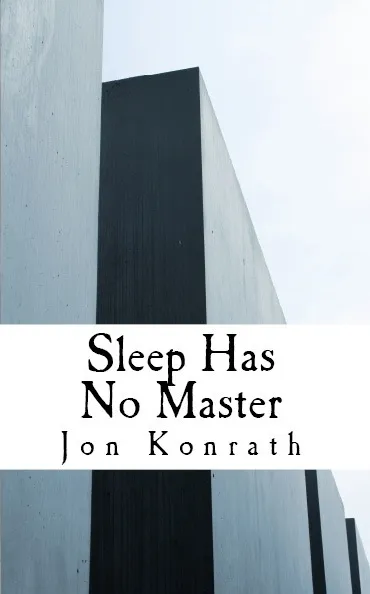
cover-front

I’m proud to announce my new book, Sleep Has No Master, is now available!

It’s on Amazon for the Kindle here. The print version will be available shortly - it’s currently in the proof process.  The book’s site is here.

The book’s a novel-in-stories of sorts.  It’s 27 pieces, flash fiction and short story, with each piece standing on its own.  It resembles The Earworm Inception in that sense, and I’d consider this the third book in an unofficial trilogy.  (The “flash” trilogy, for those of you not keeping track, would start with Fistful of Pizza, then The Earworm Inception, and then this.)

This time, though, I wanted a different theme that tied together all of the pieces, and it happens to be dreams.  The narrator’s got severe insomnia issues, and gets to the point where he can’t tell where his surreal, twisted dreams end and his mundane life in this nihilistic world starts.  Reading all of the stories in order is like drifting through a series of dreams and nightmares.  Or, just drop in at any point and start reading, and you can enjoy each piece separately.

Please check the book out - you can get a preview of it from the Amazon site, and Amazon Prime users with Kindles can check out the book for free.  (Does anyone actually do that?  Well, you can.)  More word in a bit when the print version comes out.  Thanks!
Dumping Word

I hate Microsoft Word.  I don’t know how much of my life I’ve wasted on Word, although I’m certain I will be on my deathbed and wish I had all of the years back I spent cursing at Clippy and the Ribbon and every idiot who ever handed me a book or story entirely formatted by hand, every single paragraph still sporting the Normal style.  Whenever I’m working on a project and the phrase “let’s just use Word”, it must be like when people working at a gym hear a person say “fuck it, let’s just order Pizza Hut and eat a gallon of ice cream, because it’s easier than a treadmill.”

I’ve never written fiction in Word; until I switched to Scrivener, I did all of my work in emacs.  But because most print-on-demand houses and lit magazines work with .doc and RTF files, I’m usually forced to go through a final production step where I drag my completed work to Word and style and format it there, sometimes while doing battle with someone else’s templates.  Some places will take a PDF, and for many of my books, I’ve used FrameMaker for the layout.  It’s what I use at my day job, and I know it well.  But it requires me to use Windows, which happens to be written by the same company that makes Word, and that’s a zero-sum game for me.  I might be able to producecompiled Scrivener PDFs that meet all of my requirements, but right now, it’s not there yet.  I’m sure if I took a weekend or two to screw around with it, I could get it to work, but as the book production part of the book cycle happens last, it’s usually at the point where I have no patience for this and just want to get it over with.

I’m in the middle of finishing a book, and was going to use Word to lay it out for CreateSpace, like I did the last few times.  Three things stopped me.  First, my copy of Word 2008 for the Mac is slightly flaky, and it’s just “off”.  Second, I wanted to go buy a copy of Word 2011, and of course, there’s a huge maze of torment involved with this.  I am not even sure if Microsoft officially sells Word 2011 alone; I found one price on the web that costs more than buying all of Office 2011.  Also, they don’t have a 64-bit version, and the current Amazon listing is hovering at a star and a half out of five, with a ton of reviews saying “don’t buy this version!”  So I’m not willing to throw down a few hundred dollars on something that will cripple my machine.  Lastly, I started up Word the other day, and it got into this update death spiral, where it would download half a gig of updates, sit for an hour installing them, and then restart and say more updates are available.  That’s about the time I said fuck this, I’m ditching Word for good.

I have a copy of Apple’s Pages on my machine, but I’ve never really used it for anything.  I bought it for $20, thinking I’d eventually make a zine with it or something, but never got around to it.  On a whim, I had Scrivener export an RTF and then opened it in Pages, expecting the formatting to take a day or two.  I finished the whole thing in a couple of hours.

So here’s a list of why I like Pages more than Word:

  1. It’s much faster on my machine.  I have a 2.66 GHz i7 with 8 GB of RAM, and Word just clunks along.  It’s not swamping the CPU or flooding the memory; it’s just clunky.  Sometimes you click on something and there’s a delay.  It’s not a major delay, maybe a few dozen milliseconds, but it adds up.  It often feels like I’m working across a shared screen on VNC to another computer across a slow wireless connection.  It’s not unusable, but it’s maddening.  I know the MS apologists will say this is something screwy with my machine, but this is the top-of-the-line in mid-2010 MacBook, and right out of the box, with nothing else running, it was like this.  Pages runs fine, and performance is snappy.  No problems.
  2. Page sizing in Word for the Mac is fundamentally broken.  When you go to File > Page Setup and select a paper size, there’s a chance it might work, a chance you’ll only change the size in one section, and a chance it will do nothing.  You can sometimes get it to stick by doing a File > Page Setup > Word Options, then selecting Layout, then clicking Page Setup.  Sometimes that doesn’t work.  Sometimes you have to try it an even number of times, and then an odd number of times. In Pages, I just go to File > Page Setup and select a size.  You can also see the page size in the inspector in Pages.  I don’t know how you can see the document size in Word, other than turning on rulers and counting.  (You can go to File > Page Setup, but if that doesn’t work, it could tell you the wrong size.)
  3. The headers and footers in Pages are fairly intuitive.  You see the boxes for the headers/footers, and you enter your stuff in them.  Word has that weird “they’re greyed out, but if you click on them, but not too fast and not too slow, I’ll open some bizarro editing field for you” that has always been clunky for me.  Sometimes I can do it in two clicks, but sometimes it takes seven.  And when every click is just a few milliseconds off, it adds up.
  4. In Word, working on a document with different even and odd pages is a crapshoot.  Like when you put in a section break to start the document on an odd page and there’s going to be a blank even page, Word won’t show the blank page in Print Layout.  It will be printed (or not printed, depending on how you look at things) but it won’t show that in Print Layout, which is cute.  Pages, just works.
  5. Also, that blank even page in Word will still have your header/footer on it, which is wrong in a printed book.  In Pages, not there.  And as per my last point, you can see that it’s not there, which is nice.
  6. In Pages, all of your paragraph, character, and list styles are in a slide-out drawer that’s easy to find, easy to open, and easy to keep open next to your document.  In Word, there’s a Toolbox window, which can appear anywhere and is easily lost. Also, all three types of styles are just “styles”, and you have to know that a style with a paragraph mark is for a paragraph.  Plus all three are lumped together in a single list which is sorted by odd criteria such as when you last used the style, or if it’s in the document or in a template, meaning you almost always have to move to a different window and lose focus in your document, then scroll with some clunky non-Apple scroll mechanism to find your style.  Repeat that times 9000 and you will go mad.  Also, that toolbox window will vanish if focus goes to another application, so good luck trying to do some tech support involving looking at your browser and the toolbox window.  (To be fair, Pages has an inspector dialog box with similar behavior.  The difference is, they don’t put vital controls like the style chooser in that window.)
  7. When you import a document into Word that has manual formatting, it first appears that the entire document is in the Normal paragraph style.  It isn’t until you pull up the Toolbox that you can see each paragraph is styled with “Normal + Comic Sans 20 + First Line: 0.5” + Space After: 8pt” or whatever.  This is one of the 19 reasons why people completely fuck up formatting in Word.  In Pages, you can see in the Style drawer that each paragraph is marked as “Free Form”, meaning you need to either define some styles or assign existing ones to your paragraphs if you want to avoid chaos.
  8. When you have a paragraph that’s been assigned a style and you make a change by hand to that paragraph (like, say, change the font), in Pages, a little red triangle appears next to the style in the Style drawer, telling you that you need to either redefine the style or otherwise get your shit straight.  In Word, good luck.  It doesn’t show up in the Toolbar’s style chooser; maybe if you see that the font is changed there, you’ll spot it.  If you open the Toolbox, you’ll see “Style + whatever”, but because the box is only about 20 characters wide, you probably won’t see entirely what changes have happened.
  9. If you’re inserting photos or whatever into documents, Pages lets you simply open a little browser of your iPhoto library, where you can easily preview pictures.  Word has this abortion of a “scrapbook” feature that you have to populate with your stuff manually.  Oh, and it’s in that ever-vanishing bastard of a Toolbox, and you’ll need to click back and forth between that and your list of styles.
  10. There is a version of Pages for both the iPhone and iPad.  I can bring this book to the iPad, and it works well.  I could even write an entire book on the iPad using my bluetooth keyboard, if I really wanted to.

I’m sure there are things Word can do that Pages cannot.  I don’t know what any of them are off the top of my head, though.  An often-desired, often-missing feature is track changes/commenting, which is supported in Pages.  It does not support VB scripting, but neither does Word on the Mac.  (Both support AppleScript, though.)  I think the big difference is that Pages was essentially born in 2005, and slowly added crucial features, meaning it’s much leaner.  Word has a twisted history, always trying to capture feature parity with Windows versions, always failing, and always trying to support backward compatibility.

The biggest difference, other than the efficiency of the codebase, is that Pages is a hybrid word processing/DTP program.  It’s like a simplified version of Pagemaker, where instead of a flowing document like Word, you can choose from templates and select which page layouts you want to use, and then flow in your text.  If you’re doing something like a brochure or flyer or catalog, this is infinitely easier than trying to fake this in Word.  Microsoft has half-assed some DTP features in Word, but it’s all duct tape, and you’d never want to do something like a magazine in it.  Pages is nowhere near as powerful as InDesign, but it’s got enough templates and it’s easy enough that doing that zine or homeowner association newsletter is going to be pretty simple.

One word of warning - if you use Pages (or any other Mac software) and you export to PDF and your document had graphics, it’s going to create a 72dpi PDF that won’t work for press.  There’s a way to add a free add-on so it will save in PDF/X-3 format.  I don’t have the link in front of me, but if anyone’s running into that problem, drop a line or leave a comment and I’ll dig it up.

So, that’s done.  Now maybe I will screw around with that zine project I originally thought about.

Pulp Fiction

IMG_3926

I watched Pulp Fiction for the millionth time last night. We’re trying to get through that AFI 100 films thing, starting with all of the ones I have on DVD at the house. I haven’t seen Pulp Fiction in maybe ten years though, so it was interesting to see it with some distance. I think the big thing I realized is how much of a big chunk of my past has to do with that movie, and how much it influenced my writing.

When Pulp Fiction came out in the fall of 1994, I was living with Simms, and that movie wrapped around his brain in a big way.  I don’t remember if I was with him the first time I saw it, but it absolutely obsessed him.  I think a big part of it was the soundtrack, which was all of this old surf music, a big thing with Simms at that point.  He had this band, a rotating cast of characters, called The Surfing Richards, and they were essentially this ever-changing group of music theory PhDs obsessed with Frank Zappa.  Their music was a mashup of Dick Dale, Devo, and Zappa.  So the Tarantino soundtrack really clicked with him, and our house was filled with it for months.

Simms became this prophet of Tarantino.  We’d be record shopping or walking around Bloomington, and he’d run into someone at the store he hadn’t seen in a semester or two, and ask them if they’d seen the movie.  If not, he’d immediately drag all of us out to the mall to see the next showing.  I think I saw the movie at least a dozen times because of this, and he really got off on seeing people’s reaction to the film.  We pretty much memorized the film, and it got worse when I got a tape of it.  Back then, there was usually a year between a theatrical release and the home video release.  But I found some guy on usenet that made a pirated copy; he worked in a theater, and set up a camcorder in the booth to record the whole thing, with the audio jacked into the booth sound.  I think I traded him something for it, and got a VHS copy months before it was available in stores.  This meant we watched the movie constantly, even running it in the background while doing other stuff. So in the back of my head, I’ve still got the film memorized.

This was the first time I’d seen the film since I lived in LA.  I remember when I first visited Los Angeles in 1997, the Tarantino-verse very much molded my preconceptions of the city, and the feel that I had for the city reminded me of what he caught in his films.  When I lived in LA in 2008, I worked from home and spent most of my time in Playa Del Rey, which is not really LA, but I’d have to wander around Hollywood or Culver City or El Segundo on various errands and doctor’s appointments.  And I also remember the week or so I spent driving all over the city trying to find us an apartment, going to all of these little places during the day to meet with realtors that never showed up for their appointments.

There’s one scene that really captured a specific feeling for me, and that was when Butch went back to his apartment to get his watch.  The scene is very quiet, nothing but ambient noise of the North Hollywood neighborhood, as he cuts through an apartment complex and then a vacant lot on the way to his apartment building.  That eerie silence, aside from the Mexican families cooking or babysitting kids in the background, and the sight of those old Bukowski-looking walled compound apartments captures a certain LA that I always felt when I was driving through side streets or walking from my car to various doctor’s appointments or whatever else I was doing back then.  The film itself is not an LA film in many ways; he captures bits and pieces in the background, but a crime film could be filmed almost anywhere.  What he does is use those background pieces to fill out the film and give it a vibrancy that transcends what a typical TV crime drama usually is.

I also found that there was a lot of dialogue that I picked up on that bled into some of my early writing.  When I was hacking out Summer Rain, there were so many exchanges and bumpers and pieces of wording that came out of Pulp Fiction without even thinking about it.  Tarantino’s dialogue can be corny, and tries too hard to be hip, and I think that rubbed off on me a bit.  One of the advantages of spending so many years rewriting that book is that I had many opportunities to kill my darlings, and beat the hell out of the dialogue until it shook any of those references.  But while I was watching the movie, little lines would jump out at me, things that I know got morphed into my character’s words at some point, and then cut.

Tarantino also relies heavily on cross-references through his work, little things like Fruit Brute cereal or Jackrabbit Slim’s (which also appears in an almost inaudible radio commercial in the background during the aforementioned scene with Butch.)  Simms, being a Zappa nut, was really big on conceptual continuity, which I assumed, being a literary idiot with about six credits of literary theory that I barely passed at that point, was some kind of common term, although now I find out that it’s something only used in the context of Zappa.  But Tarantino has all of these little recurring things that appear in all of his films, like Red Apple cigarettes.  And I never thought about it in the context of his influence, but I constantly do the same thing.

I think the biggest influence of Pulp Fiction to me was the idea of a non-linear narrative.  I spent a lot of time in my first couple of years of writing trying to figure out plot, trying to think of how to twist together a huge, linear story, and Tarantino’s films were one of the first things that really sent me sideways on that, and challenged me to think in other terms.  Rumored to Exist started at the end of 1995 because of a perfect storm of a few things swimming in my mind, all of which were consumed over a long and boring holiday break: the book Catch-22, and the movies Naked Lunch, Pulp Fiction, and Slacker. Put those in a blender, give me too much free time without an internet connection, and that’s what happens.

I’m almost done with my next book, and I’ve got a todo list a million things long.  But now I really want to watch Jackie Brown.  Let’s see which one wins.

Editing and Allergies

It’s the middle of allergy season, or one of California’s several allergy seasons, at least, and I’ve been wheezing away this week.  On a normal day, I only dose up on non-drowsy stuff in the morning, but this week, it’s involved two doses in the day and a heavy bit of Benadryl to make it through the night.  And that means I spend half of the day recovering from its hangover, and the other half wishing it was time to swallow those pink tablets and nod out.  I like a lot of things about California, but the pollen count is not one of them.

I’ve been hacking away at this next book for a bit now, and it’s almost done, which is probably why I’m wasting time on here instead of editing.  The book has a title now, which is always the biggest pain in the ass for me, and it’s down to the final nits and copyedits, so I hope to start laying it out soon.  But I hate hate hate editing.  I mean, I like getting the bugs out, but I’ve read this book probably ten times since we left for Europe, and I’ve got at least a couple more to go.  And it’s like picking any random word (say, banana) and saying it over and over and over until you don’t even know what you’re saying anymore and it sounds completely alien.

The editing process is the most depressing part of the writing cycle for me, too.  I’m not creating anymore, and I feel like any ideas I get have to go on the back burner if I’m going to get this damn thing done.  When I’m in this deep on a final draft, it’s really easy for me to go see a movie and then rush home thinking “I want to write a space opera with zombies!” and put a 95% done book in the closet and start brain-dumping and outlining.  So things close in on themselves, and I want nothing more than to get this damn thing in a final PDF and upload it and be done. It’s also depressing because instead of reading great new books by other authors, I’m reading the same book over and over and over.  I can’t wait until I can read something that isn’t this book, especially because I have this huge pile of new stuff to read that’s just staring at me.

Okay, I should get back to this.  More news on this once I get a cover figured out and a web site and description and all of that good stuff.

2008 Interview at Hipster Book Club

[This is a reconstruction of an interview I did for Hipster Book Club in 2008.  The original site is gone, and I couldn’t find it in the wayback machine, but I have the questions and answers from my email archive.  So the intro and whatnot is missing, but you get the idea…]

You started off doing zines, right? Back in the early 90s, the heyday of zine culture… What made you do that and how did you get the word out about your first zine, the death metal zine Xenocide?

My friend Ray Miller did a zine called Metal Curse, covering thrash and death metal, and starting in 1990, I wrote reviews and later a regular column for him. We also spent a lot of time planning, scheming, and answering mail. When I moved away to school, I still worked for Ray, but decided to start something myself, and did the first issue of my own zine in early 1992. I also DJed a death metal show at a shithole public access station in 1992, and got a lot of interviews and contacts that way.

When I was doing Xenocide, there were a lot of people into death metal who read usenet news on the internet, and it was easy for me to keep in touch with them for free. (This was when long distance still cost an insane amount, and way before cell phones.) There was also this “underground” of death metal fans that traded demo tapes and dubs of obscure vinyl and photocopied zines in the mail, and everyone traded everyone’s address. Whenever you mailed anything to another person, you would put a handful of these flyers into the envelope. Each flyer was a fraction of a photocopied page, with an ad for a zine or band or record, scrawled out in that sick drippy-blood font with a picture of a demon on it. The good news was that these things ended up all over, and you’d get mail from Norway or Japan or Alaska because of it. The bad news was that this was a trade-based economy, and everyone wanted free crap, so you never made any money, and often got stuck with some sub-par stuff. And this happened outside of death metal too, because zines were getting very big at that time. Thanks to Factsheet Five and Zine World, I got a lot of mail from non-metal people who were just into zines.

One interesting thing came out of Xenocide much later. This kid used from California used to send me record reviews and artwork, and we used to trade mails until I stopped the zine, then I never heard from him again… until a decade later. It turns out this kid was Adam Gadahn, aka Azzam the American, up-and-coming Taliban member that ended up on the FBI’s most wanted list. When that story broke, I ended up getting calls from the FBI and pretty much every major western news organization out there. I never thought reviewing Cannibal Corpse tapes would get me in the New Yorker, but it did.

At its biggest, what was your print run on Xenocide? And how were you making the zine? I have not so fond memories of using pagemaker on my PS-70, going to the copy shop, having folding and stapling parties…

The last issue, #5, had two runs of 100 issues, plus a few dozen more. I was photocopying at Kinko’s, and would pop in and run off a half-dozen copies if I was out and needed a few. It was photocopied on 11x17, or I would have printed a hundred thousand more in the campus computer labs.

The first three issues were actually more of an email newsletter or ezine, which in 1992, absolutely nobody understood, so I had to make printouts and photocopy those for the computer-impaired bands and labels. #4 was done in the Mac version of WordPerfect, and #5 was PageMaker. I never got to the volume where I offset printed, although the fifth issue had a “color” cover (printed on solid red paper). Every issue was (and still is) available as an ezine, which was way ahead of the curve.

Is it true that you started producing zines to get chicks and free CDs?

There were only like three women in the entire death metal community, so it was mostly for the music, and zines. No CDs though - this was still the era of the cassette tape.

At some point you dropped Xenocide and started doing the more literary-focused Air in the Paragraph Line. What happened?

After doing #5 in 1993, I ran out of money and ran out of steam, and realized I really needed to get my act together and graduate from college. Also, death metal was fragmenting and falling apart quickly. Major labels snapped up bands because they wanted the next Metallica, and when that failed, they moved on and tried to find the next Nirvana. I fretted over doing a sixth issue, but eventually let it go.

Air in the Paragraph Line was something I started in 1996. I missed publishing a zine, and coincidentally found a photocopier at my job that pretty much nobody knew existed, so I had to do something. I was trying to write fiction at the time, and I pieced together bits of email and book reviews and travel writing, and tacked on excerpts of current projects, like a personal newsletter sort of thing. Eventually, it became a place for me to publish other people’s writing, and after a long hiatus and a move across the country, it became a shiny printed book, as opposed to a photocopier zine.

You were the first person I knew who had an online journal. When I first met you in 99, you’d already been doing one for two years. I think you may have once explained to me how you wrote a script or an interface, but I was still completely baffled about how you updated without hand-coding everything each time you updated. Now, of course, even my cat blogs. What was it about the way the web worked that made you want to start keeping an online journal? How do you think it influenced your writing? Were there other people keeping online journals then? How do you feel about the blog explosion?

I don’t remember the exact moment I decided to keep a journal online, except I’d been doing it on paper for years, and thought it would be a good way to crack out some writing every day at lunch. I think the biggest influence for me was that it forced me to practice every day, even if I was writing dumb shit about how the grocery store was out of frozen corn dogs again.

Back when I started in ‘97, there were a few people keeping online journals, and some web rings (remember those?) of people who wrote in journals. The half-dozen I read in the mid-nineties were all very spectacular, and either had solid writing or strange adventures, or both. I remember one by this Canadian guy who was riding his bike across China from Europe and then down into Vietnam. He would write offline almost every night, and then when he found an internet cafe to upload, you’d get this burst of updates, truly incredible tales.

I think I’m done bitching about the quality of new blogs versus old stuff, because there’s good stuff out there now. I guess what pisses me off about blogs are that people think the entire format of the blog was invented in like 2003, which is a lot like saying that all forms of acting were invented when RCA sold the first color TV. Most people didn’t know the internet even existed before 1997. It makes me wonder if, in the 1920s, there were people bitching about cars saying, “I was driving an Arrol ten years before that Henry Ford prick even came out with his Model T!”

You were also the first “real” writer I knew who went the self-publishing route, beginning with your first book, the memoir of spending the summer in your college town of Bloomington, Indiana, Summer Rain. What influenced your decision to self-publish? And how was that experience for you?

Summer Rain was a very typical first novel, and I mean that in a bad way. I love the book to death, but it was completely unmarketable, and I was certain that if I spent the $47 to mail the 800-page manuscript to an agent or publisher, the only possible response would be “christ, not another one of these.” And in the old days, a writer would finish a book like that, throw it in the fireplace, and start their first “real” work. But I felt that some of the people who were in the book or knew me in that timeframe might dig reading it, and print-on-demand was perfect for that. I would make a minimal investment (actually I think I didn’t pay anything up front) and people could buy it if they wanted it, but if not, no big deal. It was cheaper than photocopying a thousand of them, and I wouldn’t have them rotting in my attic for the next fifty years.

I published at first with iUniverse, and the experience was okay, and then gradually tapered off. They completely fucked up the front cover, and they used a really padded layout that made the book 200 pages too long. Fulfillment and orders and all of that were fine, though. They eventually became too involved in hand-holding and offering expensive packages with services I had no use for, so I later switched to Lulu, which was much more bare-bones and ala carte. The big thing with PoD is to check your expectations. The PoD publishers won’t market your book, or get you a book tour, or put your book in Borders, or get you on Oprah. They will print the books, and keep your from having to warehouse in your kitchen, but don’t expect miracles.

Then you self-published your second book, Rumored to Exist. Rumored is a very different book from Summer Rain. Why did you decide to self-publish that one, and not try to go the traditional route?

Rumored was a tough sell, based on its content. It was non-linear, experimental, and mentioned sex with sheep and vomitophilia probably too many times for a traditional publisher. I thought it was destined to be, at best, a cult classic, and decided if a publisher would be disgusted with it, that publisher should be me. It also took me about seven years to write it, and I think less than 5% of the first draft was in the final draft. I’d get sick of it, chop off parts, write more, and keep that cycle going. I almost needed to find someone to physically take the book away from me and publish it.

How do you get the word out about self-published books? And how many copies do you bring to readings and stuff? Do you keep a stash around to hand sell? What about bookstores?

I’ve found online networking to be the best way to tell people about books. One of the ideas of having different writers in AITPL is to have each writer tell their own fanbase that they are in the book, so those people buy it and maybe get turned onto one of the other writers. Aside from email, there are the usual suspects: myspace, facebook, usenet (when it was still around), and I’ve been doing more cross-pollination with other small press publishers and journals. Sending out print review copies has been completely worthless. I would love to get reviews from PDF copies, but reviewers want print copies.

We haven’t done a lot of readings, but I usually have some amount of books at home to hand sell, maybe a dozen or two of each title, and will unload those at a reading at a discount. Stores are a hard nut to crack for PoD, because they typically want a big discount up front, and the ability to do returns on the back-end, and both of those are cost-prohibitive with PoD books, at least going through a third-party publisher like Lulu. Back in the zine days, there was a huge list of independent book stores and newsstands that would do consignment or work with individuals instead of distributors. Pretty much every address on that list is now a parking lot or a Starbucks, and the remaining few are hanging on by a thread and aren’t going to pay you in advance for copies of your shitty poetry book about how you can’t get laid. I almost accidentally got books in a Borders store, but I knew the manager. I wish I knew more managers, but until then, my only hope is to find a real distributor.

Now you’re not self-publishing—you have your own publishing company called Paragraph Line, and are publishing the lit journal Air in the Paragraph Line and have just come out with John Sheppard’s book Tales of the Peacetime Army. How different is it publishing someone else’s work? Are you doing any publicity? I saw the book trailer and I loved it, but I haven’t read the book yet.

It’s a lot different working on someone else’s stuff. I can trash entire chapters of my own work or mess around with the layout, without giving it a second thought. But when I work on someone else’s pride and joy, I’m always worried that I will change something that I think is little, but that’s really a major deal. Also, a big thing that John and I talked about as we started working on his book is that this publishing company should not “own” manuscripts like a traditional publisher, and then have a heavy-handed editor mangle them to conform better or sell more or whatever else. It’s better to offer ideas on edits, and constructive criticism, and to have the writer polish things up.

We did an initial round of publicity and sent out copies of Tales earlier this year, and John did the two trailers. Everyone loves the trailer idea (which we stole from Luca Dipierro) but the conversion rate on reviews was fairly pathetic. I was hoping to figure out some campaign to spam a bunch of military sites, since they have pretty devout readerships, but I’m not sure all of them would appreciate Tales. We did put it online recently though, so it’s available free for people who want to read it.

I bet a lot of the great literary writers would have a hard time getting published in today’s marketplace. Would Pynchon or Wallace get a book deal now? Or Carver, Sukenick, Gaddis? Don’t you think that the next Mark Leyner is probably self-publishing?

I think any writer that’s a strong member of the academic-industrial complex is going to get a crack at a book on a university press, and if its sales fall into line with whatever mainstream publishers want, they’ll get the bump to a bigger deal. Leyner is an example of that: he kicked around in the Fiction Collective and did well. Right around then, that 90s pomo rock star trend started, and all of a sudden Random House is shilling him out to Details readers, and he’s in a full-page spread in Vanity Fair, lifting weights. (Maybe that didn’t actually happen.) If 1990 would have been the year of the transgendered drug addict literature secretly written by housewives trend, Leyner would never have published anything outside of magazine work and short story collections.

And yeah, then maybe he would be self-published. My big thing is I never wanted to follow the trends and read Writer’s Digest and say “oh, gay detective stories set in 17th century Ireland is going to be big next fall, I better write one of those.” I want to write what I want to write, and publish it when it’s done. And I want to read stuff produced the same way.

Rumored to Exist, the lit mag AITPL, and Tales of the Peacetime Army all have a brash grungy punk feel to them, but without typos. It seems like most of you were raised during the Reagan-era in flyover states and you all have a sense of cynical detachment that also has a thread of hopefulness. There’s a definite Clerks/Slacker feel, but less goofy, more sharply ironic, but still yearning for something more. No one is ready to give up. Do you consider the people you chose for AITPL and Paragraph Line Books to be part of a movement of any sort?

I think one of the biggest difficulties in doing what I do is that none of this writing does fall into a category or movement. If this was 1991, I could say “slacker lit” and people would instantly know what it is. That’s an obstacle, and it’s something I tried to address by having this “greatest hits” sort of collection in AITPL. You don’t need to know what genre Dan Crocker or Dege Legg write; if they are in the zine, you know they are similar in some way, or at least might be interesting to you.

There are essentially two kinds of writing I like. One is the more modernist, outsider, or “slacker” writing, like a younger Bukowski, or the kind of essay stuff that Aaron from Cometbus zine usually lays down. The other would be the more experimental, Leyner-esque stuff. If I were smart, I’d create two imprints and publish stuff in each of them, but I’m too lazy to handle that.

What are your new projects? And where do you go from here?

The thirteenth issue of Air in the Paragraph Line is getting scraped together right now, and will be a themed issue about bad luck. I’ve also recently switched to using Ingram’s Lightning Source to print and fulfill books, which will require a little more work and cash up front, but will be about half as cheap, and enable me to drop list prices a bit, send out more review copies, and eat the cost of returned copies a little easier.