The description of my next book
Are you ready to hear the description of my next book?
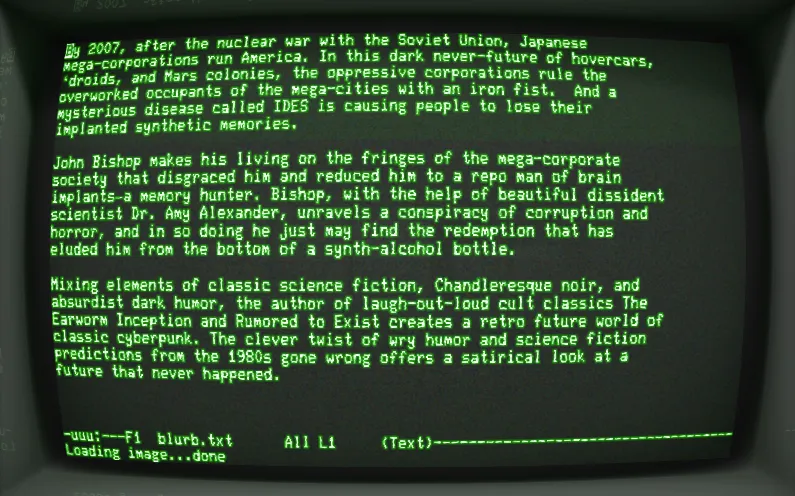
Well, let me fire up the VT-240 terminal, and pull it up in emacs for you:
Are you ready to hear the description of my next book?
Well, let me fire up the VT-240 terminal, and pull it up in emacs for you:
I am in the midst of production work for my next book, and this is the time I always learn new things about Scrivener. Here are some random bits of info. If this makes no sense to you, don’t worry; I’m mostly documenting this so that a year from now, I’ll google it again and find it here. BTW all of this is in the latest version on the Mac.
Need to have a monospace font code style that shows up in your final Kindle output?
<code> tag. Like this
Scrivener probably put a page break instead of a section break between a couple of chapters, and now the Pages “use previous section” heading/footing setting behaves wrong. Change the page breaks to section breaks.
Also, if you don’t use section breaks between chapters and your chapters start on even pages of your book, stop doing that.
That’s because it’s horrible. You might want to check your spelling and grammar in another program.
Hope these help someone, or at least help me in six months when I do this again.

Okay. It’s about time to give you some more updates on the next book, because the release is imminent. The book is being edited right now, then it gets designed, goes through production, and all of that pain-in-the-ass stuff. And then you buy it. Right?
Okay, so here are the latest updates. I’m putting them in a bulleted list, so hang on:
This book is a huge change for me, and I am really proud of it. I hope you will like it. I’ll tell you more when we get closer, but you absolutely need to sign up for the mailing list and go check out the facebook page for more news.
I’ve been bitching and moaning about how Adobe decided to move all of their software to the cloud, and make people pay per month forever to use their stuff. I’ve also been bitching about how Apple decided to kill off Aperture, which happened about ten minutes after I imported and tagged 50,000 pictures, and would probably require me to spend six months of my life migrating to Lightroom.
Well, fuck it, I decided to give up and get a Creative Cloud membership, while Adobe is trying to court Aperture users and is quoting a lowball price. I joined with the photographer’s membership, which is ten bucks a month, and includes Lightroom, Photoshop, and 2GB of cloud storage. There’s some other junk that I don’t need or understand (Typekit? Bridge?) and there’s a ton of “try this!” links everywhere, to get you to upgrade to a full-blown membership. But I don’t need Illustrator or InDesign this second, so I’m fine.
I have not used Photoshop in a long time. I’ve been using Pixelmator for a while, to do book covers and whatnot. (Here is my latest.) And I make endless stupid things like the above drawing I re-captioned. But I haven’t used Photoshop in forever. It’s interesting to see how much it changed.
Back in 1991 when I returned to Bloomington after a year at IUSB commuter college hell, they had a shit-ton of new computer gear, because they’d recently tacked on a technology fee to tuition and were in a mad rush to spend it. The Fine Arts college had this cluster of brand spanking new top-of-the-line Macs, which I think were the IIfx at that time. Each one had a gigantic color monitor, probably 20 inches, but about a yard thick, plus a second paperwhite portrait screen, along with a scanner and a Jazz drive, which used those insanely expensive removable hard drives that could hold something like 100 Megs, which was pure science fiction at the time. Anyway, they had Photoshop 1.0. I recently found a color printout me and my buddy Ray did when he visited once, an Ann Geddes overhead shot of nine babies in a nursery, but we’d horribly mangled them all: one beheaded, another eating that head, one with a swastika on its forehead, one spitting blood, etc.
That was my first exposure to Photoshop, and the new version makes the 1.0 version look more primitive than MS Paint. I am absolutely amazed by all of the retouching and healing tools, and how you can do stuff like move parts of an image and it will automatically fix the background. The $10 a month is well-spent on getting more book covers done. (And of course, photoshopping dicks into the mouths of various Facebook friends.)
Speaking of books, I am almost done with the next one. I’m in the last sprint of edits, and I have a roughed-in cover, and I’m maybe a week from entering production drudgery. This book is so amazingly different from anything I’m written, I’m not sure what people will think. It’s absurdist, but it has an incredibly plotted story, like Michael Bay plotted. I think it will really show readers that I have the ability to do more than just stories about taking a dump at the county fair. But, I’m anxious to get it done, so I can get back to writing stories about taking a dump at the county fair. Anyway, stay tuned.
I wanted to write something about Amazon Unlimited, and about the huge pissing contest between Amazon and Hachette. But I really do not have the energy to care. It’s billionaires fighting billionaires, and every move Amazon makes to make you think they are on your side or they’re saving you money is really one they’re making to increase their monopoly. Amazon Unlimited is nothing but a race to the bottom, creating the equivalent of a thousand-channel cable TV plan that will cause readers to read five pages of everything and enjoy nothing. And Hachette charges too much for ebooks, but Amazon is only bringing that to your attention because they want more of your money.
It’s all bullshit. I’m still selling on Amazon, but eventually, their monopoly will squeeze out small authors, and I’m waiting for the day when they start charging KDP writers insane prices to list their books, or drop their royalties, or start an inane approval process for self-pubbed books “to increase quality to customers” (i.e. make it impossible for anyone they don’t like to publish weird stuff.) It will happen. But I’ll still be here. If I have to photocopy my books at the local Kinko’s and sell them out of the trunk of my car, I will. If I have to memorize them and go town to town reciting them like one of those poor fuckers with The Iliad, fine. If I was here to make millions, I would have started selling penny stocks back in 1997.
OK, back to editing. What’s up with you?
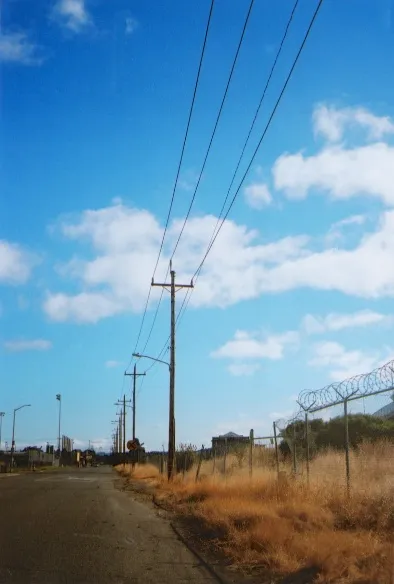
I’m still thinking about film a lot, maybe too much. I’ve ended up buying two 35mm cameras on eBay this week, a Canonet QL17 rangefinder and an Olympus Trip 35 point/shoot. I ran the first roll of film through the Trip (see attached picture) and I love it. I need to take more pictures, figure out a good workflow for developing, scanning, and posting things, and determine what I’m really doing with photography. Mostly, I need to learn, and I feel like there’s a deep rabbit-hole of things out there to master. And the whole thing has me falling down a deep nostalgia hole, thinking about previous experiences with analog film.
A couple of years ago, I bought a photo book by the parents of Christopher McCandless, the guy that died in Alaska, described in the book and movie Into the Wild. His parents self-pubbed Back Into the Wild, which contained his journals, letters, and snapshots. The book had a strong impact on me, not because I particularly admire his story and plight, but because it was a strong link to a nostalgic period of the recent past.
All of the guy’s photos were taken with cheap 35mm cameras, the point-and-shoot variety now largely forgotten. The book also included copies of post cards and envelopes, with old stamps and cancellation/postmarkings that also reminded me of the early 90s. I did so much mail for the zine around that time, and the look of those old 22-cent stamps and the cancellations, with their little public-service messages (“end breast cancer!” or whatever) draw me back instantly. I still have old paper mail in storage, pieces in their well-creased envelopes, and it all reminds me of that period so much.
But the film, the cameras - they mentioned a few of the makes and models, and I googled these, wanting to see what gear he brought along on his adventures. In the 80s and 90s, there were so many junk cameras, so many different brands. it was like that with any electronics, too. Today, if you wanted a CD player, you’d have a choice of maybe three or four brands (Sony, Panasonic, Samsung, and some no-name Chinese thing) and maybe three or four models for each brand, and each one would be very similar to the other, aside from a differentiating feature like Surround Sound or digital output. But back in the 80s, if you wanted, say, a VCR, there were dozens of brands, all of these different major Asian players shelling out radically different versions, competing with a dozen different American firms, with factories in San Jose or Dallas, plus all of the no-name Korean brands imported and given an American label, like the JC Penney brands or Sears versions. And they were all so completely different, not identical in any way.
I remember I used to go through a lot of jam box tape players, because for a long period, I didn’t have a good car stereo, and would instead go to a pawn shop and buy a $50 jam box and then wire a 12-volt adapter in the car and use that until it got stolen a few months later. And at the pawn shop, that $50 would buy so many different types, with removable speakers, various space-age plastic chrome finishes and grilles, fabric-covered woofers, and mystical buttons that offered hi-fi settings or switched on LCD power meters that measured nothing from a scientific standpoint, but would light and rise and fall with the volume of the music. And they all had different EQ types and tone knobs or “boost” switches and different tape counters and ejection mechanisms, and the feel of the mechanical buttons was always different.
Cameras were the same way. There were the high-end SLRs, which were all too expensive for my blood, but I had a friend or two, usually working for the yearbook club, who would learn how to work a good Canon or Nikon, and maybe borrow one from the school. SLRs all looked similar, but had weird differences, and there were the usual Pepsi/Coke religious wars about which one was best, although it was a ten-front war back then, not just Nikon/Canon. There were also the low-end things, the Kodak 110s and disc cameras, and cheap Polaroid one-shots with no controls at all, just a dust cover, a trigger button, and a place to plug in the flip-flash with the exploding bulbs that would cost a fortune and smell of burning plastic after they ignited. My parents liked these cameras, the ones with no settings, the Brownie or the 126, with nothing but maybe a film advance lever to manually crank through the roll after each shot. And there were also a wide variety of cameras between the two, with some advanced features, some things missing, and some fully automated.
When I was a kid, I won one of the cheap-o cameras at the company picnic for my dad’s job. It was a Kodak 110 kit, a little rectangle with the lid that pivoted open and worked as a sort of handle, hanging off to one side. It was as thick as one of the plastic film cartridges, and had a little eyehole to look through, to frame shots. This model had a “zoom” lens, a glass piece that slid back and forth on a track, so you could snap it into place and increase the range by a small factor. Everything else was manual, with no focus, no aperture setting, just a film advance lever and a shutter button. It would take me a year to take a dozen shots, carefully framing them, snapping a picture, and then not knowing for months if it turned out or not. As a ten-year-old, I never had money for a flash, and would shoot everything in daylight with fingers crossed. When done, the exposed film got thrown in a junk drawer, with pens and checkbooks and broken calculators and instruction books to appliances. If we were lucky, a third of the film I shot as a kid was developed. It always looked bad, with faded colors, grainy prints, and half of the shots underexposed or dark. Everyone had red eyes, and all of the macro photography I attempted with Star Wars models never looked anything like the films. It was disappointing, and not a hobby for me to get into, so I didn’t.
In high school, on a lark, I bought another 110 camera. This was a small “spy” camera, a tiny piece of plastic that clipped over a 110 cartridge, leaving most of the film case exposed on the outside, not much more than a lens and advancing mechanism that clipped over the film cart. I don’t remember if it had a flash, but I do remember it had no viewfinder, just a small plastic rectangle that clicked up on the top. I bought this in October of my senior year, right before visiting Canada for the first time. I took a few rolls of shots with this, and paid to develop them myself, since the $3.45/hour wages at my job afforded me this luxury. The quality wasn’t much better, but there was more immediacy, and I took a lot of pictures of things. I knew I’d leave town in a year, and want to remember old friends and my old car and my old house, so I captured it all to film. And that Canada trip yielded a few good shots, too. The film quality was still bad, lots of reds to the color mix, and the plastic-lens camera was total garbage. But the small size, the novelty, and the budget to actually develop photos made it a decent experience.
In my freshman year of college, I had a few bucks of christmas money to blow on the after-holiday sales, and bought a 35mm camera at an Osco drug store. It was some semi-known name, like Vivitar, but was a low-end, all-manual affair, similar to the ones McCandless used. This was my first foray into a middle ground that existed, with the pro film format (35mm) but the cheap and easy to use camera that offered no settings or adjustments. It did have a cheap built-in flash, and it maybe had an aperture setting (a little lever with an icon of the sun and another of a cloud). And it may have had a similar focus (picture of a mountain, picture of a person’s head.) But it had no zoom, no focus ring, no tripod mount, none of that. It also had a manual film advance, and you had to load the film by hand, stretching the first flap out of the film canister across a set of sprockets before closing the back door.
This camera only lasted a few weeks, before the film spool broke, the cheap plastic splitting apart, in an unrepairable way that instantly let in the light, making the $25 gadget useless. But I got two rolls of film through it; one while I was still home, and one at school. The school roll had some great shots on it. I walked a loop of the campus during the day, and the January sun and blue sky made for some great shots of the old limestone buildings, a perfect capture of the 1990 glory of Indiana University. The home set of snaps had a couple of good pictures of Tom Sample at New Year’s, and the only picture of first college girlfriend Angie I still have. (A horrible picture of her in my mom’s car.)
I did not have another camera until the middle of 1993, when I was home for the summer I don’t know what compelled me to dip back into photography, but I think it was from working on the zine, the idea that I would take pictures at shows. I spent close to $100 on another 35mm camera, once again one of those fixed-focus things. This one was closer to a DSLR in its general shape, and it did have a motorized zoom lens, along with a better flash, and a motorized auto-load, the kind where you would put in a can of film and it would quickly suck up the end after you closed the back door. And then at the end of the roll, it would suck the film back into the canister for you, instead of spending minutes cranking on a small dial or lever manually.
I got really into the idea of becoming “a photographer” even though it was a cheap and cheesy all-plastic camera. I’d buy expensive film, like 1600 ISO Fujifilm or Kodachrome, and keep it in the fridge and get it developed at the one-hour place, always asking for matte prints. I went to a lot of shows that summer for the zine, getting in for free by talking to record labels, and I’d always ask for a “photo pass” to try and get better access. I never got any good pictures at shows, just blurry, poorly-lit snaps of Glen Benton or Cannibal Corpse, completely unusable stuff. I took some decent snapshots though, artsy pictures of Goshen College, some pictures of friends, along with a roll or two of the Milwaukee Metalfest, although none that were actually of the bands, just the booths and the drive there and back. I also got the last few shots of the Mitchell House before I moved out, the only pictures I have of that place.
The camera went into “occasional mode” after that, only getting pulled out on a whim here and there, for parties or trips. I wish I would have taken far more photos back then, many more shots of people and places, images capturing the Bloomington of 1994 and 1995. I never knew the importance of these things, that I’d want to write about them, and I got a few good shots, but not enough. I did a little more later, but I’ve taken more digital pictures in the last three months than the grand total of every frame I ran through that cheap 35mm.
That camera followed me to Seattle, chronicling that voyage. I didn’t travel much when I was living in Jet City, but it made a few trips down to California. And then after K and I broke up, there was a period where I wanted to be a “photographer” again and went around taking pictures of cemeteries and airplanes and lakes. It also went with on my long trip from Seattle to New York in 99. Once I got to NY, maybe a roll or two went through it, shots of my apartment, or maybe Times Square. I’d switched to video for the most part by then, which is bad because the quality is so low, and the camcorder was bulky enough, I didn’t shoot as much. By the time I started to take vacations, like my first trips to Vegas, it was 2000, and I had my first digital camera, so the film went away forever.
Anyway, the McCandless book reminded me of this, because he took these shots of the desert, the wide open spaces of Alaska, the plains states, and everywhere else off the beaten path of the early 1990s America. And his pictures, the feel of film going through the low-end optics of a cheap import camera, I could feel the places he visited, much more so than if he’d just snapped some Instagram pics with his iPhone. That particular type of shot, the lenses or the grain of the film or whatever else, just screamed 1990, the same way my dad’s old slide film 135 shots from when he was in the service are easily IDed as being from the late 1960s. They just had a certain feel to them.
I made that journey across the desert in 1999, driving through New Mexico and Arizona and Nevada and Texas, on some of the same roads as him, and pulled over many times to walk across the flats and look at dry riverbeds and take a few shots with my cheap camera. And his pictures remind me of my pictures. And my pictures remind me of standing there alone, feeling the nature and lack of mankind around me, in a way that a hundred snaps from a camphone would not. That era is so close to us now, only a few years ago, but it seems like a lifetime away. And when I pick up a film print I took from them, or look at the copies of his, it makes me jump from my life back to that one.
Anyway, enough rambling. More film will be shot. And I have a huge project I dread, involving scans and restoration of these giant tupperware storage bins of negatives and prints, before they all rot into rancid chemicals and fade into nothing. I should get on that.