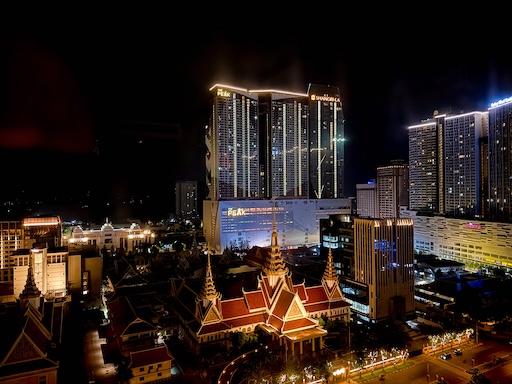
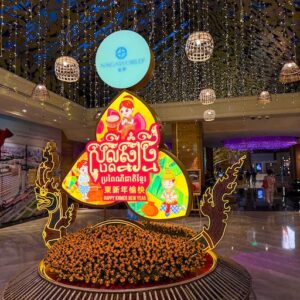
 It’s Friday night. I’m in Phnom Peng, Cambodia, on the verge of the Khmer New Year. I’m 7851 miles from home. I’m in a Chinese casino that looks like if I ordered a 1990s Mirage casino from Temu. I’m the only non-Chinese person on the gaming floor. I’m playing a Squid Game slot machine that’s yelling at me in Korean.
Where am I? What the hell is going on?
Trip Prep
Before I booked a trip to Cambodia, I basically had three data points in my head: the Dead Kennedys song, Apocalypse Now, and a marginal amount of knowledge on Operation Menu, the US bombing campaign during the Vietnam War. And I guess there’s the Spalding Gray monologue, although it’s been so long since I’ve seen it, I couldn’t tell you a single line. I went to Vietnam last year, and I vaguely assumed Cambodia would be similar, since it’s next door. Two people from work visited and said they loved it. So it went on the list, and when it came time to find my next trip and I started running the numbers on Expedia, it quickly became the front-runner in terms of price, weather, distance, and general interest. I booked a week-long trip, then started my research. (I should probably do this the other way around.)
It’s not easy to research tourism in Cambodia, at least compared to Vietnam or Thailand. I had to order a travel book from the internet, and there’s no Duolingo for the Khmer language. It’s virtually impossible to buy Cambodian Riel from money exchange services. The Rough Guide for Cambodia is borderline useless; you’re probably better off reading Wikipedia and the State department’s web site. Things are changing quickly there, and most stuff online is already out of date. Finding tourist information is possible, but it’s not as straightforward as, say, visiting Hawaii. I figured a good place to start was reading history, and that went south pretty quickly.
I read two books before I went. One was Amit Gilboa’s Off the Rails in Phenom Penh which is a slightly sensationalist take on being a young expat in Cambodia in the 1990s. It’s a Hunter Thompson-style romp that talks about guns, drugs, political turmoil, and prostitutes. It was a fun read, and wasn’t the usual about the Khmer Rouge or Angkor Wat, but it didn’t instill much confidence in my trip-making abilities. I assumed the information was horribly out-of-date and it wouldn’t be the same when I visited.
I also read Joel Brinkley’s book Cambodia’s Curse which is a more journalistic take on the country’s history. Brinkley first came to Cambodia in 1979 to report on the fall of Pol Pot, and then returned in the 2000s to see the country again. This is a well-written book, but gets heavy right out of the gate. One of the quotes that really got me was former US Ambassador Joseph Mussomeli, who said “Be careful, because Cambodia is the most dangerous place you will ever visit. You will fall in love with it , and eventually it will break your heart.” Brinkley’s book did give me a good background, but also further emphasized the “what the hell am I doing?” of this trip.
Two other bits of research took place in the weeks leading up to the journey. First, I watched the 1984 movie The Killing Fields, which is probably not what you want to do right before visiting Cambodia. Then I watched both Anthony Bourdain shows about the country. The first one was almost juvenile, as were most of his early episodes, and he spent his trip running around a market trying to buy a machete so he could slice open a durian. The second episode he did, many years later, he admitted he was a bit of a dumb-ass the first time around, and spent more time talking to people about their food and history. That balanced things out a bit more, but it didn’t make me want to run to a night market and eat a bunch of fried bugs or organ meats.
Aside from the usual questions of what I’d do or what pictures I’d take, I had a lot of serious questions about how I’d deal with things. I mean, this is a country where if you look up what power plugs they use, the reference pages basically say “well, whatever” and I found there are basically three different standards, depending on what they were using the week they built your hotel. What would I do about cell service? Internet? Food? Water? Money? Was this safe at all? Should I cancel the whole thing and go to Nebraska for the week? I booked a few Hail Mary attempts at activities and tours, started obsessing about camera gear, and did my best attempt to prepare for the week.
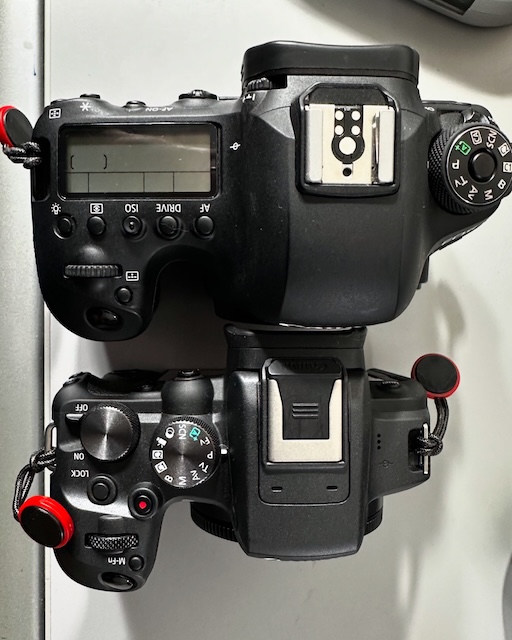
BTW, the final camera load-out:
- Canon R10 mirrorless APS-C body
- Canon RF-S 18-150mm f/3.5-6.3
- Canon EF 50mm 1:1.8 II and EF-RF adapter (I didn’t use this at all)
- DJI Osmo Pocket 3
- Olympus XA-2 35mm film camera
- A dozen rolls of Kodak Gold 200 and Pro Image 100 in a lead bag (I probably only shot four)
- iPhone 16 Pro
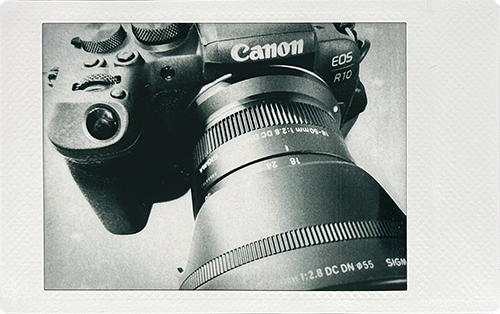
Because of weight restrictions, I couldn’t bring any of my big L lenses or a film SLR body. The 18-150 was new for this trip. I really need a wide RF lens like the Sigma 10-18mm f/2.8, but no time. (I did buy one when I got back.) This was all last-second, because I didn’t start packing and weighing until the day before I left.
Saturday/No Sunday/Monday
My flight out didn’t leave SFO until 11:00 Saturday night, which was a weird one. It meant I had all day to do the usual Saturday stuff, finish packing, have dinner, then head out to the airport. I didn’t know if Cathay Pacific would enforce their 15-pound carry-on bag limit, so I packed light, with just my camera and lenses, a laptop, and a change of clothes in a small duffel. I also checked a suitcase filled to the limit with clothes, a water purifier, two pounds of trail mix, a case of protein shots, and a box of power bars.
The long haul was a 15-hour jump to Hong Kong. I had a bulkhead exit row seat, but absolutely could not get comfortable enough to sleep, even with the late departure time and a mix of NyQuil and Sonata. I think I got almost two hours of very restless sleep. Food was horrible, but that may have been because I requested low-fat meals, which meant they gave me like only the chicken breast and none of the various sides or additions. We landed just after 5:00 AM on Monday morning; I missed Sunday entirely. The Hong Kong airport looks like a high-end mall, but all the stores were closed at that hour. I remembered from last time there was a 24-hour lounge, so I found it, got a shower reservation, and sat around for an hour waiting, avoiding the food and drinking down as many Coke Zeroes as I could. (Sorry, but fish curry soup at six in the morning is not my speed.) The shower was magical, the best HK$40 I could spend after spending 15 hours fermenting in an economy seat. I called my sister – it was still Sunday there – then headed for the gate to my flight to Phnom Penh.
I met a freelance film journalist and archivist from Oakland while waiting for the plane and we talked a bit before boarding. I ran into him again after the quick two-hour flight and the various security and customs stuff. (Cambodia requires a tourist visa, which I applied for before leaving. It also requires an e-entry application you have to do 48 hours in advance, which I didn’t know about, but I got it sorted at the airport.) My cell phone was acting weird, as was his, and I asked if he wanted to split a cab or something to get into the city, since I wouldn’t be able to use the Grab app to get a car. He said he had a colleague coming to meet him, and offered me a ride, which was awesome. (I got the cell phone to work after futzing with my roaming settings and forcing a carrier, rather than randomly assigning one.) We met up with his coworker in his truck, and headed in to town.
* * *
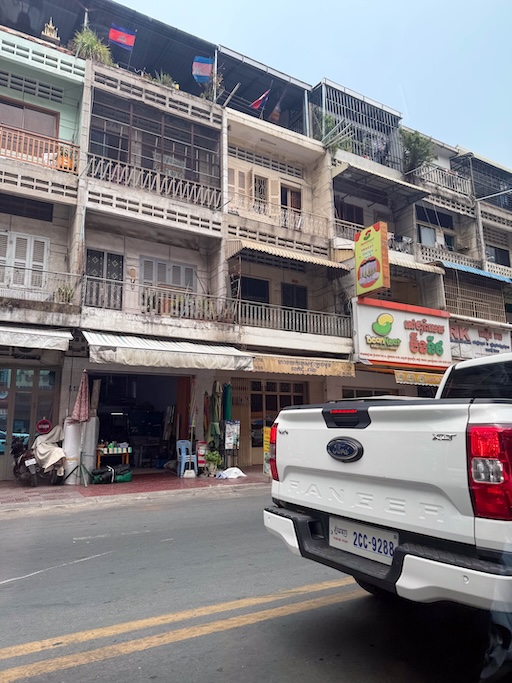
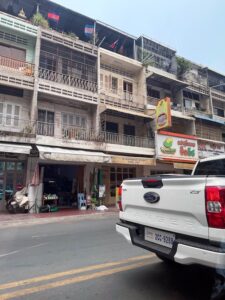 First impression, as we drove the 45 minutes or so to my hotel: Cambodia looked to me like a mix of Bangalore and Ho Chi Minh City, with brief hints of Singapore. It had the bustle and chaos and randomness of urban India, but the flavor and feel of Vietnam. Streets were packed with cars and tuk-tuks and mopeds and bicycles, in a completely jumbled stream. In some ways, it looked like Saigon must have maybe five years after the war. But a block later, there would be some massive Singaporean steel and glass high-rise that looked like it was constructed fifteen minutes ago. There were also many “ghost towers” where China or Korea built the floors of a 20-story office building and then paused before putting in the walls or windows.
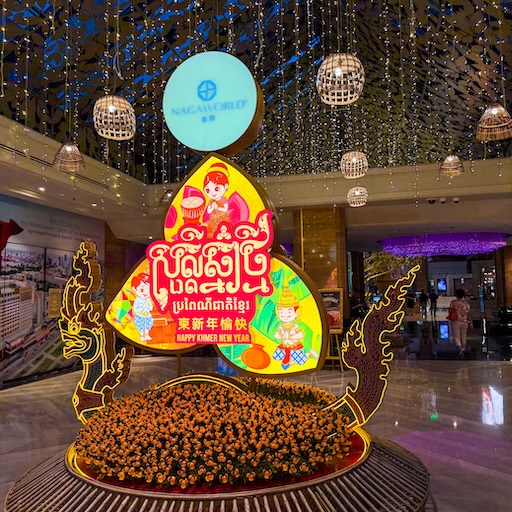
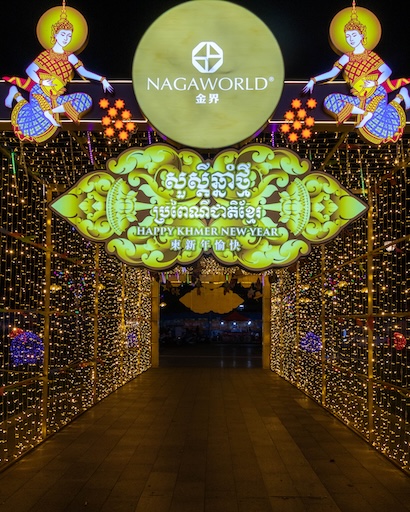
Amex Travel gave me a deal on a weird one: a four-star casino hotel called NAGA WORLD. Every time I saw the name, I thought it said MAGA WORLD, and it sort of looked it. It resembled a mid-90s Vegas casino with gold trim and marble floors and a gaudy look of fake opulence everywhere. I actually stayed in NAGA WORLD 2; the original was built in 2003, and the second opened in 2017. Cambodians can’t legally gamble, so the resort was primarily for Chinese visitors. But on the Monday before the Cambodian new year, that meant the place was largely empty. They put me in a room on the 20th floor, with a view of the Mekong on the horizon.
I got settled in the room, then went for a quick walk around the area. The heat was absolutely brutal – it was maybe 97 degrees, 85% humidity – and I was completely jet-lagged, now awake for days. But the jumble of worlds all converging in the few blocks of the hotel was overwhelming. I walked through a chaotic mass of street vendors and food carts and mopeds blocking the road, then turned left and strolled through a corridor of four-star Chinese hotels like the Snowbell, the Peak, and the Shangri-La. These were all maybe 40-story buildings of steel and glass built in the last ten years. I also saw a ton of construction going on, heavy work on more large towers. I turned down a side street and through the Golden Street mall, which was a Chinatown-style shopping center that looked like a Blade Runner-style dystopian series of corridors packed with half-empty local stores and bags of rice and fruits I’d never seen in my life being sold from carts.
I somehow crossed one of the busiest streets in the world with no crosswalk, navigated to the NAGA 1 complex, and realized I hadn’t eaten in probably a dozen hours, since the half-edible airplane food. I didn’t know where to go or what to do, so I wandered into a series of restaurants above the casino, and ended up at an Italian bistro place. I ordered a margherita pizza, not knowing what to expect, and I basically got the same exact pizza I’d get at a fake Italian place in the Grand Canal Shops at the Venetian in Las Vegas. It was actually decent, but the entire thing was bizarre. All I’m thinking of is the line in the Dead Kennedys song about a bowl of rice a day, and I’m filling up on bread in a place with cloth napkins and waiters in suits.
That lunch/dinner was at about 2:00. The entire trip, I ended up eating twice a day, and then ate trail mix or power bars between meals. I got back to the hotel room after eating, got everything unpacked and set up, then forced myself to stay awake as long as possible, so I’d sleep through the night. I think I blacked out at about 6:00, which was close enough.
* * *
A note on the money situation. Cambodia has their own currency, the Riel. It’s a closed currency in that it’s technically not legal to bring in or out any Riel, and it’s worthless outside of Cambodia. I wasn’t able to easily buy Riel before I arrived, because no money changing services sell it. I usually like to have some small amount of local currency when I enter a country, in case I get stuck on a cab fare or a visa charge. I found a hole-in-the-wall eBay coin collector who was selling a few loose Riel online for roughly the normal exchange rate, and bought all of his stock, maybe 220,000 Riel. That cost about $57 with shipping.
Cambodia also uses USD as an unofficial de facto currency. The Riel isn’t officially pegged to to the US dollar, but unofficially, it’s widely used. A dollar is worth between 4,000 and 4,100 Riel. There aren’t Riel coins anymore, but given a 100៛ note is like 2.5 cents, they aren’t really needed. The notes range up to 50,000៛, which is worth about $12.50. During my time there, I saw a lot of 10,000៛ and 20,000៛ notes floating around.
The pain here is that Cambodia has phased out the use of US bills smaller than a twenty for the most part. So when you go to an ATM and ask for US currency, it’s going to spit out hundred-dollar bills. And it’s about as hard to spend a hundred in Cambodia as it is in the US. You get a lot of suspicion of any bill that doesn’t look like it’s fresh off the printing press. Even passing twenties is sometimes a pain.
If you do manage to break a hundred, you’ll often get fifties back, which have the same problem. Or when I would spend a twenty, I’d maybe get back a ten and a tall stack of Riel. I had a lot of trouble doing the math and parsing the value of bills, given that they’re printed with large Khmer numbers and then smaller Arabic numerals that are easy to miss. By the end of the trip, I had this giant stack of bills that was about an inch thick, and they were worth maybe $17.
Credit cards are sometimes taken, but it’s not like Norway or Sweden, where I was able to not touch money for an entire trip. I think Cambodia was probably the least digital country I’ve visited, money-wise. There are also sometimes oddities when credit cards are accepted, like some places will take Visa but not MasterCard. Amex was fairly useless there; I’d reserved and paid for my hotel with Amex, but they didn’t take it for the incidentals charge. Bottom line: bring a lot of US twenty-dollar bills, and make sure they’re crisp.
Tuesday
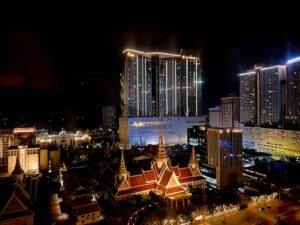 Going to bed at 6:30 obviously caused problems. I woke up at midnight not knowing where I was. I popped a sleeping pill, then woke up at 3:30 AM, pitch black outside but wide awake and ready to start my day.
After trying to write for a minute, I showered and went to find the breakfast buffet included with the room. It was over in NAGA 1, and I found the secret to getting across that busy street: there’s a half-mile long mall underground between the two NAGA complexes. At 6am, this was completely dead, with a few security guards, but otherwise it was an absolutely empty liminal space to the highest degree. The mall was a China Duty Free operation, run by the state-owned China Tourism Group. So this Unitary Marxist–Leninist one-party socialist republic runs a super high-end shopping mall filled with brands like Dior, Gucci and Bvlgari. Until recently, Cambodian nationals could not shop in this mall; they recently got permission to do so for anything except alcohol and tobacco. This is otherwise like the duty-free in the airport, where you have to show a passport and return ticket and they seal the stuff in a tamper-proof plastic bag. It’s yet another absurd contradiction well into “where the hell am I?” territory: a 68-degree Vegas-like luxury brand mall that’s absolutely spotless in a country where it’s 100 out and people make $200 a month.
I went up to NAGA 1, and the breakfast restaurant was the same deal I had at the hotel in Norway last January, except instead of brown cheese and lingenberries, they had a ramen station and a counter serving fish curry for breakfast. They had all the usual Western breakfast items: eggs, sausage, pastries, donuts, and a waffle station. I filled up on protein and got ready for my 8:30 door call to what would be a very bizarre field trip.
* * *
I decided to knock the most horrific part of the trip out on the first day: a trip to the Killing Fields and S-21.
You probably already know the basics of this story. In 1975, Pol Pot and the Khmer Rouge took control of Cambodia and started a ruthless campaign of persecution, relocation, re-education, and systematic execution of a wide swath of the Khmer population. The Khmer Rouge emptied cities, marched people to forced labor camps, and turned Cambodia into an agrarian society. Pol Pot wanted an isolationist society with no need for support from external nations, and used racism and anti-intellectualism to drive a fierce genocide, eventually killing 25% of Cambodia’s population.
I met up with a tour guide and a driver in a van with maybe a dozen others, and we headed out to Choeung Ek, one of the killing fields twenty minutes south of my hotel. Our guide gave us the brief history of the site and the conflict, trying to set up the background and prepare us for the visit. I think Choeung Ek used to be a fairly remote location, but recent growth of Phnom Penh has pretty much connected the area with the city proper, including a colossal Aeon Mall just built on the highway where you turn to get to the site.
The outside of the unassuming memorial looks like a typical Buddhist temple site, with a bus parking lot out front, and a set of gates. When I went inside, the surroundings resembled the orchard the site was before 1975, with a large, modern stupa in the center, a building that holds remains. But the first thing I noticed was that this stupa had columns of windows looking in. And in the windows were shelves containing rows and rows of human skulls stacked twenty feet high.
Choeung Ek was connected to the S-21 detention center, which I’ll get to in a minute. But basically, after being processed, interrogated, and tortured, people were trucked to Choeung Ek, executed, and thrown into shallow mass graves. To save bullets, many of the people were killed with farm implements or simply smashed against trees. We walked on a wooden walkway that went through the fields and graves, which was an absolutely harrowing experience. The small wooden bridges reminded me of the walkways through a wooded park where I grew up, but there were signs every few feet telling you not to step on the mass graves. Many of the graves have been exhumed, and they’ve identified about 9,000 bodies. But many are still there. When it rains and floods, they still find pieces of bone and clothing. It’s not uncommon for visitors to find teeth or bones as they tour the site.
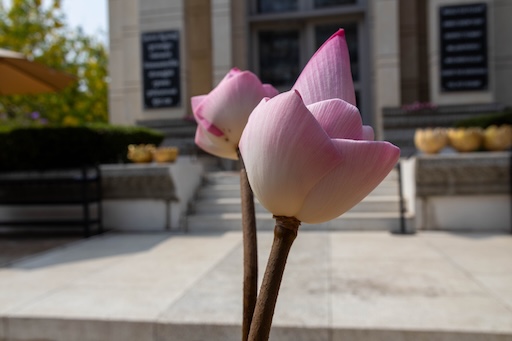
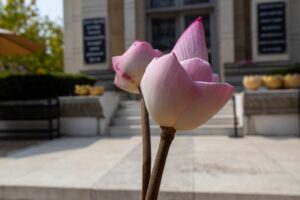 After walking the bridges, seeing glass cases filled with femurs and rags of clothing, I went to the stupa, to take off my shoes, walk clockwise around the perimeter, and leave lilies on the edge. There are 5,000 skulls packed into this small building, and they’re arranged by age, from adults to children. It’s absolutely chilling to walk around the stupa and see this, skulls stacked two stories high. And Choeung Ek is one of hundreds of killing fields that killed millions of Cambodians in less than three years and nine months.
After the tour, we returned to the bus and drove back into town to see Tuol Sleng also known as S-21. This secret torture center used to be a high school that was built in 1962, with a perimeter of five three-story concrete classroom buildings overlooking a courtyard park and playground. When the Santebal (secret police; literally “keepers of peace”) took over the site, they erected electrified barbed wire, put bars on the windows, then turned the classrooms into narrow jail cells and torture chambers.
Between 1976 and 1979, 18,145 people were brought to S-21. Most of them were politicians and their families, and teachers, students, doctors, and engineers. Between 1,000 and 1,500 people were at S-21 at any time. They were tortured, coerced to give confessions, shackled in narrow cells, starved, and beaten. They were then trucked to Choeung Ek for execution and burial.
Of the 18,145 inmates brought to S-21, 18,133 of them were killed. 12 people survived. I would meet three of them that day.
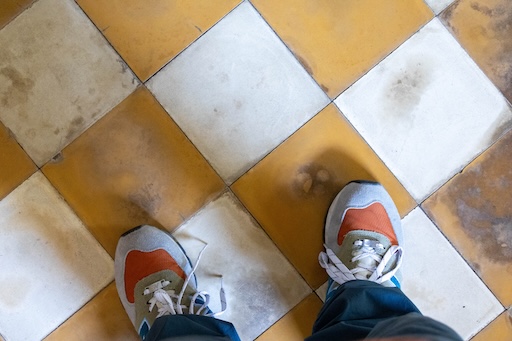
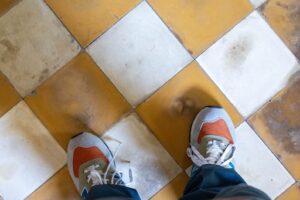 Walking through the buildings of S-21 is absolutely gut-wrenching. You look in the windows with bars and razor wire over them, then step into a room with brown and white square tiles. The concrete walls and ceilings make the rooms look like bedrooms in a French-era Vietnamese tenement building. Then you look down and realize these are the floors where people were tortured, beaten, and killed, and there’s still faint stains in the grout, and tiles that were broken by skulls smashed into the ground. There are pictures everywhere of emaciated teens and peasants and the shells of men who were interrogated, starved, then loaded into trucks. In some ways, there’s a sense of normalcy, the bustling neighborhood surrounding the facility, the trees in the courtyard, the playground monkey bars right outside the torture buildings. But in the negative space of the rooms, there are nothing but ghosts.
I don’t know how to write about this. I couldn’t write about Birkenau when I visited in 2023, because I felt any writing was insulting to the memories of who were killed. I don’t know how to capture my feelings about a place like this because I often think my feelings are wrong. While I haven’t lived a trauma like the people who were here or the people who survived those years of this regime, I have this base trauma in my life, some of which happened in September of 2001 and some of it that’s generational and started long before I was born. And my first feeling is that I can’t compare my suffering to theirs, and I have an immense guilt about even thinking that. And then I see how others react, and I realize I’m not feeling what they feel. Everyone in the group stared in horror, broke down crying, or completely locked up from what they were shown. And if there’s anything that’s worse for me than feeling upset, it’s being with other people who are upset.
After walking through two or three of the buildings, I had to leave the group and stand outside, and it wasn’t because the display was completely shutting me down. It’s because it wasn’t. And I don’t know why. This is all so horrific, but there’s something in my PTSD mind that reaches a certain point and completely shuts off any connection to reality. I’m not me; I’m a person watching a video of me and not reacting to it. After seeing my thousandth human skull or the room full of shoes at Auschwitz, I don’t feel anything anymore, and have complete clarity. And… that’s probably wrong. And it worries me. And it’s hard to admit.
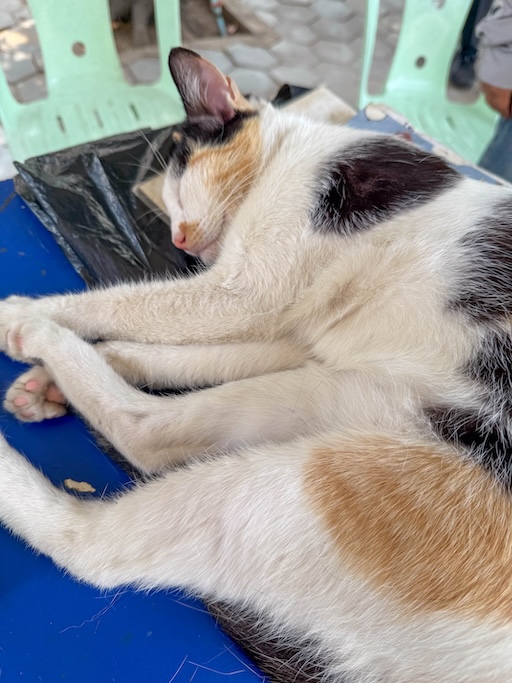
I stood outside among the palm trees in a quiet part of the courtyard while my tour group finished going through the rooms. Then I went over to where three of the survivors were selling their books and posing for photos. I paid double for all three books, then basically emptied my wallet stuffing money into every collection box I could find. I talked to Norng Chan Phal, who is roughly my age, and was eight when he was brought to S-21. His daughter was there, and I talked to her too. She had a calico cat with her, asleep on a pillow next to the pile of books. It was the first cat I’d seen in Cambodia. I asked to pet her cat and took a picture.
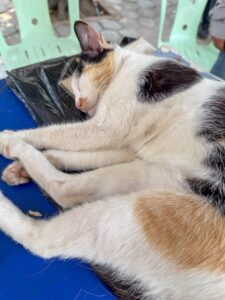 I don’t know why, but the cat connected me to reality, this site to reality. There’s a transformation that has to happen to move from what’s seen to what’s thought to what’s felt. And for me, that last step lags or doesn’t happen or happens erratically. Like I said, I know this a problem, and I know the reasons and I’m working on it. But that moment, petting the cat, is when I felt again. Maybe this is a bad description of all of it, but this is as far as I can go with it right now.
* * *
That night, I booked a “sunset voyage” which was basically a booze cruise that circled a boat around the Mekong River for an hour and a half or so, with a bar and buffet on board. I wanted to go out on the water, get a lay of the land, and maybe get some good pictures from an open platform. I think I ended up getting a ticket for free, so the price was right, too.
This started with a quick ride on a tuk-tuk which picked me up at my hotel. I’ve probably talked about tuk-tuks before in my India trips, but they’re basically a motorcycle with two rear wheels, then an open cab with bench seats in the front and back. The driver sits in front with motorcycle-style handlebars, and a little ten-horsepower engine is under their seat. A tuk-tuk sounds like it would be a lot of fun, and I’m sure I would have thought they were the coolest thing ever when I was like 15. But in practice, I’m not a huge fan. It doesn’t feel super safe bouncing around in the open back seat with no seat belt, and depending on the country, drivers can range from scary to absolutely delusional. There’s also an engine right at your feet, belching out fumes and heat. I guess it’s better than being on the back of a moped in Vietnam with no helmet and nothing to hang on to, but it’s not exactly like an air-conditioned Mercedes sedan taxi.
The ride to the boat wasn’t too bad, maybe a mile in rush-hour traffic. I shot a bit of video as we zipped east past the Chinese tower buildings, over a small bridge, and onto Diamond Island. Right as we approached Norea bridge, we hung a left and went along the shore, past a theme park and a bunch of shops, and to a dock. Sitting on the shore of the Mekong was a two-deck boat that looked like it had been abandoned by the Viet Cong in 1973 and later fitted with a cheap Soundesign stereo system as a PA and a bar. I went to the upper deck, which was covered in tattered astroturf and old patio furniture. There was one life jacket for show, which looked like it had been ordered on Temu. Cambodia doesn’t exactly have OSHA, so there were many areas with no railings or any thought about safety. I should also mention that I don’t know how to swim.
Maybe five or six couples and an extended Indian family of another dozen people got on board. The captain fired up the massive rumbling engines and we went chugged along on our way. They blasted yacht rock through the speakers as servers went around asking if we wanted to buy well drinks or pay for the buffet, a steam table of questionable food that I didn’t even want to think about trying. I passed on the $6 all-you-can-eat listeria, got a can of Coke Zero, no ice, and sat at a table, taking pictures as we sailed out.
I know it’s stereotypical to say it, but this was giving me serious, serious Apocalypse Now vibes. (“Sampan off the port bow!”) On the starboard side of the boat, the shoreline was nothing but chrome and glass hotels and resorts, extravagant restaurants, and what looked like a mini-Singapore. But on the port side was Kandal Province, which was all unimproved beaches, farms, and villages of two-story shacks. Kandal could have been 2025 or 1925 from a distance, and it was utterly striking to see the two terrains collide. Also, on the water were various sampans casting fishing nets, and aside from the occasional five-horsepower outboard motor or maybe a radio antenna, these boats could have been from a hundred years ago.
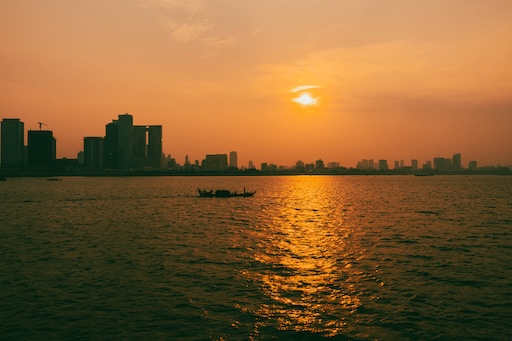
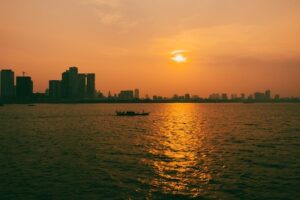 We did a lazy loop around the confluence, with Croft and Seals and Jimmy Buffet blasting through the cheap speakers. The temperature cooled and the sky turned golden yellow and then bright orange as the sun passed behind the horizon. I snapped pictures and stared at the odd juxtaposition of the two worlds, the colors of the brightly-lit Norea bridge and the skyscraper resorts versus the bamboo stilt houses and flat-bottom canoes clustered on the Akreiy Ksatr Village shoreline. I thought about the horrors of that day, in the background of my head, then saw the two worlds and it once again begged the question: “Where am I?”
We pulled to shore right as Journey’s “Don’t Stop Believin'” blared through the stereo. The Tuk-Tuk driver was on shore waiting for me, and he slightly scammed me on the way home. He mumbled something about having to go around, and what that actually meant was he was taking me on a 30-minute “tour” for an extra $40 that I didn’t entirely understand we were taking. I just wanted to get home, but I was a good sport about it. I flipped on Facebook Live and recorded a big chunk of the random journey in the night in the city that was bustling, even on a Tuesday night. He weaved through traffic, and I’d look over and there would be a family of four on a 50cc moped literally six inches away from me. It felt a lot like Saigon, with everything lit up, the street markets in full swing, everyone out eating, listening to live music, relaxing, socializing.
I came back exhausted and starving but didn’t want to spend $75 on a sushi dinner at the hotel and then eat only a third of it. I went back to the room and ordered the worst club sandwich imaginable. It had a bunch of non-club sandwich stuff on it like eggs and baloney, so I picked it apart and ate it bit-by-bit as I watched a David Lynch documentary on my laptop, then quickly fell asleep.
Wednesday
Once again, I woke up early and had no idea where I was, what country or continent or decade or universe I was in. My first thought was that I was in Vegas, then I opened the drapes and saw a Buddhist Institute and the Mekong river. Where am I?
I had most of the day to myself. I did the same breakfast buffet and did a bit of recon on Google Maps, then headed out for a walk. My goal was to find a mall and see what the city looked like on foot, along with shooting as much as I could on my DSLR.
I immediately found out the problem with this: it was way too hot to walk. By 9am, the temp broke 90F, and it went up to 100 after lunch. But it was also 70% humidity, so that 90 felt more like 106. I strolled along Sihanouk Boulevard and snapped some pictures of the decorations and the statue of the king. But I knew my hang time on this walk would be severely limited.
* * *
I ran into something very firmly in the “you don’t see this every day” category: the Korean Embassy. No, not the home of K-pop and the show M*A*S*H, the Republic of Korea. I’m talking about the Democratic People’s Republic of Korea, aka North Korea. North Korea only has 30-some diplomatic missions, and they obviously don’t have an embassy in America. North Korea is also an interesting footnote in Cambodia’s history, because after the 1970 coup, King Norodom Sihanouk was in exile in North Korea, living in a guesthouse in Pyongyang and trying to convince other communist Asian countries to stop recognizing Lon Nol’s government.
Because of this, Cambodia has an above-average diplomatic relationship with the DPRK. There used to be a number of North Korean restaurants in Phnom Penh, places where you could get the more bland northern dishes along with a generous serving of propaganda performances from the servers. These were all shut down by the UN recently, because of sanctions. There was also a musem in Siem Riep about Angkor history that was built and operated by North Korea, but it was also shut down in 2020.
The embassy is on Sihanouk Boulevard, across from the (French) Indepenence Monument and right next to PM Hun Sen’s mansion. It doesn’t look much different than other nearby embassies, with an iron gate across the drive, flanked by a small guardhouse and a display case. There’s a front courtyard and an unassuming two-story building set back from that. But, there’s a North Korean flag flying up front, which seemed pretty bizarre outside of the Mercenaries video game. I went closer and there was a security guard dressed in a full-on DPRK uniform sitting behind the glass, watching a soap opera on his cell phone. Next to that was a display case with pictures of Kim Il Sung and Kim Jong Un posing with schoolchildren and handing out supplies.
I only spent a minute in front of the embassy and moved away fast, because I didn’t want to get in trouble. But that ominous minute was another example of the every-present question: “Where am I?”
* * *
I hung south on a street and walked towards a mall, hoping to get there before I completely short-circuited from the heat. The walk was on a not-so-pedestrian-oriented boulevard, and it gave me a nice view of a cross-section of the city. My usual thought process was to think “what is this city like?” and compare it to other recent destinations. It was nowhere near as busy as Bangalore, but it did have some of the same feel, with the three-story buildings, disparate mixes of stores on every street, and tuk-tuks everywhere. The mopeds and the bustle reminded me of Saigon. And some of it made me remember when I got deep into Singapore, away from Marina Bay and the massive malls, and into the Chinatown area filled with cramped shopping stalls and busy markets crammed between temples. And this was sprinkled with Western influence everywhere, a random 20-story hotel with a brand new Starbucks on the ground floor. Phnom Penh was bits of all of these things, but it wasn’t strongly any one of them.
After passing the Russian Embassy, Google Maps said I was just as far from the mall as when I started, and I had no idea where I was going. I ducked into another mini-mall, which was more of a narrow collection of small stores with an open area, a shopping arcade with a bunch of ramen shops that looked like it just opened recently. At least it was air-conditioned. I went to a convenience store and grabbed two cans of Coke Zero, drank them in twelve seconds, then gave up on this mall adventure and stumbled back north to the hotel. (Quick video from the walk back: https://youtu.be/Wy7XGC_X-YY)
Back in the room, I felt slightly dazed and heatstroked, and my clothes were 100% wet with sweat. I spent the afternoon hydrating and researching a bit more, trying to get my energy back. I really wanted to go to that big mall, but I needed to get some rest and figure out a better way to do it.
After a few hours, I figured out where I messed up my walk, and found another path to the mall. It was about the same distance, but on a more pedestrian-friendly street, and said it was only 16 minutes. I drank more water and headed out, leaving behind the DSLR and bag. The trick was to head down the hotels and shops of National Assembly Street, then get around the Russian Embassy in the other direction, which dumped me out in front of the parking structure of the Aeon Mall.
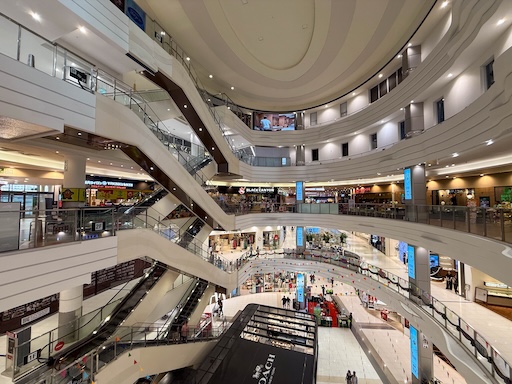
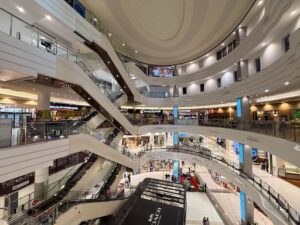 I know I keep using the word “bizarre” for everything I see, but I don’t know how else to describe the Aeon Mall. It seriously looked a notch nicer than the nicest Westfield Mall I’d ever been in, which wasn’t even one in the states; it looked like a giant mall from Sweden. This Japanese company Aeon is dropping these mega-malls all over Asia, and they all look like they’re from the 22nd century. This was a triple-decker with over a million square feet, zero vacancies, packed on a random Wednesday afternoon. It was all high-end stores, all glass and chrome, all built recently. This was in a city that was 100% destroyed within my lifetime, and this place filled to the brim with Coach, The Body Shop, Pandora, H&M, and the usual lineup. I walked around and completely forgot where I was, thought I was in San Jose at the Valley Fair mall, and I would go to the garage, get in my car and drive home.
In addition to building malls, Aeon is also a hypermarket brand. Their anchor store was basically like an old-school Marshall Field smashed into a Meijer store, but all for an Asian audience. Like the bottom floor was an actual grocery with live fish and snails and snakes and exotic fruits I’d never seen. It was packed wall-to-wall with stalls and hawker food and everything a Ranch 99 would have if it was ten times bigger. Second floor: all hardlines like an 80s department store: TVs, air conditioners, fridges, and toys. Third floor: clothes, bedding, housewares, and other softlines. I wandered around in a daze. This is Cambodia? It looked like Singapore. Instead of that bowl of rice a day from the Dead Kennedys song, you could swing by the Auntie Anne’s and get a thousand-calorie pretzel with cheese like you’re shopping back in Ohio.
I thought I’d eat early, and being the Ugly American, I had to pull my typical Ugly American stunt. I went to a Burger King and ordered the usual: a Whopper Junior meal. It was pretty much identical to the same meal I’ve eaten in Saigon, Stockholm, Bangalore, and Goshen, Indiana. The 27,000 KHR price gave me sticker shock, but once I translated that to dollars, that’s like $6.75, which I guess is cheap for fast food these days. I quickly ate the forgettable burger, then headed back to the hotel to get ready for my night activity.
* * *
That night, I took a night tour on a tuk-tuk for three hours, just me 1:1 with the driver. He met me at 6:30p and I think the usual gig is he takes you to street food places or restaurants, or to see S-21, but I told him I had a big camera and mostly wanted to take some great night photos of the streets, and he was more than happy to oblige.
This was the setup where the motorcycle was in front, pulling a trailer-like carriage, so it was less cramped and I wasn’t breathing fumes from an engine right underneath me. My driver was very personable and talked about the different areas of town, what was going on, where people went and ate and shopped. We took the same route out towards the bridge that I took the night before on the way to the boat, but he stopped every block or two to explain things or point something out. We talked history, and I’m glad I’d did some reading before I left, because he appreciated when I knew a few random facts about the past.
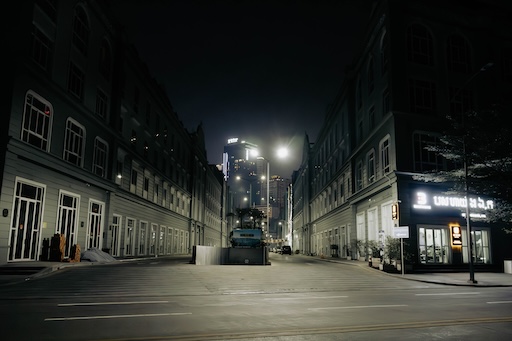
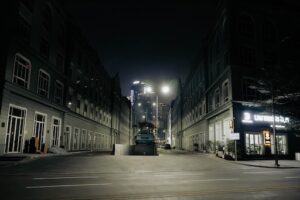 We left Boeng Keng Kang I, crossed the Swan bridge, and went to Koh Pich, also known as Diamond Island. This was once a swamp off the Mekong. Twenty years ago, a conglomerate built up an island with silt and sand, and then constructed a giant planned community that looks like if one of those fake “town center” malls in the US went all-out and tried to reconstruct a facsimile of Paris. Many of the tallest buildings in the city are now there, surrounded with walkable communities. We stopped at a place called Elysée, designed like Paris, or maybe the Paris casino in Vegas. It’s all brand new and largely vacant, entire city blocks of expensive apartments and empty shops, completely dark at night. We drove around and it looked like the Universal backlot where they film European street scenes for movies, but everything was like a year old and vacant.
 We drove under the new Norea bridge, a cable-stayed suspension bridge almost a kilometer long, spanning where the Bassac River meets the Mekong. The bridge was lit up at night to look like the Cambodian flag, the suspension wires brightly lit in neon shades of red and blue. As we rounded the island, we stopped at a strip of modern restaurants that looked like they could have been in Santana Row back in California, hip new sushi places filled with bankers and NGO workers with money to burn. We sat and talked at a pedestrian mall on the riverfront, and watched a stream of young folks out for the night, grabbing dinner and drinks and mingling.
The driver had choice words to say about both the Chinese and Vietnamese. I was careful not to go there, but he did. Many working-class Cambodians harbor some resentment or ill will towards the Vietnamese, and every conspiracy theory about their version of “the swamp” has to do with them. Like some government official who’s corrupt: “oh, his wife is from Vietnam.” Or “he secretly works for the Vietnamese.” All of South Vietnam used to be Cambodia centuries ago, and nobody will forget it. The Vietnamese liberated Cambodia in 1979 by stopping the KR with that war, but the Vietnamese occupation and the war continued for another decade. It’s a complicated situation, and even a book or three can’t explain it clearly. The driver’s opinion of the Chinese was way worse. They threw around money for tons of development like Diamond Island and the casinos and skyscrapers and everything else, but there was nothing for the Cambodians. The Chinese own all of this new glitz and glamour, and most Cambodians reap no rewards. Maybe they can get a dishwasher job at an expensive restaurant, but they aren’t eating there. The Chinese keep to themselves in their gated communities. Interesting to hear about this side of it from him.
We drove more, and he dropped me off at the front of the Royal Palace, and told me to walk across and meet him at a large gate on the other side. This gave me a few minutes to wander the grounds, look at all the people strolling at night, getting street food, having night picnics in the green spaces, taking pictures. I met with the driver on the other side, and there were street vendors selling fried insects, which I really did not want to try. We kept moving and walked past Veal Preah Meru Square, the funeral complex of King Norodom Sihanouk, where he was cremated. Next to that was Wat Ounalom Monastery, a temple from the 1400s surrounded by stupas and a monastery. Young monks in orange robes sat in the courtyard around the temple, drinking water and lounging on the stairs of the buildings in the heat of the night.
I wish my camera had a GPS so I could track the next hour and a half, because we circled around to see various temples and gardens and tourist areas, the giant clock and the oldest temple and every other big photo op in the area. We crossed the red light district – no pictures, but I did snap one of a tea place called PourHub. When then went on to the big night market. He said to meet him at the pharmacy with the large green cross on the opposite side and left me to roam through the massive central market.
This place was an entire city block packed with rows and rows of tents, tables, vendors of every possible ware, lit by bare bulbs and fluorescent lights, neon signs on some of the food carts. It was overwhelming, shoulder-to-shoulder, packed with people of all ages wandering the stalls, looking at bootleg merch and endless fruits and snacks and treats. In the middle of the market was a large open area, covered with rugs, filled with people sitting down, eating food, watching a duo singing what sounded like karaoke up on a stage. It was too tight to take pictures, so I kept my camera at my waist and kept shooting without looking, hoping to get something that would look okay. I scan through the stream of photos now and it’s a river of old women selling housewares; teenagers at ice cream carts; kids looking at walls of fake Nike shoes; families eating various meats on sticks; toddlers sitting next to their grandparents at fruit stands. I just skimmed through the hundred or so pictures and determined I was the only westerner there; every other person was Cambodian. I was completely immersed. And the world of this market was 100% different than the world of the riverside park a block away. There were so many layers to this central neighborhood, each one totally a different galaxy from the one ten feet away.
I talked a lot with my driver, probably more than anyone else on the trip. He told me about his youth, his family, how they all lived in a remote province and he worked all the time in the city, driving and touring and hustling. He showed me pictures of his wife, his kids, his wedding, his dogs, his animals, his house. We talked about the economy, the pandemic and the recovery, about America and China and Vietnam and Singapore. It felt good to just talk, but to find out so much from another person. I think back to the Norway trip and how completely isolating it was, and this was the absolute opposite. It was an amazing few hours with him. By 10:00 I was fading fast, and we headed back to the hotel. I think I tipped him like 200% what I paid for the tour and wished him a good new year and to have a good time with his family next week.
Thursday
Woke up again at early o’clock to walk the empty ghost mall and get my breakfast. By this point, I’d lost track of all time and day and didn’t really know when to respond to messages or text people or anything. I felt like I was in some parallel universe and I could only communicate with people by dropping books on the floor like in Interstellar. Cambodia is 14 hours ahead of home, and for some reason that extra few hours completely threw me. Being 12 hours off is much easier, because you just flip the AM/PM in your head and you know everyone is opposite you. But the little bit extra of a time-slip made it next to impossible for me to deal with reality.
Thursday’s activity was a van trip to Oudong, maybe 50 clicks north on the Tonle Sap river. I had a female tour guide and a guy driving who spoke no English. It was just me, and she started with the usual history of the country, talking more pre-European colonialism, the Post-Angkor era and such. Some tour guides start with the 1953 Kingdom of Cambodia and go forward, so they can quickly get into the 1970 coup, then the Khmer Rouge. There’s no Hollywood movie about the French Independence, so they don’t always go back that far, but she did.
After about 45 minutes of driving north on highway 5, we stopped at a little village called Chey Odam. It had a handful of silversmith shops, like any of these small artisan gift shop clusters where tourists get dropped off to buy trinkets. I watched a few women in an open garage working metal with hammers, smoothing out pots and elephant statues, while two guys had a forge going in the corner of the already-hot space. I shot a few pictures, then went to the gift shop and dropped $50 on a little silver Buddha statue. Before we took off, I stood outside on the narrow road, the side street, and looked around. Most of the structures were almost improvised, a mix of cinder block, bamboo, and loose wood or metal that looked like it was salvaged or found on the side of the road. But this was dotted with random pieces of the 21st century, like a bright sign for an ATM, a new ice cream freezer, an umbrella from a local beer company on a patio. And the cluster of shops reminded me so much of being in similar places in upstate New York or Alaska, the same kind of artists and craftsmen banging out ashtrays and decorative plates.
Next up, we went to the Vipassana Dhurak Buddhist center. This was about the size of a college campus, where they teach meditation, school the monks, offer food to everyone, operate a nursing home, and run a language institute. Walking the campus of the center was absolutely amazing, because at every turn was some temple or pagoda or statue or thing of beauty. We walked up to a huge temple, scaled all the steps, and walked into a large room (after taking off hats and shoes) to see scores of people sitting in front of a 30-foot tall Buddha statue and listening to a monk chanting away, the sound echoing through the massive hall.
Everything about this center was fantastically designed, a collection of steps and statues and school buildings, everything with ornate decoration and meticulous handiwork. I’d be standing at a holy chamber, turn to my right, and see a reflecting pool that was acres wide. Past that, there would be a grove of carefully groomed trees. Next to that, there would be a pond full of lilies. We went in a few of the chambers, where I couldn’t take pictures but I could be overwhelmed by the altars, statues, collections of relics, and monks everywhere, in prayer or just carrying buckets of food from one building to another.
The campus looked centuries old, untouched by time. In reality, a lot of this was destroyed by the Khmer Rouge and rebuilt recently. I asked about this, about when various things were built, thinking it was from like 1473, and the guide would say, “Oh, they finished that in 2021.” While digging around the web to write this, I found someone’s pictures from 2004 or 2005, and most of the center still looked completely bombed-out, the Buddha statues broken apart, the pagodas torn down or in the process of being rebuilt. It’s amazing that the government and the people have put so much into the restoration of the culture. But it’s also a way of life; when families can’t afford for children to go to school, they send them to the monastery to have a better way of life. I don’t know anything about Buddhism and have mixed feelings about state-run religion (or any religion), but it was good to see this working here.
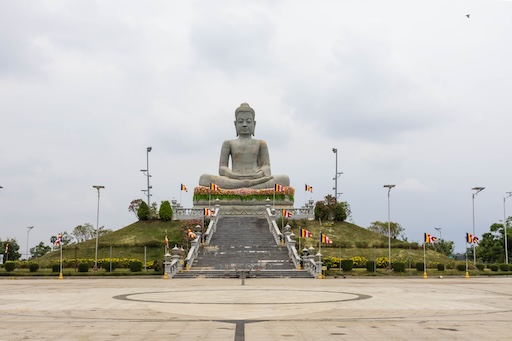
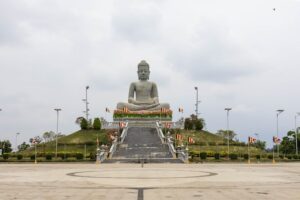 We continued to one edge of the campus, where there was a massive Buddha statue maybe ten meters tall, sitting on the top of a hill, surrounded by a promenade of tiles. I wasn’t allowed to go up to the statue, but I took many pictures from a block away. We headed back through a grove of mahogany trees, talking little and taking in the serenity of the area. The whole thing was somber but very peaceful. There were also lots of stray cats wandering around, who were all well-fed by the monks, but who would of course come up to me and say otherwise.
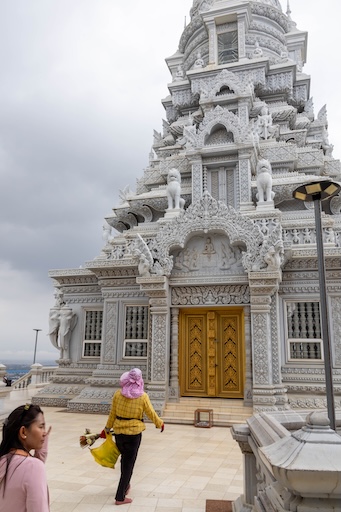
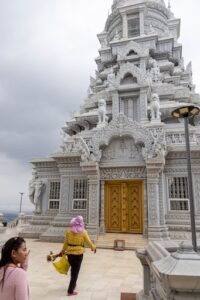 We drove over to a series of temples in the forest and climbed the hundreds of steps to the top of Throap Mountain. This was all 16th-century architecture, 509 steps from bottom to top, and felt slightly precarious, but it wasn’t like climbing Everest or anything. These shrines were much more rustic and unimproved compared to the center, with more trees, more rocks, and a more weathered appearance. Some of these were stupas of former royalty. At the top of the mountain, the climb culminated with a massive spire temple, the royal tombs, a sandstone tower with extremely ornate carvings and an observation deck circling around it. From the top, we could see the entire Buddhist center below us. And in the distance, you could also see a large industrial park full of garment factories, a bit of a hot topic with the current events of the tariff war just starting the week before.
Once again, I waited until she brought it up, but I did talk politics with that tour guide. She was worried about the current American administration and I told her I don’t like them either. She asked, “No Americans I talk to like him, how is he in power?” Yeah, exactly. Cambodia has its own swamp, the same people in charge for 38 years, one-party elections where all opposition parties are now illegal, the father PM handing it off to the son yet staying in the background to run congress. The whole thing is heartbreaking, because these people are like “maybe we can make a trade deal with the Americans” and “maybe we can get more tourism” and I’m thinking, maybe I’m pessimistic, but you need a plan B here. This brought back that quote from the Brinkley book. “You will fall in love with it , and eventually it will break your heart.” That’s what I felt like any time someone mentioned economic recovery. The more I saw the beauty of Cambodia, the more I thought, “This really isn’t going to work out in the long run, is it?”
The sky suddenly turned dark and the temperature dropped, and we were certain a thunderstorm would start, so we scattered back down all the stairs through the woods. It miraculously did not rain on us, though. And I saw monkeys on the steps below, including a mama monkey tightly gripping a baby against her chest. At the end of the trail was a small market, a tent-covered promenade full of vendors with cauldrons of stir-fry and egg rolls and fried insects. We made a quick run through the market, and I did more from-the-hip shooting, but politely avoided all food. It was neat to see everything though, snap some pictures and watch everyone else shop and eat and socialize.
* * *
I had a brief moment to myself, when the tour guide called up the driver, who was parked a few minutes away, then had to take another phone call. I sat on a bench, sipping a bottle of water, watching the people on mopeds, the kids playing, the people shopping for their weekend. I saw a small shrine in the middle of a courtyard maybe twenty feet away, watched a kid who was maybe three or four running around the perimeter of the yellow spire building. The kid looked over at me and smiled, and I snapped a quick candid shot of him. I thought it would make a cute picture, and filed away in my head to crop and develop it when I got home.
Back at the hotel, I pulled up the shot. That spire had glass windows on it. I didn’t notice it, but it was filled with human skulls.
When you visit Cambodia, you can go to the Killing Fields and the monuments and S-21, and there’s a certain “history porn” aspect to this. When I saw this in Poland or in Ho Chi Minh City, there was this unsaid “always remember, but always forget,” because those societies have grown beyond the horrors of their past. But in Cambodia, I felt this strong undercurrent where the scars of trauma run deep. A very high percentage of the survivors of the Democratic Kampuchea era have completely unchecked PTSD, and no resources to come to grips with it. They’re silent about their trauma, and it has a ripple effect of generational trauma to their children and grandchildren. This leads to rampant health problems, pathological mental health disorders and behaviors, and it’s all unanswered, unresolved.
The war ended decades ago, and three-quarters of Cambodia’s young population were born after the fall of Democratic Kampuchea. Aside from the two museums I visited, the government does little to remember the genocide. Cambodian children do not learn about the Khmer Rouge in school. The elders who could tell them more are all aging away and soon to be gone. None of this is talked about; my tour guides for this trip and the night trip the day before said almost nothing about the Pol Pot era, talked very little about the genocide. People want to forget, but I felt like the country was still haunted by the wounds of this in a deep way I couldn’t fathom until I was there and saw it. The genocide is largely sequestered to those two museums, but it was also still everywhere.
Friday
There’s this memetic phenomenon called “Sunday scaries,” which is the crushing feeling when the end of the weekend has arrived and a crippling doubt over what was accomplished sets in. I get this a lot, and I’ve noticed I get a very similar vibe when it’s the end of a vacation. I often don’t plan things for the last day, except “pack back up and get checked into your flight,” and that was the case on Friday. I felt a strong need to do something, but I didn’t know what, and I felt like I’d already hit my stated goals for the most part.
So: shower, breakfast, start sorting things in the room, think about what goes in the checked luggage, the carry-on, or the trash. Then I obsessed over weather and Google Maps for a bit, and decided to head out without the big camera, only carrying the palm-sized Olympus 35mm. My main goal was a picture of a 7-Eleven. That place is obviously big in the Konrath lore: I always joke about me and Ray going there when I lived in Indiana, and it was part of my writing ritual in Seattle to work until midnight, then get a Slurpee. It’s always amusing to me to see them everywhere in the world now. I think I’ve been to them in Sweden, Iceland, India, Poland, Singapore, Vietnam, and Norway. Time to add another to the list.
The walk took maybe twenty minutes, and I took my time on the stroll, burning off film with snapshots of the side streets. I made my way down Rue Pasteur, past embassies and UN buildings, managed apartments and spas, a lane with a few more trees and shade compared to the big boulevards. The 7-Eleven was brand new, on the ground floor of one of the secondary buildings of the Brunei embassy. Inside, it didn’t look much different from any other Asian 7-Eleven, except the Hello Kitty rip-off characters on the walls and signs were speaking Khmer. The front counter had some kind of Asian dumpling things instead of roller dogs and nachos. I got two cans of Coke Zero, took my pictures, then headed out.
After finishing my second roll of film, I circled back and went to the big Aeon mall again. I know I’m supposed to be done with malls, and I am, but there’s something so oddball about a top-tier mall in a country like Cambodia that I could not resist it. It’s like wandering through Death Valley and stumbling across an exact duplicate of Rockefeller Center in the desert, then taking the elevator up to 6-A and seeing a young David Letterman doppelganger doing a monologue in Khmer. Nothing about Aeon made any sense, and because of that, it was spectacular.
I don’t know how, but I promptly lost my baseball cap, and with the bald head and the sun, that’s a significant problem. I went to four or five stores to find something that wasn’t completely stupid and would fit my giant head. I wandered to the MLB store and thought it would be worth a LOL to buy a Cleveland cap, but every one in that store was sized to fit a toddler. At a New Era store they had choices other than NYY/LAD and I found an adjustable snap-back black-on-black Raiders hat. The idea of buying a Raiders cap in 2025 seemed so obnoxious and absurd that it was absolutely perfect. I decided I’m going to start wearing it to work, and when people give me grief about it, I’ll start yelling THE GENO SMITH DYNASTY STARTS NOW! (Oddly enough, every time I wear the hat back home, someone compliments it.)
I went to a Krispy Kreme booth in front of the Aeon store and got a chocolate sprinkle donut and can of soda, and sat at a table, recording a long video with the Pocket 3 camera pointed at the concourse, capturing the people bustling through the stores on a Friday afternoon. (https://youtu.be/l-pYV6qmsNM) I soaked in the absurdity of eating 350 calories of pastry from a North Carolina-based company, wearing a Raiders hat, watching people shop at a Swedish fast-fashion store selling garments made in Vietnam. Once again, where the hell am I?
* * *
I left the hotel at about 5:00 to catch the last hour of daylight and snap a few pictures with the big camera before heading to dinner. I also resisted gambling all week, but felt a need to drop $50 into a slot machine just to say I did. I made the same stroll up Norodom Boulevard towards the Independence Monument, and took some video of the Friday night traffic and the fountains in front of the monument, but nothing earth-shattering. It just felt good to be in the cooling temperature, the golden hour.
While standing across from the North Korean embassy, I ran into an “influencer” couple, filming what would probably become a click-baity “7 things you should never do in Cambodia!” video. They both looked like a page from a J. Crew catalog, and were adorned with expensive sling bags and photo gear they likely got for review. I asked if he was American, and it was obvious he was, but he immediately got defensive and wouldn’t answer. I just said, “Dude, relax – I didn’t vote for him either.” I pointed out the embassy and said it was a good photo op. He sort of mumbled and I left them alone. Two minutes later I saw him shooting footage of his conventionally-attractive girlfriend pointing out something you don’t see back in Park Slope. Whatever.
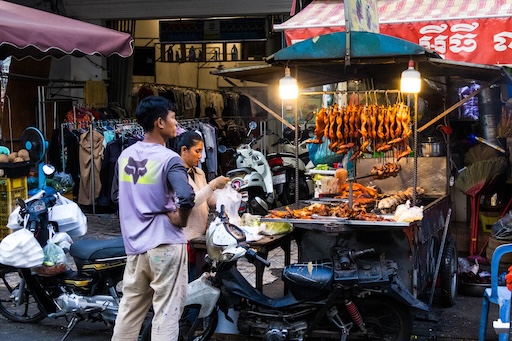
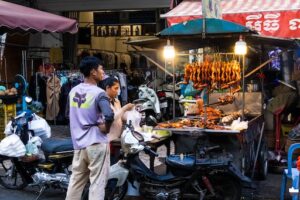 As the sun set, I walked down to Kabko Market, an open-air street of food carts and outside vendors. I traversed the parade of parked mopeds and watched people buy satay skewers and whole roast ducks and chickens. This was yet another completely different world, a sea of pedestrians of all ages, shopping for fresh fruits I’d never see back in the states, couples at open patios at brightly-lit colorful restaurants, people streaming in and out of pastry shops and beer gardens and small clubs. I was only two blocks west of the hotel, but it was a completely different world. It was like walking out of the Bellagio, going over a block, and being in downtown Ho Chi Minh City. It felt so good to be out on a Friday night with a cool breeze and a wide lens on a new camera, 7851 miles from home and 14 hours ahead in the future, watching the people and shooting from the hip.
Twilight faded to dusk and then to darkness. I cut through the underground Chinese mall and over to get some dinner. Speaking of traversing worlds, I ended up in a Japanese teppanyaki place that was totally empty. I didn’t want to sit at a grill alone and then smell like fried meat for the rest of the trip, so I got a small booth and spent way too much money on an A5 Wagyu steak, which was decent but unremarkable. It was like the Japanese food you’d get at any other mid-level Vegas resort. I think the big takeaway for me was that it was decidedly not Cambodian.
Down in the casino, I immediately got approached by security, who tried to bounce me because I was wearing a hat. Okay, calm down, dude. For the rest of my brief stay in the casino, I had three security guards within ten feet of me. This rudeness made any thought of spending more than the fifty dollars I budgeted quickly leave my head. There was a token $10 table but everything else was $50 and up, with continuous shuffle, dealers communicating only in Mandarin. Everyone but me who was gambling was Chinese. I walked past a hundred-dollar table, and the dealer had a handheld RFID scanner, and was checking every chip put in play. I knew in Vegas, high-denomination chips all have RFID – there was a high-profile robbery at Bellagio a few years ago where someone took a cart with seven million in hundred-dollar chips, and security was able to immediately killswitch them all. But I’ve never seen dealers scanning chips at tables.
Chinese slots aren’t as kinetic as American ones, with all the bonus rounds and animations and music. They’re rarely branded franchise things, like you won’t see a Ghostbusters or X-Files machine. It’s all golden lucky 777 dragon stuff. I played the one branded machine I found – and this is hilarious – they had a Squid Game slot machine. It’s barking at me in Korean, and a crowd of gamblers behind me are arguing in Chinese, and there’s Khmer New Year music blasting through the casino. I’m the only white person in there, and all I can think of is, “Where am I? Why am I here? What is going on?”
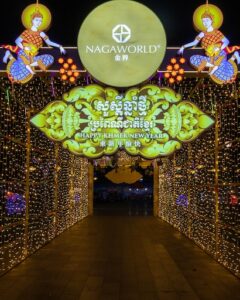 I quickly lost the $50 and went back outside. On the boulevard in front of the resort, there was a park between the streets, maybe a few blocks long, with just green space and decorations and lights for the new year. Almost nobody was outside, and I took a long stroll up and down the park area. It felt tranquil, with the hum of the traffic in the background, the bright neon lights of the two casinos in the background. I took a long selfie video with the Pocket 3, five minutes of me rambling and experiencing the experience.
And I had this sudden sense memory, an absolutely overpowering teleportation into the past. The temperature had dropped from 100 to 80 since the sun set; I heard the sound of bugs chirping in the background; and the darkness and crispness of the night gave me this absolutely clear recollection of being back in Indiana on a summer night in 1992. And I thought about what I knew about Cambodia or the world when I was 21, which was almost nothing. And I thought about how back then, I wanted to someday leave, and didn’t even know how that would work, how I’d graduate and get a job and move away, given that I had $3 to my name and no real job and no skill at anything. And thirty-some years later, I felt the same feeling as those late nights in Indiana, the same air and sound and sense, but I was half a world away, in this strange land that was a collision of many lands, a place that didn’t even really exist in 1992.
It’s not that I miss Indiana or I’m nostalgic for that past. I’m not going to write a book about it. (I already did.) I don’t want to go back. But sometimes I see a faint reminder of it, and I see another part of this world, and looking at the two, I have more context of what I now have and who I have become. And that has nothing to do with Cambodia or travel or vacation or anything else, but I think it’s the most important thing I can take from any of this.
Saturday
I woke up early on my last day, which I knew I’d pay for dearly about twenty hours later if I forced myself to stay awake on the plane. I got breakfast, packed everything up, tried to write for a bit, and ran out the clock on the noon checkout. I have this new habit of staying at my hotel until the last possible second, like until someone from the front desk calls and asks when I’m checking out.
At 11:58, I said my last goodbye to NAGA WORLD 2, took one last look at the Buddhist center and the Mekong, then went downstairs, checked out, and asked the concierge for a ride to the hotel. He got me a car and we headed out. Luckily the car had good AC, because the “feels like” temperature outside was 106. The airport was a straight shot up Norodom Boulevard and over on Russian Federation Boulevard, maybe 13km that would take us an hour to traverse. I took a few lazy shots out of the window on my phone as the city unspooled, looking at the university and the embassies and the mopeds and traffic ebbing through the district. Any time I do this, those last few moments lock in my head and I know for sure if I liked the city or just endured it. And I liked Phnom Peng. I never knew where I was or what I was doing, but it has its own vibe, and i enjoyed that.
Everyone would ask me when I got home if Cambodia was what I expected, either wanting to hear it was some incredible adventure of hidden treasures or a miserable quest of disaster. I feel like Cambodia was everything I thought it would be: a struggling nation that’s quickly developing; the scars of a genocide slowly healing but ever-present; the duality of an ancient culture and a quick push into a high-tech future. All of that was there, and it was magnified by actually seeing it. But Cambodia was so much more than I expected, because it wasn’t just one world. There are so many Cambodias twisted together, and every time I fell into a different one, it was yet another completely different experience.
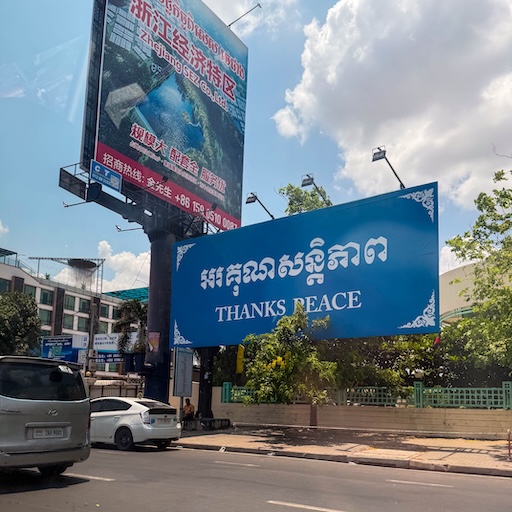
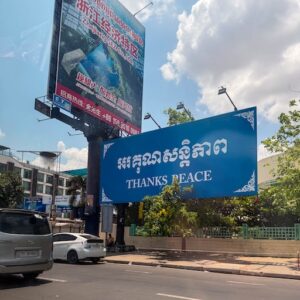 One of the last things I saw before we turned off and went into the airport was a large blue sign with a single phrase in Khmer script, no picture. Below the large word was an English subtitle, which just said “THANKS PEACE.” I wasn’t sure what they were selling or who posted this, but it seemed like a nice coda to the week.
* * *
I tipped the driver a large fistful of Riel that was soon to be worthless to me, and he was confused as to why I’d pay him extra. Inside the terminal, I realized I was like five hours too early to check in, and there were no lounges I could access. I bought a couple of cans of Coke Zero and found a table in an open cafe where it was air conditioned and I could work without hearing someone on speakerphone. I chipped away at my next book for about two hours, which was nice, especially since I got basically no writing done all week. I’m discovering that I can’t really get much done on my new laptop computer and the small screen. I’ve pretty much conditioned myself to using a big external monitor and my weirdo ergo keyboard. Fair enough.
Check-in and customs was a fairly minimal experience, with no crazy questions, no problems. Once I got through security, I ate a subpar chicken sandwich at a Burger King and then found an Amex lounge where I could sit in a little cubicle and dissociate for a while. I thought maybe I’d buy a last-second gift or two with my remaining Cambodian money, but I wasn’t going to spend $68 on a Hard Rock Cambodia t-shirt. I took most of the remaining Riel and shoved it into a Red Cross donation box. Then I fought my way onto the plane, which took patience, because the concept of lines hasn’t really made it there yet.
After a quick two and a half hours, I was back in Hong Kong, with the usual bustle and futuristic weirdness. I landed just in time for most of the duty-free shops in the mall to be closing for the night. This is an airport with 89 boarding gates, so even with a two-hour layover, I immediately went through security as fast as possible, then started hustling in the direction of my plane. I reluctantly stopped at a McDonald’s for the usual two-cheeseburger meal, then completely forgot about arming up with waters and Cokes before being shoved into yet another screening line, where a belligerent representative of the Chinese government asked a bunch of random questions about the usual. I just gave them yes/no, destination/length. Saw a woman a generation older than me going into an extended monologue about her travelogue and what friend they wanted to see and what they ate yada yada and I was thinking, “You poor idiot. Good luck with Chinese prison.”
I had a bulkhead exit row seat again, but planned on not sleeping. They put me next to a 400-pound guy who wanted to talk my ear off about work for the entire flight, but he eventually fell asleep. Food on the flight was completely inedible, again. They were also extremely stingy with the fluids and I finally got sick of waiting and just got up, went to the galley, and started pouring myself Cokes. I paid an extra $400 for the seat, so why not.
The entertainment center had a random mix of movies, mostly Asian. I went to the “classics” section and they had a wide swath of what I’d categorize as “movies I’d always surf into the middle of on the TBS Superstation on a Sunday, start watching, then fall asleep to.” I watched Empire Strikes Back, Return of the Jedi, and The Fugitive, a bit of a Harrison Ford marathon. I also put on Apocalypse Now, which is pretty burned into my head, but I hadn’t seen it in a few years. I had a whole new take on it after after having just been in Cambodia, and I guess Saigon last year, although it wasn’t actually filmed in either, and the river was fictional. It made me realize how two-dimensional the backdrop of the river and the jungle were to the characters and the story, and gave me this new sense of depth to the 147 minutes of the masterpiece.
I landed in SFO at 10:00 and waited forever to get through customs. They initially had a single agent for two widebodies that landed at the same time. Everyone was wondering if customs would be impossible given the current regime, and we all were shutting off phones, disabling Face ID, but I didn’t see anyone get pulled aside. Not saying it’s not happening, but it was pretty sedate on a late Saturday night.
I caught an Uber back home, told the driver about how I’d been flying for the last 24 hours. He was an Afghani national who was initially very guarded about that, but when I mentioned I had family from Pakistan, he opened up and I had a great conversation with him. We talked about both Cambodia and Afghanistan, how he wanted to visit his family back there again, how he missed the food and the people and maybe someday it would be safe again. I also said I wanted to visit, because I needed to learn about the people there. He said something that stuck with me, and summed up the last week perfectly: “It’s always better to see than hear.”
Anyway. Good trip. Already planning the next two for 2025, so stay tuned.