The Wrath of Kon

Dispatches, thoughts, and miscellanea from writer Jon Konrath

The Retail Race to the Bottom

IMG_0631

The Borders by my house looks like a food warehouse two years after the apocalypse started.  I went a few weeks ago, when the sign dudes stood on the corner with the “ALL TITLES 40-60% OFF”, hoping to snag an armful of good science fiction, because I’m going through this phase where I’m trying to read everything I “should have” read when I was a kid and too busy poring over Car Craft and trying to figure out if I had to replace the front springs in a ‘76 Camaro if I wanted to swap out the 305 for a 454 that I couldn’t afford in the first place.  I found maybe two or three books I wanted, but everything else was already picked clean.  They still had stacks of “destined to be remaindered” books, but I didn’t need to Teach Myself HTML 4 in 30 days, so I ignored all of that shit.

The whole store was so depressing, for some unexplainable reason.  Store designers spend untold sums doing subtle things to layout and placement to hypnotize consumers in optimal ways to buy more stuff or feel more comfortable or set the mood.  You don’t notice it, but if you’ve ever worked in a department store and you’ve spent time after hours during a massive store reset, when pieces are scattered everywhere and the kayfabe has been dropped, you know the deal.  Something didn’t look right, and it wasn’t just the hoarders digging through the out-of-date celebrity cookbooks, looking for a deal.  Half of the entrances were boarded up already, covered with giant vinyl banners advertising the fact that everything but the fillings in the cashier’s teeth had to go.  And something about the lighting, the vacancies in shelves, the massive numbers of books in the wrong place, faces out - it made me feel overwhelmingly depressed that this place would soon be yet another vacant storefront.

I don’t even shop at that Borders; I think I’ve bought a grand total of three books there since I moved to the East Bay in 2009.  I’ve eaten at the neighboring food court quite a bit, so I guess it’s become part of the routine to go there after a falafel or some Afghani food and shuffle through the magazine racks.  But I somehow feel both strange remorse and responsibility for the sinking of this ship.  And it’s not that I miss this Borders as much as it sets off a chain reaction of emotions and memories about all of the other stores that have turned to vapor and vanished in the last decade or two.

I used to love malls.  Ask my pal Larry about the overwhelming obsession I had with wandering million-square-foot indoor shopping empires, and he’ll tell you stories of being dragged to College Mall for no reason other than to run the circuit, walking up and down the hallways  and then ending up at Morgenstern’s Books for two hours to ogle over every single World War II book in stock.  (And Morgenstern’s wasn’t even technically in the mall - it was in a strip of stores across the street.)  I found some strange peace in going to any Simon-operated property and wandering past every storefront, from Ayres to Zale’s, looking at mannequins donning bad early 90s attire.  It wasn’t even that I bought anything; I wasn’t like one of these housewife machines that walked out of the clothes stores with a maxed out piece of plastic and two armfuls of boxes.  I’d just get some osmosis-hypnosis effect, listening to the muzak and peoplewatching.

But those bank-issued sixteen-digit hologrammed devils did get shelled when I went to record and book stores.  All through college and my time in Seattle and New York, it was a weekly ritual to take every ounce of disposable income to the media gods, the places that stocked my fix for reading and listening.  In Seattle, I had a two-night-a-week habit locked in at Silver Platters, this CD palace up by Northgate mall.  They had this certificate plan where you got a paper dollar for every title you bought, but if you went in on Tuesday or if you bought certain sale items, they’d give you extra points.  And if you came in on Wednesday, you could turn in your dollars for extra value.  So I’d go both nights, buying armfuls of every Gary Moore or Peter Gabriel import single I could find on Tuesday, and then redeeming these paper coupons for more stuff on Wednesday.  And I’d end up there on weekends anyway, spending my Saturday afternoons cruising all of the other retail outlets nearby.

And I had this routine with the book stores, too.  Every Friday night, I’d end up at the Barnes and Noble in Bellevue, after gorging at the Denny’s there and scribbling in my notebooks for hours.  I’d wander the stacks, pulling books that looked interesting, things I could consume, inhale through the late nights.  I’d end up reading some obscure title in bed late into Friday, knowing I’d been hypnotized too long when I’d hear the sound of the landscaping sprinklers seven stories below my open bay windows going off at 5 AM in the Jet City darkness.

New York helped break me of the mall habit.  There aren’t really malls in Manhattan; the square footage of a single food court could be broken up into a thousand studio apartments renting for two grand a month, so you’re not going to see that shit unless you take a train to Jersey City.  And I did, for a while.  I’d take the N to the Path, and emerge in this bizarro world where people drove cars and parked in outdoor parking lots and shopped at huge Simon-owned palaces of consumerism.  But these trips became less frequent.  Any time I found myself in a strange new (or old) land like St. Petersburg or Pittsburg with keys to a car in hand, I’d visit the old haunts and take a lap or two, get a corn dog on a stick and think about the days when I wore the name tag and listened to the muzak professionally for hours on end, asking people if they needed help with anything.

But then Amazon happened.  I started buying books from them way back; I remember in I think 1996, buying an old book I could not find anywhere else on the history of Indiana University, and it slowly became my go-to place for the things I could not dig up at Elliott Bay Books.  CD Universe entered my ecosystem around then too, and I’d hunt down the rare finds I couldn’t get at Silver Platters.  Amazon went from supplementary purchases to my main outlet for everything, as my go-to media places in New York began the long slide into nothingness.  I dumped serious cash at the Virgin Megastore in Times Square, which used to be on the first floor of where I worked (very dangerous), but is now a Forever 21 clothing store.  I also made the Best Buy pilgrimage every Saturday, when they still sold CDs.  Now, unless it’s Miley Cyrus or Lady Gaga, good luck finding anything there.

So yeah, my purchases, or the trends behind how people like me make purchases, may have killed off the retail stores.  I don’t know; I know I don’t even buy CDs or DVDs anymore, and either get stuff through iTunes or stream it from NetFlix.  I still buy paper books, but I also buy stuff for the Kindle.  So I’m sure the anti-digital luddites can scold me about how it’s my own damn fault that Borders filed Chapter 11.  Except for the part where Borders has lost money every year since 2006, or how they thought back in 2001 it would be genius to hand over their online retail operations to Amazon.com, or how in early 2008 (when about 7 people owned a Kindle) they announced they were so in debt, they were going to sell out to Barnes and Noble, a misstep that plummeted their stock price through the floor.

You can armchair quarterback this one in a million different ways, and the same holds true for any big retail collapse.  Blame it on Wal-Mart, or online sales, or poor holiday seasons, or the cost of gas, but it’s really this perfect storm of different things that makes it too complicated to predict or correct.  I mean, I always bemoan the shuttering of Montgomery Ward, where I did my time as a teenager and did a couple of summer moonlighting stints in college.  Most blame a bad 2000 Christmas season as the reason for their bankruptcy, but there were so many other factors: the debt from their leveraged buyout; the two-front war against discounters and other department stores; the failed attempts at re-marketing themselves; the expense of facelifting a bunch of their stores; the hundred million dollars they threw at IBM to overhaul their computer back-end.  Some even say the problems go back to just after the end of World War II, when the company focused all of its energy into building stores in the heart of metropolis areas and resisted expanding into the suburbs.  But it’s one of those things where you can’t just say “the internet killed it” and leave it at that.  And I think Borders is the same way; I think their mistakes at running a business go back much further than the advent of an e-ink screen or even the HTML shopping cart era.

And there’s all of these other things that have changed since I was in high school that alter the game.  People used to buy stuff from mail-order houses, or from catalogs; then they switched to malls; then big-box stores; then discount stores. Indoor malls have been “de-malled”; outdoor malls have shifted from low-end to boutique and probably back again.  People “don’t read anymore”.  The middle class is gone.  Gas costs as much as uranium did when I was in high school.  Book stores only sell clip-on lights and picture books of cats dressed as movie stars.  Everyone is an obese hoarder that never leaves the house.  Kids keep playing these god damned video games and Angry Pac Bird Mans.  Focus groups and religious nitwits and crowds of “what about the children” whiners have killed off anything more controversial than a loaf of Wonder bread.  All of this is true.  None of this is true.  The more things change, the more they stay the same.  Things never change.  Things work in cycles.  People never forget failures.  People don’t remember what happened five minutes ago.  I don’t even remember what I was talking about.

I was trying to remember the last time I’ve been to a mall, and I can’t.  We have a “mall” just up the road from us, one of those new urban bullshit outdoor mall things that has apartments in the top tier of it, and an Apple Store and some movie theaters, and a bunch of stores I’d never shop at, and a parking garage that is always a total clusterfuck.  But I can’t think of when I was last in an indoor mall.  I think I went to the Concord Mall during a visit to Indiana in like 2007, and was amazed at how totaled it was, how the old Wards store got cut into three or four pieces and turned into a discount car stereo place and some kind of hillbilly craft store where post-menopausal women buy glitter to paste on their angel centerpieces.  No wait - we had an indoor mall, Tanforan, by our old place in South San Francisco.  It was more or less the no-man’s-land between a Target, Penny’s, and Sears, with a big movie theater, and two floors of places selling clothing I’d never, ever wear.  It’s the kind of mall that made Pierre Moran mall in Elkhart (aka the “other mall”, where “other” means “not white”) look big, and they de-malled Pierre Moran about five years ago.

Must stop writing about this, because every paragraph I write involves about 200 web pages of nostalgic searches for old department store catalogs, and I’ve got other crap to do.

Rumored to Exist eBook Now Available

“One day in 1971, Ozzy and Tony Iommi took 47 hits of acid and just outside of Newark, New Jersey accidentally found the giant tablets of gold from which the Mormon religion was founded.  They decided it would be wise to melt it into a giant bong and take it on the road with them in a converted tractor-trailer.  With the aid of an early prototype of the first Apple computer, they hired several technicians and wrote a text-based video game based on the works and philosophy of John Locke, where you used the paddle controller to navigate corpuscles through a maze drawn with *’s and %’s.  However, in the course of developing the first video game, they sold all of the gold plates to fund the venture.  And after another acid bender, Ozzy had a vision of Locke arisen from the dead.  He sold his Apple computer to buy thousands of gallons of pure, artesian water for the mammoth bong that did not exist.  Ozzy went insane, and in a few years, Ronnie James Dio was trying to sing ‘Iron Man’ to clubs full of disgruntled Sabbath fans.”

-from section 99 of Rumored to Exist

I’m proud to announce that my second novel Rumored to Exist has been released as an eBook in the Amazon Kindle store and via Smashwords.  It’s now available for only $2.99, in a new revised edition.  This is the latest release from Paragraph Line Books, publishers of fine outsider and absurdist literature.

Rumored to Exist is a collection of 201 vignettes or flash fiction pieces, loosely tied together into a non-linear narrative about a protagonist attempting to find meaning in a bizarre near-future world. It’s a densely packed stew of ideas flashed together, morphing between dreams, emails, conversations, and action. It’s a novel in the style of Naked Lunch, written for today’s short-attention-span hypertextual world.

Influenced heavily by Burroughs, Mark Leyner, Raymond Federman, and Hunter S. Thompson, I knitted together the dense patchwork of fiction over a seven-year period in a half-dozen cities across the US.

It’s also still available in its original print edition from iUniverse, but why spend $15.95 and wait a week to kill another tree, when you can spend under three bucks and check this out now?  There’s also a free preview available on both Amazon and Smashwords, so check out the first part for free.

More info


Buy it now

Details

  • 264 pages (print)
  • ISBN: 978-0595234769 (print, iUniverse)
  • ISBN: 978-0-9844223-1-9 (eBook, Kindle)
  • ISBN: 978-1-4581-0977-4 (eBook, Smashwords)

The Death of Death

DSCF2946

I was in the allergy clinic last week, waiting for my arm to swell up until it looked like it took a Justin Verlander fastball, and I saw some magazine with a cover story about man reaching immortality. I didn’t read the article, because I know there are exactly two types of articles in magazines: 1) “Everything is fucked and we’re all going to die,” and 2) “You really need to buy this random useless gadget, or you’re worthless.” (I guess there is a third type, which is 1+2.)

It’s not an unfamiliar concept, especially if you read a lot of SciFi: eventually, we’ll get to the point where all of the diseases and maladies that currently kill off people will be treatable or curable, and the only way to die will involve motor vehicles with a fast 0-60. That’s not to say all people will live forever; everyone who can afford it will be able to.  Also, maybe there will be some kind of Logan’s Run cutoff date or death lottery or other optional euthanasia scenario which will prevent infinite population growth.  But what I find interesting is that immortality is already available to the ultra-infamous, and we just saw an example of it this week.

So Osama Bin Laden found himself on the wrong side of a SEAL team last Sunday. They installed some additional ventilation to his brain, which had the side effect of stopping his pulse for an indefinite period.  Half the world took the opportunity to get drunk, scream “USA! USA!”, wave flags, and thank the wrong president for a job well done; the other half of the country posted quotes incorrectly attributed to the wrong civil rights leader.  I’m not here to condemn or condone either reaction, except to say that I had a different one, which is to acknowledge that Bin Laden did not die, because at this point in time, nobody of his stature can die.

Before anyone flies off the handle, I don’t mean that OBL was a great guy or anything like that.  What I mean, is that in today’s world, when you get to a level of infamy like he had, there will always be people who insist you are alive, regardless of your body temperature or lack thereof.  Governments are corrupt, and media is worse; we see constant examples of that.  Things get covered up, and conspiracies occur, so any time anything happens in the world, a plurality of people will insist that it didn’t.  People so carefully cherry-pick their news from partisan sources, any time they hear something they don’t want to believe, they move on to another news source until they find the one they agree with.

Case in point: how many people believe Bin Laden really got killed?  I’m not saying the number is down there with the percentage of people who think the Washington Nationals are an awesome baseball team, but it’s not 100%, either.  The government didn’t drop fifty tons of Mk.82 love from 40,000 feet and turn the entire village into jelly, so there was a body, and there was DNA testing done. (Or was there? The fact that I don’t know this off the top of my head sort of proves my point.) But there weren’t rotten.com-style photos released, and the body was quickly buried at sea.  That’s fine by me, but it means that there will forever be doubt in some peoples’ minds about whether or not this really happened.

And there’s a whole list of reasons why people don’t want to believe.  Some think there’s no way that the current president could have pulled off such a coup when the last one spent 7 years burning calories on a quest to do the same thing, but failed.  Some people think the whole thing is an October Surprise situation, a Wag the Dog scheme to bump up poll numbers.  There’s a group who think 9/11 was engineered by the government in the first place, and this dude had little to nothing to do with it, so a scripted end to him brings a false closure to that whole operation.  And who knows what other motives are there for a lack of trust.  But some folks on both sides of the spectrum will insist that OBL did not die on 5/1/11.

This sort of reaction isn’t limited to high-ranking terror suspects.  Did Tupac die?  You’re a google search away from his autopsy photo, but “tupac alive” also gives you four and a half million results.  What about Michael Jackson?  JFK?  Elvis?  People elevate superstars in their mind, making them larger than life.  When that life happens to end, the legend continues, and that dovetails nicely with a media that prints anything for money and a political system that does the same.

So now the White House wrings hands over whether or not to release some death photos.  But peoples’ minds are decided.  They could cart out that corpse during sweeps week on Dancing with the Stars and it would get a twenty share and people still wouldn’t believe it.  The Navy could personally bring his dead body to your doorstep like Ed McMahon with the Publisher’s Clearing House cardboard check, and you’d still say, “I dunno - looks fake / you could put that beard on any homeless dude.”  I know the dude’s probably dead, and to me, that’s not a bad thing, but the speculation will continue forever.

And I can see why they did a burial at sea.  I was in Berlin a few years ago, and I did not seek it out, but I walked past the spot where Hitler’s bunker once existed on my way to Potsdamer Platz.  They’ve since put up a sign, but at that point, the Fuhrerbunker was underneath a Chinese restaurant, and nobody was in a hurry to mention it to anybody, for fear that every skinhead with a passport would show up to turn the place into a Neo-Nazi Graceland.  People get weird about stuff like that.  When I lived in Seattle, people still cruised past Kurt Cobain’s old house, looking to get a glimpse of the garden house where he offed himself.  (It’s gone now, BTW.)  And I just recently wasted too much time on Google Maps, trying to find the spot in my neighborhood where Black Panther Huey Newton got gunned down in 1989.  (The exact spot on the sidewalk where he died now has a sign warning you of the speed bumps on the street. Unrelated — or is it?)  I could see the reluctance to having a burial which would become a monument to whatever followers might still be knocking around decades from now.

At any rate, this all shows we’re at a weird time in history.  It used to be you remembered where you were when you heard about things like this. Now, when something monumental goes down, chances are you’ll first get the news on the computer, which will make all of these events blend together.  And when it happens, people will flock to Google Maps to find the death site; they’ll reload their twitter feeds over and over to get the latest distorted quotes and unvetted news.  Back when I was a kid and a space shuttle exploded or a president got capped, even the pre-emption of all three TV channels brought little information.  Now, there’s too much, and we only believe pieces of it.  Not sure which one’s worse.

[2020 update: wow, not to get political, but this got way more horrible in the last ten years. I never thought we’d get to the point where like half the country thinks the world is flat, but here we are.]

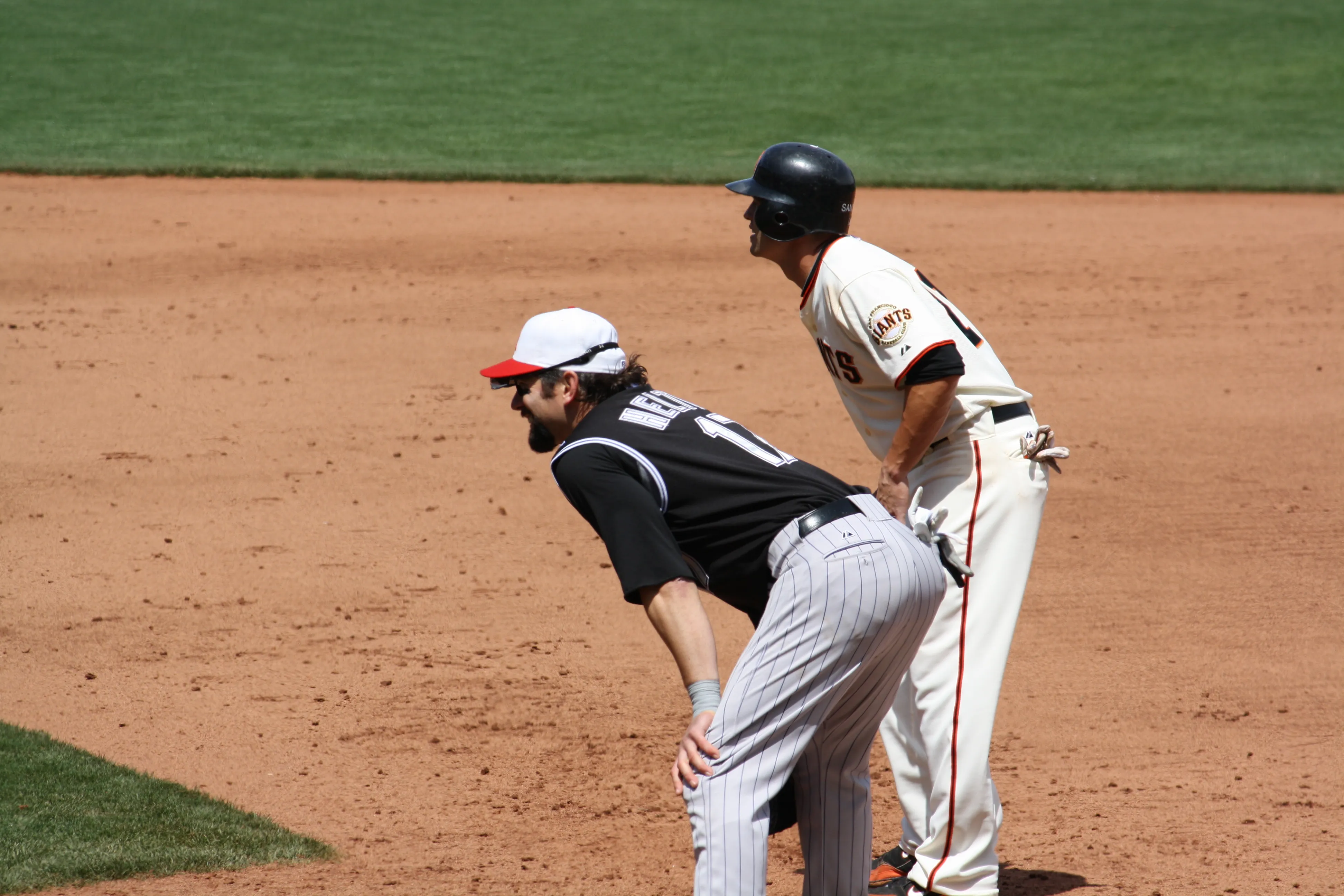
List: 30 Ways to Reach First Base

IMG_1899

  1. Hit a single.
  2. Reach on an error.
  3. Walk on four balls.
  4. Get hit by a pitch.
  5. Catcher drops the ball after the third strike.
  6. Fan interference.
  7. Catcher interference.
  8. A pitching infraction that results in a 4th ball.
  9. A pitched ball lodges in the catcher or umpire’s mask on the third strike or fourth ball.
  10. Replacing another player that just reached first base.
  11. Purchase failing MLB franchise, build new stadium, create a ground rule stating that a player with your exact name is awarded first base at each at bat regardless of the strike/ball count, add yourself to the 25-man roster.
  12. Star in a stupid movie based on a British book written about a different sport, run on field to chase romantic interest Jimmy Fallon.
  13. Take a 25% dose of the steroids normally used to hit home runs.
  14. Take 4 train from East Side or B/D train from West Side, stop at 161st St, enter at gate 6.
  15. Hire Uri Geller, learn secrets of hypnosis, hypnotize all defensive players and umpires.
  16. Jet pack.
  17. Time at-bat with zombie apocalypse, wait until all players are infected, have co-conspiritor drop large pile of human brains on the warning track by center field.
  18. Build time machine, send cyborg back in time to kill pitcher’s parents; repeat until you get a really bad pitcher you can easily hit.
  19. If you play first base, you will always reach first base nine times, provided you don’t leave the game early.  (Why isn’t this ever on any of these lists?)
  20. Have fans throw batteries at the head of the pitcher.  (Works best if you play for the Phillies and are at a home game.)
  21. Scout a pitcher born with phenylketonuria; feed him large amounts of aspartame prior to his start.
  22. After strikeout by a pitcher born outside of the United States, petition the United Nations Commission on International Trade Law for arbitration, arguing the pitcher’s work status is in dispute due to paragraph 9 of General Assembly resolution 2205 (XXI) of 17 December 1966.
  23. Up-down-up-down-left-right-left-right-A-B-Start.
  24. Either build a second moon, or move an asteroid into Earth orbit, with enough mass to change tidal patterns and conversely change barometric pressure to alter the pitcher’s ability to locate the ball correctly.
  25. Do not give the pitcher LSD (especially if it is Doc Ellis.)
  26. Start a facebook petition to put you on first base.
  27. Travel to bizarro alternate reality where you get to advance to first base after you swing at nothing three times.
  28. Send a photo of a gun to the pitcher’s cell phone. (This probably works best if you are Elijah Dukes.)
  29. Be the daughter of Bud Selig when he is on first base and suddenly needs it to look like he doesn’t own first base because he took a new job.
  30. Practice.

On writing tools

In my last post, I talked about my old standby writing tool, emacs, and how I’ve made a gradual break from it.  So here’s what I’ve been doing.

First, there was a recent stream of different full-screen writing tools dumped on the market.  It’s the latest fad: some program that closes off everything but a single window to write.  To me, that seemed largely stupid; you just expand your editor window full-screen and shut off your IM program, right?  Well, there’s more to it than that.

First, I have horrible ADD or ADHD or something.  Not diagnosed, no pills or doctors, but I - what was I talking about?  Seriously, I have a hell of a time focusing on writing these days, especially with all of the distractions out there in the internet world.  And writing involves a certain amount of self-hypnosis, that ability to suspend disbelief and not even think about writing, but still type it on the page and channel your subconscious and capture it into your work.  And it’s damn hard to do that when you can click on the other window to check your twitter feed and derail the whole thing.

For a while, I would either turn off my wifi, or I would use this program called Freedom, which completely locks your internet connection unless you reboot.  (And those of us who don’t use Windows aren’t in the habit of rebooting hourly, so this is a Big Deal.)  I know, I should just be able to shut off wifi, or just not click on that god damned browser window.  But I can’t.  It’s nice to be able to completely childproof the process.

I also experimented with trying to fake a full-screen writing program with emacs, adding some margins and pumping up the font size, so I could go full-screen and only have a nice blank page to stare at.  But one day, in a fit of writer’s block fury, I went to the app store and picked up a copy of OmmWriter.

Screen-shot-2011-04-17-at-10.49.49-AM

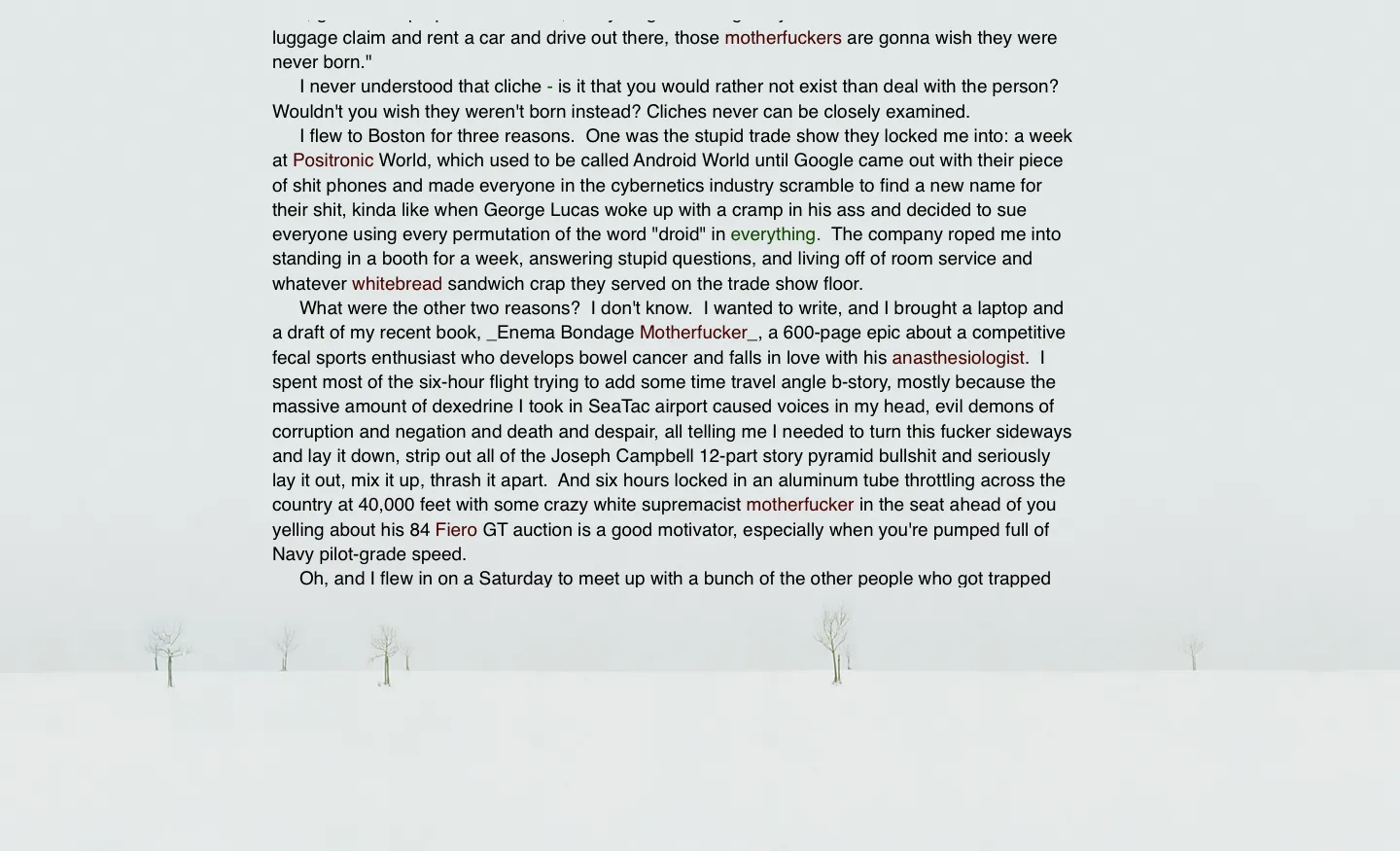
OmmWriter is pretty damn amazing. Basically, you start it, and it opens a text editor over your entire screen, plain and simple.  But the little details are what make it so slick.  First, it shuts off all notifications.  If you’re using Growl to sling popups when you get new mails and whatnot, those all get halted.  Next, it draws this background picture of a winter landscape that looks like some lost Tori Amos album back cover.  And as you start typing, the borders and minimalist menu buttons fade away.  The fonts are very readable and high-design typography too; no more Courier New or whatever the hell emacs uses by default.  There’s also a word count tally at the bottom of the resizable text area that will vanish as you get to work.  And there’s a choice of several mellow, new-agey ambient soundtracks that play in the background.  And all of this sounds hokey, like I’m about to talk to you about an opportunity to resell some healing crystals to your family and friends, but it seriously works.  I don’t know why, but it made it much easier to fade into the work.  It was awesome for journal entries and articles and brief bursts of automatic writing.  But it was not a full-fledged content management system; there’s no way I could write a book in this thing.

Side note: this thing uses OSX’s text editing widget or engine or whatever you call it.  And something I did not realize: most of emacs’s key shortcuts work in any program that uses this.  So if you reflexively use Ctrl-A and Ctrl-E to jump to the start and end of a line, that totally works, either in the Mac’s TextEdit, or a program like Ommwriter.

So I’ll cut to the chase: after a few other trials, I finally got into using Scrivener.  And it has completely changed the way I write, because it finally does what I need to keep organized.

One of the biggest things is I need a system that can deal with me writing in “chunks”.  There are other virtual index card systems, but they typically don’t let you meld the cards into one huge work.  And outline programs are great (I’m a long-time user of OmniOutliner) but I always hated trying to reconcile changes in the actual writing with changes in the outline and vice-versa.  I wanted a way to have the outline be the document.

Screen-shot-2011-04-17-at-11.14.24-AM

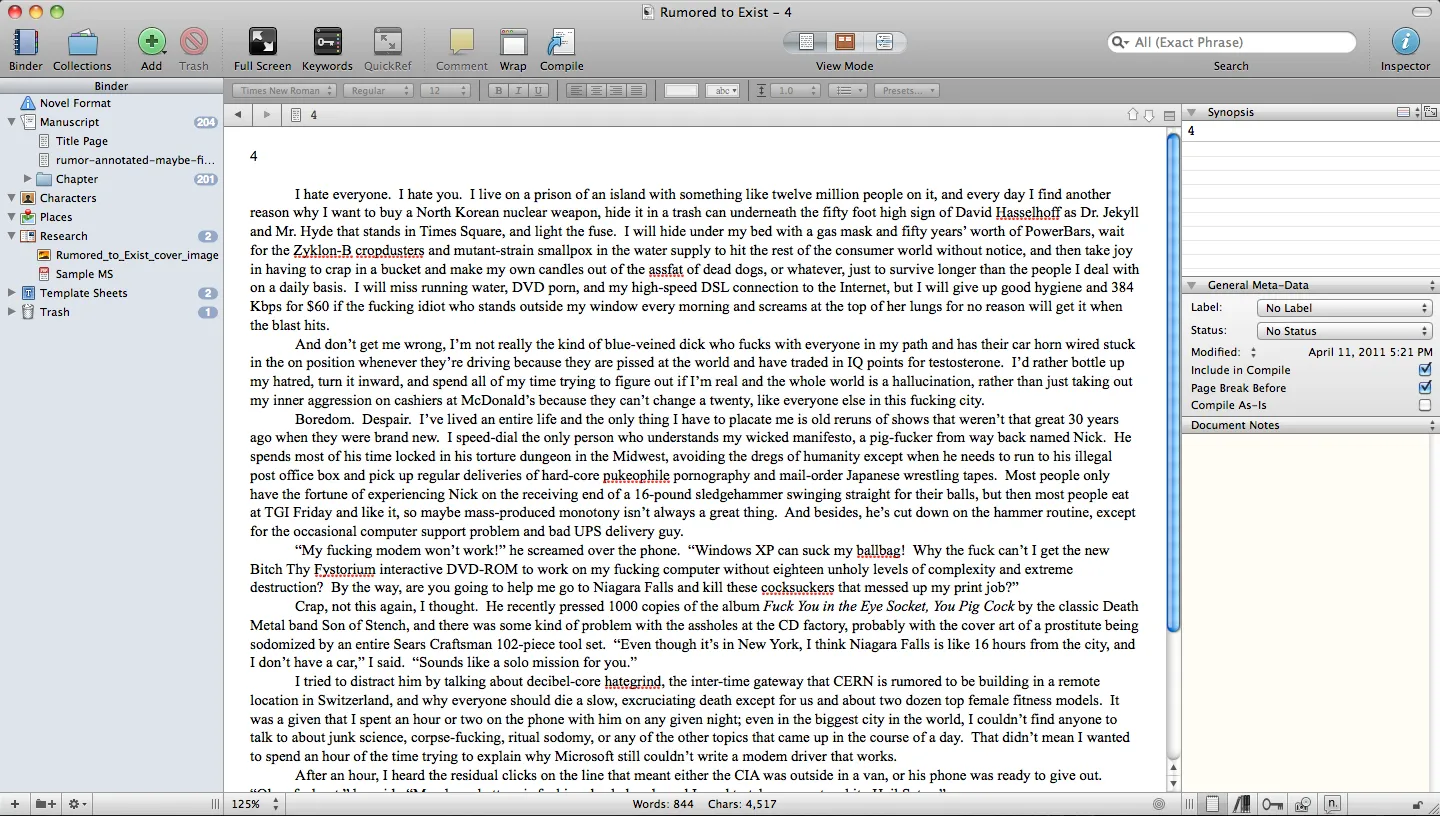
Scrivener is a lot like modern IDEs you’d use to write code: there’s a binder that’s a project-level collection of folders, with one folder being the actual manuscript, and the other folders being whatever the hell you want.  In a folder, you can create other folders, or you can create documents.  So let’s say my manuscript has a dozen chapters, I can make each of those a folder.  Then in each folder, I can have a bunch of text documents, one for each scene or paragraph or whatever the hell I want.  I can drag those around in any order, chop them into smaller pieces, merge them, add more, delete them, whatever.  Then when I click on my chapter folder in the left navigation pane, I’m presented with every piece in that folder, all glued together into one document.  Click at the root level, in the manuscript folder, and you’ve got your entire book.  It makes it very easy to write in fragments, and move things around easily.  This is pure magic for me.  I really wish I had a program like this when I wrote Rumored to Exist - it would have saved me at least a year of time.

Here’s the real beauty.  You like to work with index cards?  Each of these fragments has an associated title and page of metadata that you can see in the right pane inspector.  You can type in a little blurb of what happens in your fragment, or what needs to happen, or what you want to fix.  Then you click a button in the toolbar, and instead of seeing the text editor, you see a corkboard with a bunch of index cards, each one being that metadata for each text document.  If you don’t like the order, drag them around and make it work.  When you go back to the text editor, all of your pieces will be reordered.  You want an outline?  Click another button in the toolbar, and you see all of your documents and folders and stuff in an expanding/collapsing outline.

I take a lot of notes when I’m writing, and have all sorts of loose text documents and other crap associated with a project: loose wikipedia articles, jpeg images, maps, whatever.  Instead of throwing all of that in a directory on my hard drive, I can keep it all in a folder that resides outside of my manuscript.  And you can totally hyperlink this crap, too.  So you can have a page per character, with facts and stats about the person, a character sketch or notes or whatever else, and you can drop links in there to scenes where they appear.

There’s a full screen mode, too.  It’s not as pretty as the OmmWriter one, and it does not have any Brian Emo ripoff music playing, but it works.  It’s pretty easy to jump back and forth between the full screen and the three-pane mode, which is good for me; I can focus on inputting long passages of text, then jump back into org mode and move things around.  I’ve still got those emacs shortcuts too, because it uses that Mac text engine.

One of the big issues I had too was import and export.  I really can’t have my stuff locked into a proprietary format where I can’t get it to a publisher or to someone for review.  Scrivener has very good import and export functions; you can work in this weird nonlinear format, and when you’re ready to lock it down, you press a compile button and jet out a copy in RTF for your Microsoft Word-impaired buddies.  Need it in plain text, or Final Draft, or HTML, or PDF?  No problemo.  It gives you a fully submittable, standard format document that’s ready to go to the world.  And here’s something awesome: you can press a button, and it will spit out a perfectly formatted .mobi file, ready to submit to the Kindle store.  (It does .epub too, if you’re not down with Amazon.)  All of the exports are very configurable, too.  So if you need different headers or footers or page breaks or fonts or whatever, you can screw around with that stuff to your heart’s content.  You can also do weird stuff like import or export parts of your document automatically.  So you can do stuff like use a standard text editor to take notes on another computer or your phone, then dump that stuff into Dropbox or a shared directory, and Scrivener will pull those files into your binder, or vice-versa.

Screen-shot-2011-04-16-at-11.02.28-PM

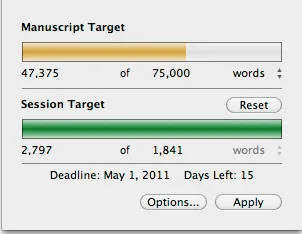
Another big thing for me is statistics.  I need to know at any given second how many words are in a project.  Whatever you have open in the text editing pane (chapter, fragment, manuscript, whatever) has a word count in the bottom bar.  But you can also do a quick Ctrl-Shift-T and get a word count for the project.  You can also set a goal date and count, and it will calculate how many words you have to write that day, and pop up a nice little reminder in Growl when you hit your target.

There are tons of other features I will never figure out.  It has comments, and little flags you can set to indicate if something is a draft or a revision, and snapshots, and citations, and tons of search and replace things I have not figured out.  But the ability to write in a completely nonlinear fashion is a big thing for me, and this works way better than any other system out there.

Anyway, if you’re in a similar predicament, check out their site and download the free trial.  The learning curve is steep, and I initially had a big freakout trying to figure out how to carve my next book project into the right type of pieces.  But I’ve got the next book underway and it’s motoring along fine.  And I’ve imported both Summer Rain and Rumored, and I’m vaguely thinking about dumping those to the kindle.

Enough babbling about tools.  Time to get back to work.