The Wrath of Kon

Dispatches, thoughts, and miscellanea from writer Jon Konrath

2016

Recent k-holes: maps

I’ve been falling down some horrible nostalgia k-holes as of late. Here’s an exercise you should never do: go find the toys and games and things that completely obsessed you at the age of about twelve, find the addresses of the corporate headquarters offices of their makers, and plug them into Google Maps. The total disconnect between what you envisioned as a child and what these places look like now are phenomenal.

I think there are a few reasons this fascinates me. One is, I never travelled much as a kid. Any preconceptions about any area outside of northern Indiana/southern Michigan or Chicago was either based on TV, or just a guess. I never had any spatial awareness for any other geographical areas of the country. When I was playing with Star Wars toys and somehow found out they were made in Cincinnati, in my head, that meant WKRP, and Les Nesmond’s domain was the same as where my Han Solo was injection-molded. Never mind that the show was a loose montage of stock footage for the establishing credits, and then some sets at CBS Television City in Los Angeles. (If you’re curious on this one, btw: http://www.kennercollector.com/2013/12/kenner-tour-of-cincinnati-kenner-street/)

Another thing that informed these thoughts is that these toys and things were everywhere, so I envisioned massive operations, Detroit-sized city-factories, pumping out GI Joes and Milton Bradley board games. In reality, most of these were small operations, with a few dozen people working on a couple of machines. I probably should have known this, given that my dad worked in a factory, except instead of Hot Wheels, it was pumping out PVC pipe fittings. But they could have just as easily swapped out the molds in their machines and injection-molded Atari joystick pieces or whatever else.

Here’s a couple of examples of these rabbit holes. One, I was into model railroads as a kid. It was a passing phase, somewhere between Legos and model airplanes. I was never that interested in the train aspect, more the scale model stuff, but I also enjoyed the electronics, and the track layouts. One of the big names back then was Atlas Model Railroad. When you got the pre-packaged oval-track train set on Christmas, it was a Tyco. (Or Lionel, if you were O-scale.) But when you went to Kay-Bee Toys or a local hobby shop, Atlas was the big ubiquitous brand of cheap add-on track, running gear, and other accessories. If you read the train magazines, they worshipped the expensive imported German trains, or scratch-built stuff, and eschewed the Atlas stuff because it was cheap or not as detailed. But I wasn’t a retired dentist and didn’t have the cash, so Atlas it was.

And although I bought a lot of their track, the big infatuation back then was their layout books. They published these paperback 8.5x11 blueprint books with a bunch of different track designs in them, things that would fit on various table sizes. The books were well-illustrated, lots of details, and most importantly, had parts lists of everything you needed to build and wire the setups. Of course, these were all intended to get you to go buy more Atlas stuff, and it worked, because I would make endless lists of part numbers and pieces I needed to buy with my allowance. I would get so lost in those books, even though I never fully built any of those layouts. I just enjoyed reading the blueprints for hours, dreaming about what I could build if I had an unlimited budget and way more space.

So, in my twelve-year-old head, I always thought about the Atlas headquarters when I saw the address in the corner of a package or book. They were in Hillside, New Jersey. New Jersey was right there by New York. And I’d seen Ghostbusters, so of course I knew exactly what that looked like. I envisioned the Atlas empire as being something like the Chrysler Building, a hundred or so floors of people packing up HO scale snap-track in yellow envelopes and shipping them off to the sixteen billion stores that sold the stuff. Well, not quite. First, I didn’t know back then that New Jersey wasn’t New York. It’s not twenty square miles of bedrock with massive skyscrapers; it’s thousands and thousands of square miles of warehouses and single-story homes and suburbs sprawled out in every direction.

So, plug in 378 Florence Ave, Hillside, NJ 07205 and you get an unassuming two-story brick building, about the size of a bowling alley. At first glance, it almost looks like a junior high school, and resembles half of the factories near where I grew up, with a single semi bay and a parking lot for a dozen and a half employees. It’s right off the I-78, around a bunch of postwar cape cod houses wrapped in vinyl siding, maybe two miles west of Newark Airport. I haven’t even thought about model railroading in decades; I’m sure they still do great stuff. But the reality of the company is such a disconnect from what I thought of as a kid.

Seeing this building and the surrounding neighborhood is such a strange look inside something hallowed from childhood, something I could never see in the pre-internet days. Sure, looking at a Google Maps photo sphere of Pyongyang, North Korea is astonishing and bizarre (another k-hole to fall down…) but slicing open a childhood memory like that and attaching a completely different context to it is oddly mind-blowing. I mean, I flew in and out of Newark many times; I took the PATH over to Jersey and walked around, drove a car through the suburbs and probably ate at the Taco Bell just around the block from that place. But it’s a weird words-colliding thing to think about that now.

Here’s another big one: D&D. Like most geeks, I was stuck on Dungeons and Dragons back in the day. (Unlike many people who now say they are geeks, this was when geeks were geeks and you’d get the shit beat out of you for being into stuff like D&D.) From maybe fifth to seventh grade, I was infatuated with all things TSR, and I was sure that Gary Gygax and crew hid out in some Tolkein-esque castle surrounded by thousands of acres of meadows and caves. Even the name Lake Geneva, the city in Wisconsin from which they hailed, sounded palatial, like its namesake in Switzerland. I remember once when we drove to the Wisconsin Dells from Chicago, and passed a sign for Lake Geneva on the 94, and I freaked out at the thought of being right there, near where my Monster Manual was originally penned.

TSR had a more rocky history past those days in the early 80s: the ousting of Gygax (see this), the ups and downs of board gaming (and the video game crash), and the eventual purchase of the failed company by Wizards of the Coast. I have no interest in WotC’s corporate offices in Renton, because that was way after my dreams ended. (In fact, I lived in Seattle at the same time they bought TSR. And plugging their Renton, WA address into maps shows me a building that looks almost exactly like every other software company in the 90s in Seattle.) So I had to do a little more digging, but I found more.

I won’t write you a whole history about TSR, because a lot of other people have. But from this article, I found that one of the headquarters was a building on Main and Broad that used to be called the Hotel Clair. The first floor had a game/hobby store run by Gygax, and the top two floors had creatives, designing away games and modules and books. This three-story brick building looks almost identical to most of the storefronts in downtown Elkhart where I grew up, or any other small city-square town in the Midwest. My mom worked as an interior decorator in a building like this; the other buildings had insurance salesmen and stationery stores and banks and dry cleaners. They did not seem like a place that would hold the mecca of all role-playing games of the 1980s.

TSR outgrew this space, and found a warehouse at 201 E Sheridan Springs Road. This looks even more like the factories I knew from growing up, two connected, low-slung buildings with a large parking lot in the front. The building next door’s current occupant is Wisconsin Precision Casting Company, which seems like it could be in either building. TSR wasn’t in some huge Disney-esque building in the shape of a dragon, but in an anonymous warehouse that could have held a plumbing supply company or a place that did fiberglass extrusions for the mobile home industry.

The TSR thing is odd to me, because the worlds created in each of these games and books and modules were, in my mind, as big as the world I was in sometimes. And to think about a bunch of people creating these things, one after another, was mind-blowing to my twelve-year-old self. There’s already the time distortion of youth that causes these things to be so much bigger. But these huge and infinite worlds were created by a few dozen people in hundreds of square feet of below-average commercial real estate in small town America. I felt like companies like TSR, or Commodore, or Coleco were on another planet, a thing much bigger than my small town. But in reality, it was pretty much the same place.

Not that much else to say about this, except that it’s a bottomless rabbit-hole. I don’t even want to start looking at where the original Atari 2600s were built. I’ll leave that as a homework assignment to the reader. (Hint: start reading here.)
New Camera

I finally upgraded DSLRs last week. This was a nagging thing with a convoluted thought process, something like this:

  • I should save a ton of money and get a full-frame DSLR / that’s too much money to blow on someone who doesn’t take a thousand pictures a day.
  • I should upgrade to the newer version of the Rebel camera / that’s not that much of an upgrade, and I don’t use my DSLR that much, because of weight/size/fear of getting it damaged or stolen.
  • I should look into these mirrorless cameras like the Fuji or Sony, because so many people are ditching DSLRs for these / I can’t deal with an LCD screen viewfinder in the sun and with my eyesight, and I have a lot of Canon lenses I’d be junking.
  • I could buy the Canon EOS-M3 mirrorless with an eyepiece viewfinder, and it can use my lenses with an adaptor / I bought an EOS-M1 and it’s a huge regret.
  • I should just use my fucking iPhone and realize I’m not a photographer and nobody looks at this shit anyway.
  • Maybe I’d be a photographer if I bought a full-frame DSLR.
  • etc.

Pressing the issue: a bunch of amazon credit card points, an upcoming trip to London. So I gave up and bought the Canon Rebel T6i. My previous DSLR was the Canon Rebel XS, which I got on my birthday in 2010, and took about 11,000 pictures with in six years, which either seems insanely high or pretty low, depending your experience level. I got in at exactly the wrong time with the Rebel, right before they got high megapixel counts, fold-out screens, really good autofocus, and video. So the new camera is a pretty big step up.

Interesting things about this one: the new STM kit lens seems much faster autofocusing, and is way quieter. There is a flip-out video screen, which makes live-view shooting much easier. The screen is a capacitive-touch, so you can swipe and touch focus points, which is neat. There is built-in wifi, which I will never use. And there’s video, which is actually pretty decent, especially the autofocus.

Minor nits: the battery is a new, proprietary Canon one, with a chip in it, so third-party clone batteries don’t work properly. It will complain, and then the battery level gauge won’t work. This would be less of an issue if Canon batteries were not sixty bucks each.

I think the biggest thing is that despite the wiz-bang features, this feels like an incremental upgrade, like the pictures aren’t astounding; they’re just pictures of whatever I point it at. A new camera doesn’t change what’s around me, or my skill level. It’s still collecting light through the same lenses (and one new one) and aside from the various future-proofing stuff, it’s still my responsibility to put something interesting in front of the lens.

I brought the new gear to the Rockies-Giants game last week, shot a few hundred snaps, but wasn’t happy with any of it. I’ve taken so many pictures at AT&T that I’m bored of it, and although I had suite tickets and could get down to the dugout area, I was too late for batting practice. Weather was too cloudy too. I did like the game (Rockies won, ate a lot) but not a good photo op. I’m hoping to get some good work in while I’m in the UK, though.

blog death freefall

So many blogs are shutting down. I just heard The Toast is shuttering on July 1. Bookslut has published their last issue. And it seems like I have a hundred blogs all added on my feedly account that haven’t done anything in months, years. It seems like every “blogging is back” article is matched with a dozen soft closings, the authors moving on to whatever the next scheme is.

We’re five and a half months in, and I’ve only posted a dozen times here. I did the back-of-envelope math, and based on number of published posts (1175) divided by number of years (19) divided by 52 times weeks in 2016, I should have like double that. But average in the dead weeks and months of the past, and whatever whatever (shut up about the math Larry, this isn’t a deposition) I should be posting much more.

The reason for all the high-profile shutterings is those are businesses, with a business model and ads and serious attempts at engagement and community and all of the bullshit I do not care about. I was blogging before there was blogging, and in the early/mid 00s when blogging was Serious Business and every single-focus blog was getting book deals, I was still posting about what I ate or read or wanted to write. And most of those blogs died when the ad revenue died, and all of these “veterans” who started in 2010 are now falling away, and I’m still here. Except I haven’t been here. What’s my reason?

I hate blogging now because when I sit down at the wp-admin console and look at the blank screen, I always feel a need to write an “article,” like a full-on Esquire piece. I feel like writing a hundred words about the Lebanese meatballs I had for lunch is somehow “off-brand” or not becoming enough to be a blog post. But when I go back through posts from 2004 or 1996, I realize that’s all I did, and I enjoy going back to see them. I have this feeling that when it’s 2025 and I go back and look at 2016’s entries, I’ll wonder what the hell happened to me.

Is it because of WordPress? I wonder if it is the tool. It’s not the best writing experience anymore; I really dislike the little text editor window on the web page. I bought a copy of Desk and it was interesting, but kept fucking up formatting and could not sync correctly. But aside from authoring tools themselves, there was something different in how doing this by hand in emacs framed things. Like I never had to enter titles before, and I loved that. Just that little difference made spontaneous blogging easier.

I’ve thought about either opening some microblog or switching tools here. That launches me into a spiral of indecision. I don’t like the idea of moving to Tumblr and getting sucked into the politics of the teenagers there; I don’t feel like going to Medium and competing with the New Yorker-wannabe writers there. I want to own my content, and not have to deal with an insane migration path when whatever hosted service gets acquired and then shut down.

I should just get in the habit of coming here, posting something short, and not giving a fuck about the blogosphere or the business of the web, because ultimately, I don’t. But I guess at some level I do, and that’s the rub.

I have a new zine out

Screen-Shot-2016-03-13-at-2.31.29-PM

I have a new zine out.

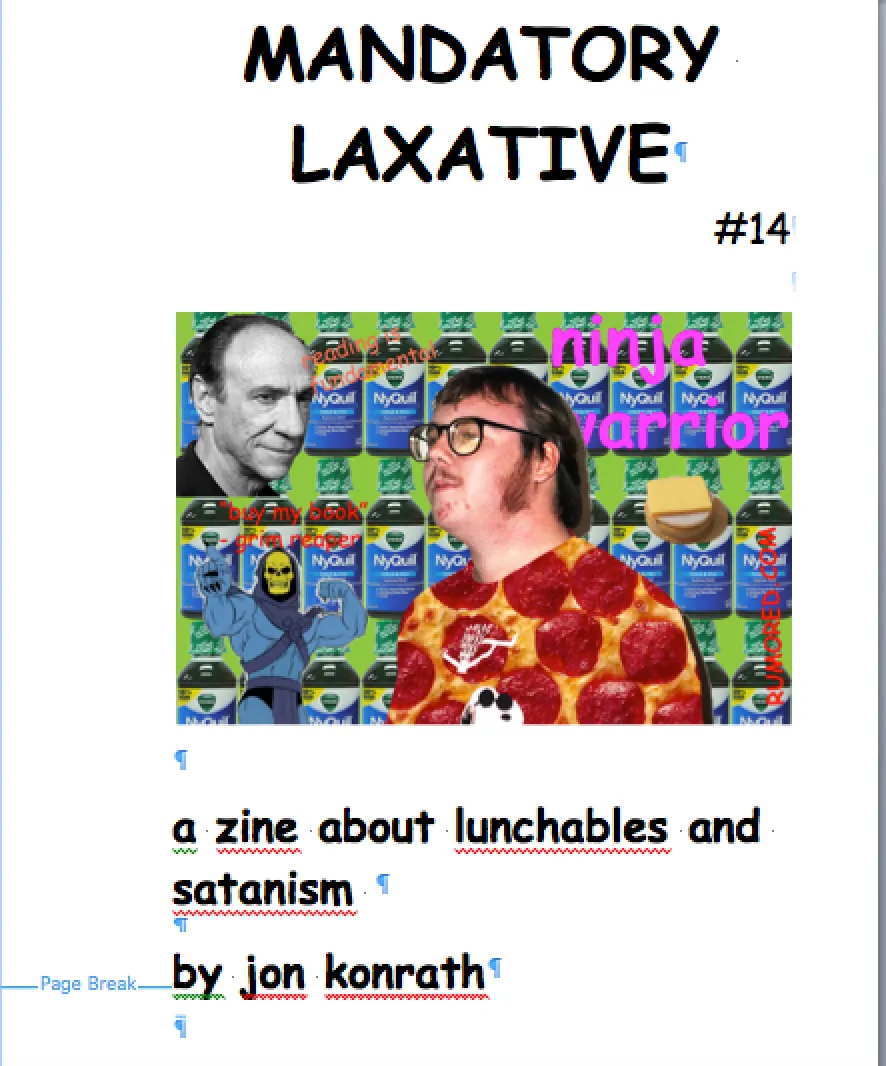
It is called Mandatory Laxative #14. It is about lunchables and satanism.

It is 20 pages long. It is printed on an inkjet printer. It is as lo-fi as possible. I didn’t even spell-check it.

It contains the following “stories”:

  • Pain Is Only Temporary (Unless It Is Chronic)
  • A Scene Where A Guy Goes To A Colonics Clinic, Falls In Love With The Cashier, And Almost Ends Up Shooting A Fountain Of Coffee From His Ass
  • Sleep Letter Zero
  • Letter to Freddy
  • I Am A Satanist And I Like Toast Because It Is Cult And Evil
  • Someday This Could Be You
  • I Love Lunchables
  • Late At Night With Dwight Dingleson
  • Remember the Alamo, Motherfucker
  • Two Men Discuss Low Calorie Pizza Before A Ritual Satanism Killing
  • This Knife Means Fucking Business
  • Chili Sweats at Aerie #666
  • The Inevitability of an Accidental Saline Enema

It is listed on Goodreads here.

It is not available on Amazon. It is not available as an ebook or a PDF. It’s barely available at all. It is a limited edition of about 30 copies. If you really want a copy, and you are in the US, paypal me $4 and your postal address. jkonrath at 34.216.9.77/.

Dead Mall: Vallco Mall Cupertino

IMG_2171

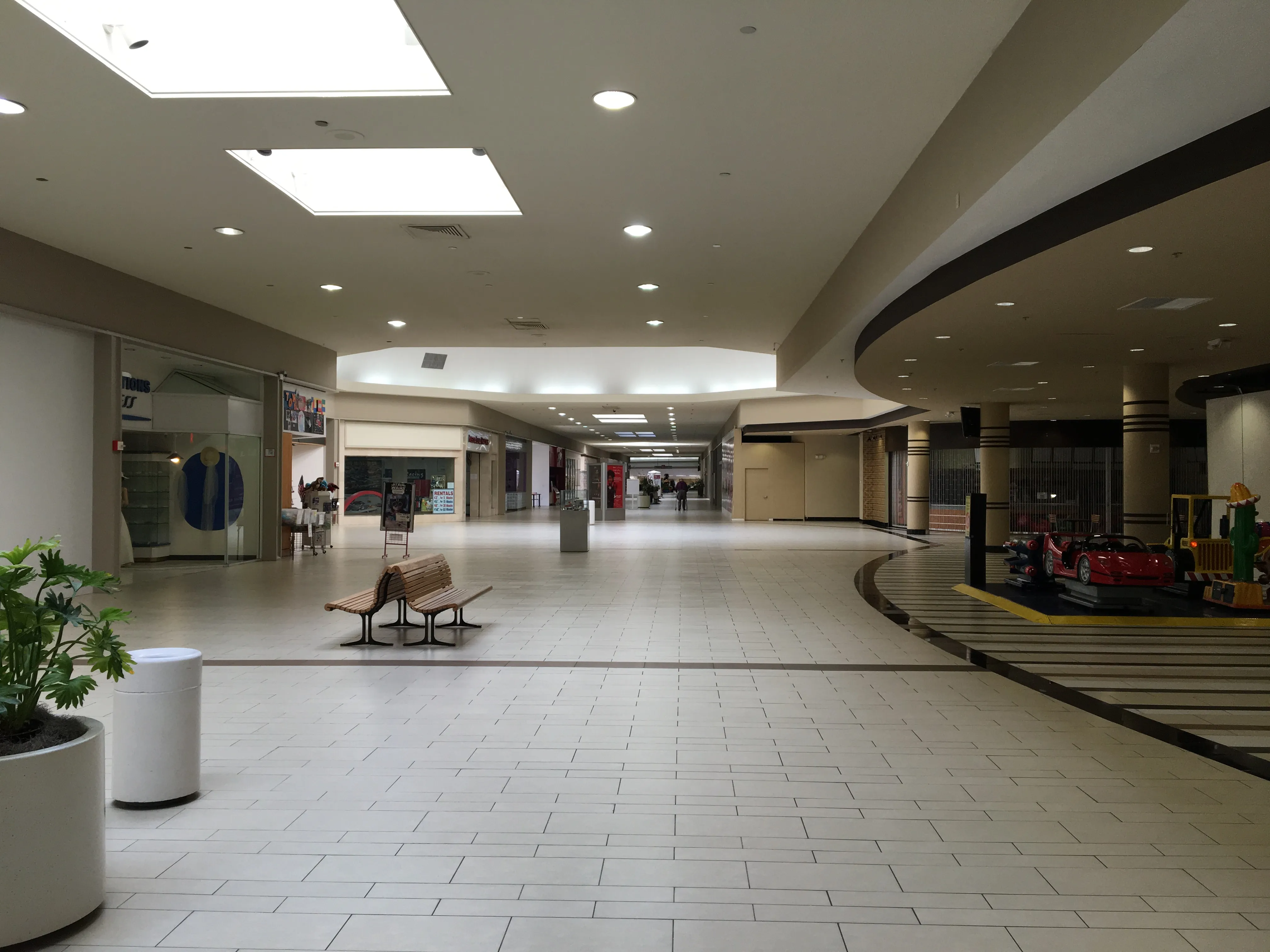
I had to go to Cupertino last week for a work bowling party thing. I followed the GPS to a Bowlmor, parked in a garage, and realized it was actually an anchor to a large mall. I had a few minutes to do a quick lap, and suddenly realized I’d chanced upon the most elusive dead mall situation: a huge mall that was in it’s final moment of end-stage death.

I’m fascinated by malls. It’s always bugged the hell out of friends that I travel a thousand miles to some new place and want to go to a mall and not buy anything, but it’s an unfortunate illness of mine, and I can’t escape it. I grew up going to malls, then I worked in one as a teenager, and spent all my time in a Montgomery Ward, or wandering the concourses during breaks. Even on days off, I’d go to work just to hang out. Or I’d drive to any of the other malls, to see the competition, and people-watch. It was the 80s, and malls were the biggest part of our cultural zeitgeist. Even in the 90s, I would find it almost meditative to go to College Mall in Bloomington or Northgate in Seattle and walk the loop, look at consumerism in action, and maybe get a pretzel or a book.

This all slowed down in the 00s. First, my default mall in New York was destroyed back in 2001, when a combined 220 stories of skyscraper fell on it. But aside from that, malls across the country crumbled. People shopped online; commerce went to big box stores; and the mighty anchor tenants all started to die. It became a quicksand situation where people stopped going to malls because there were fewer stores, and more stores closed because fewer people were going to malls. The massive indoor palaces were no longer updated, and when the seventies and eighties decor got too aged and the land underneath became too valuable, they were all “de-malled” and bulldozed under, usually to build a series of disconnected big-box stores or strip malls lacking the character or presence of a singular building with common areas.

I’d never been to Vallco Mall in Cupertino, but its history is similar to most. The mall was built in 1976, then expanded during the big boom in 1988. At its peak, it had about 200 stores, including five anchors: JC Penney, Macy’s, Sears, AMC, and Bowlmor. At one time, it also had an ice skating rink, and there are/were a variety of food options, hotels, and condos around the complex. I don’t have the full chronology, other than scattered news articles and a poorly-written Wikipedia article, but it appears it went through the standard lifecycle of a mall, including a long slide in the 00s, owner bankruptcy and buyout in the late 00s, more additions and seismic refitting, and various legal battles about expansion and condo-ing.

And now, the de-malling will begin. After much complicated legal wrangling, the plan is to destroy everything and build The Hills at Vallco, a two-billion dollar fake city square mixed-use monstrosity, with a huge green roof, expensive condos, an organic farmer’s market, upscale retailers, vegan yoga classes, green energy, and whatever catch phrase you can throw in to pull a more affluent demo. The interesting thing about all of this is that Vallco is in an incredibly prime location. It’s right next to the Apple corporate campus, in the heart of the 11th-wealthiest city in the country. In the past, Vallco was one of the only malls in the South Bay. Now, there are several, plus malls are a dying thing. I rag on the new plans, but the renderings do look nice, and it probably fits in better with the character of the town.

When I walked around last week though, the mall was absolutely heartbreaking. Of the 200-some stores, there were maybe a dozen still operational. It looked as if the mall was not renewing old leases, and letting them time out as they ended, so most of the residents were now gone, but there were a few stragglers remaining. Bowlmor was still alive, and the JC Penney was still fully operational, but both Macy’s and Sears had bugged out, and were completely stripped and boarded shut. There was a huge food court with maybe three dozen stalls, all empty except for a single taco place. A role-playing game place and a comic store were still fully operational, but completely devoid of customers. There was an indoor slot car racing place going, which is an oddity in 2016. But there wasn’t much else.

The mall had such an eerie, haunting feeling to it, though. The bones of the mall, the concourses and hallways and escalators, were all completely normal, running, clean, and decorated. But the style of the mall was very much 1993. Most malls got some injection of life around that time, expansion and facelifting, and it looks like they did this here, and it was frozen at time in the early Clinton years. Nobody was there when I visited at lunch time; I think I saw two geriatric mall walkers, and nobody else. It reminded me of being in a mall when I worked there, at 6AM before even the security guards were present, when everything was shut and locked and powered down. It very much gave me the feeling I wasn’t supposed to be there as a civilian, that I’d accidentally stumbled through a locked door and at any moment, a security guard would show up and usher me out. But everything was completely open for business, lights on, main doors unlocked.

The stores were another matter. Some were completely gone, the interiors torn out, bare to studs, the fronts taped shut, wrapped in plastic. Others were cleared out of all merchandise, but signage and racks still remained abandoned. And others looked like they closed for the evening a year ago, the night gates padlocked, but the store collecting dust, like something out of Chernobyl.

The whole thing was nostalgic and bittersweet and horrible. I’ve had a terrible problem with nostalgia recently, spending far too much time thinking about my own past in the 80s and 90s - not wanting to go back to that, but wanting to somehow explore it or write about it. It’s a terrible waste of time and bandwidth, and it’s honestly very emotionally painful. It’s a symptom of The Crisis, which I keep hinting at but haven’t been fully able to write about or wrap my head around. I almost mourn the feeling of having these communal things in my life, now that they are gone and we’re forever compartmentalized into our web browsers and tightly isolated social networking communities. I saw these monstrous commercial communities run from the inside out, and then they all suddenly vanished.

And it was so strange to stumble across one, trapped in amber like this. It wasn’t like when I go to a random midwestern mall that’s been beaten and fucked, all the prime retailers gone and the places left to cash-for-gold and dollar stores that bring in nothing, because the entire town has shifted in location and moved to far suburbs, leaving the mall to go to seed. Those have a feeling of desperation and real deer-in-headlights failure. This was much more surreal. I mean, this was a mall where a 16-screen AMC multiplex was just built in 2009 - like since I’ve arrived here - and it’s about to get torn down. It was like looking at a very late model car that had been totaled, like when you see pictures of a Lamborghini Aventador that has been flipped eight times. Parts of it were trapped in time at that high point of mall culture, and parts were already gone. It was a really hard thing to reconcile.

Anyway, more photos here. If you’re a local and want to check it out, do it immediately, because the place probably only has a few weeks left.