
Categories
general

The new camera and the march of progress

I could not sleep a week ago, and woke up in the middle of the night, nauseous from the heat. I went downstairs to sit on the couch with the iPad, and pulled the trigger on an Amazon points subsidized purchase of a new camera, something I’ve been eyeing for a bit.

This was the much-criticized Canon EOS-M, which is an odd cousin to Canon’s DSLR line. I wanted to get a replacement to my Rebel XS, and wanted to stay in the Canon ecosystem because of the half-dozen lenses I already own. I thought about waiting to get either a higher-end crop sensor DSLR (60D), or a lower-end full frame (6D).  But the EOS-M got stuck in my head, so that’s what I did.

The EOS-M is Canon’s first mirrorless, and is essentially the 18.1 MP sensor from their APS-C cameras, crammed into a tiny case the size of a point-and-shoot.  It’s mirrorless, so there’s no optical viewfinder, and no clacking mirror with each shot. The standard Canon interface is also gone, replaced with a touch-optimized UI designed for the nice capacitive-touch screen. The switches are simplified, and the flash is gone. It’s an odd hybrid, like putting a Corvette engine in a Chevette.

The thing is, the camera got a lot of bad reviews when it cost almost $1000.  People complained about the autofocus, the odd UI, and how Canon missed the mark. They subsequently dropped the price dramatically, and the bottom line is you can now buy something that theoretically takes pictures like an $1800 7D, for only about $250 for the body only.  The camera uses a screwy EF-M lens mount, but for about $60, you can get an adapter and use all of your EF and EF-S lenses.  (Or you can get a cheaper adapter and use any old FD or Olympus lenses, if manual focus is fine with you.)

I grabbed the camera with a 22mm prime kit lens, the adapter, and an extra battery.  My first impression is that it’s adequate for taking snapshots, and once you get the hang of the menus, it’s a competent substitute for a DSLR, as long as you lens up and get a decent zoom on it. The big advantage is it doesn’t look like you’re hauling around a DSLR, and the camera you have is always better than the camera you don’t have when you’re out and about. (Probably the reason my iPhone is my “best” camera these days.)  Of course, it looks somewhat stupid to have a 300mm zoom the size of a Subway foot-long hanging off of the end of a tiny thing as big as a deck of cards, but it works well.

One interesting thing to me is that this camera supports Magic Lantern. This group of hackers has created a new firmware that sits on top of the existing Canon software, and gives you tons of extra features and switches and configuration parameters, along with an alternate viewfinder and a second menu system. It’s essentially like jailbreaking a phone and adding a new UI alongside the old one, unlocking tons of features. The whole idea that a camera contains an entire computer is baffling to me, but the concept of reverse-engineering it and slapping in new features is absolutely amazing. I added Magic Lantern, a fairly easy process – you just download it, put it on an SD card, then tell the camera to update its firmware, and you’re done. The two features I like are “magic zoom” and focus peaking. Magic zoom shows a 3x enlargement of the focus point, which is good because I’m slowly going blind. Focus peaking shows a cross-hatched fill pattern in the viewfinder where the camera is focused, which is also helpful.

Oddly enough, Canon fixed the slow autofocus in a firmware update, which is also real Star Trek technology to me, the idea that what you bought isn’t what you get, and they can fix a broken feature on the fly. Also dumbfounding to me is the idea that Canon lenses can have firmware updates. Within the barrel of even a cheap image-stabilized Canon zoom lens is a RISC processor probably more powerful than the PCs I first used to learn how to program.

I don’t remember how much my first point-shoot digital camera cost in 2000 – I think it was around the same price, maybe a little more. But that camera (an Olympus D0460) took pictures that were 1280×960 and looked pretty cheesy, very poppy colors and obviously a low-end camera at the start of the digital age. The new one shoots at 5184×3456 by default, with incredible sharpness and colors, and it has a wide array of lenses to do everything from macro to high-speed zoom. It’s been 14 years, but it amazes me that basically the same price point can offer so much more now.

Also, the big thing this camera does that my other ones don’t is video. It’s capable of full HD video, 1920×1080 at 30fps or the more film-like 24fps. And because of the sensor size, it’s taking much more incredible video than a camcorder or phone could. I have no idea what I want to do with video, but I want to do something, and I’m scheming along those lines now.

Anyway, it’s a fun little toy. Now I need another vacation to Hawaii to get some more great shots there.

Categories
general

more return to blogging garbage

I saw a bunch of articles recently about “the return of the blog” and suddenly remembered I have a blog and I never update it, and maybe while I’m circling rudderless on this next book, I should maybe think about that.

I have all of these various “content boxes” to fill, and never know how to evenly distribute the random chunks of thought. Should I be posting ideas to twitter?  More pictures to tumblr?  “Serious” photos to 500px?  Meme photos to Facebook?  Stories here, or submit the stories, or expand the stories and push them into books?  And when I do all of those things, in some mystical, perfect combination, then what gets posted here?  News and info, or what I ate for lunch, or… what?  The anxiety and uncertainty over all of that makes me not post.  The only real answer is to write.

They are drilling a hole under the highway across from my house. There’s a large vacant dirt lot across the street, the immediate view under my third-story windows.  The power company has leased the land and has an armada of heavy machinery there now, large drills and generators and containers and backhoes and other unknown things, surrounded by a temporary fence emblazoned with the name of an industrial rental company every ten feet. During the day, they’re essentially drilling for oil sideways, running segments of pipe into this patch of mud and debris. I think they pump in water, or suck out mud, or something, the mess being sifted by a large machine that looks like if a dumpster had sex with a Sherman tank. The sound is not incredibly loud, but it’s loud enough, and constant. I think they will be doing it for a few more weeks. I hope they find some dead bodies, or a UFO. I’ve got in the noise-cancelling earbuds, which do little, and have some stupid new-age meditation music playing, because I have a splitting headache.  (I think it’s mostly allergies, though.)

I started my own social networking site this week, and then decided that was a stupid idea and closed it.  So now I’m sitting on the domain for RathSpace.com and don’t know what to do with it.  Any of this stuff is a waste of my time though, and I should be writing. I have become more and more disillusioned with Facebook, not the actual software itself or the company, but the people I follow. I have some really good friends on there, and then a bunch of people who only post about Ebola and whatever NFL player did whatever to whoever last week. I often wish I could find my own clique or group out there, but the more writers I find online, the more I realize I’m army-of-one’ing it over here.

I have been piddling with this UFO cult book, and it’s going slow, so I keep throwing words into the chasm of this book that’s essentially a sequel to Atmospheres, but that has no tracks yet, no structure or theme or anything else. It’s fun to work on, though. The audio book for Atmospheres is done, awaiting approval, so hopefully I will have news on that in a bit.


Categories
general

Great Review of The Memory Hunter over at Self Publishing Review

Here’s another great review of The Memory Hunter over at Self Publishing Review:

http://www.selfpublishingreview.com/2014/09/review-the-memory-hunter-by-jon-konrath/

In the far-flung future of 2007, in a world that never quite recovered from a Cold War which didn’t stay cold, where Japan seized the global economy and the world went in the direction that novelists predicted decades ago, society now relies on commercial brain implants – artificial memories that afford skills and knowledge to the owner to give them immediate access to better standards of living. Some people bite off more than they can chew on payment, and that’s where recall comes in. John Bishop makes a meager living for himself on the edge of civilized society with these recalls, having lost everything on a burn job some time ago, but on a job he can’t refuse – as much as he’d prefer – he stumbles into a darker business than just recall. So begins the events of The Memory Hunter, a retro-futuristic science-fiction Noir by Jon Konrath.

As a send-up to an older genre gone quieter in recent years, the book is a cultural grab-bag of inspiration from classic cyberpunk/sci-fi like BladerunnerNeuromancer and – closer in tone – the more absurdist Snow Crash­. More importantly, the similarity to the story Repo Men (and several similarly-themed books and films since) is hard to overlook with its dry-wit Dystopian horror of bio-technology financing a better future at unsafe costs, and the grimy, ethically-nightmarish, but stable work of repossessing a life as a distinct, even run-of-the-mill career. Mega-corporations and hovercars, AI helpers and hand-held lasers, American virtues against the Japanese and the Soviets running in the background, it’s all there. It’s tried and tested – and a bit out of time, purposefully – but used as a good springboard for this particular novel that thankfully takes different turns to any before it. A jaded, alcoholic ex-mover-and-shaker takes the job of his life, and with help of a new friend, busts open the case for the good of humanity and his own sense of honor – it’s the genre trope, and part of its reason for the adherence to that outline is to take new turns and demonstrate some retrospective good humor about the entire thing. It’s a pleasant tribute to the old-school while doing new things as its own distinct piece that borrows only what it needs to tell an original, extremely thoughtful story, even if the big questions are kept from being too big.

Konrath is a proven author with several different books under his wing with a flair for absurdity running through titles such as Fistful of Pizza and a more somber tone in titles like Atmospheres and Summer Rain. It should be no surprise to followers of his work to know that he tackles a new genre of classic science-fiction with the right balance of the ridiculous and the thoughtful. The world Konrath creates is very believable and full of details and side-notes that mesh into the narrative perfectly. It really feels like the old novels, but with a better sense of self-awareness and tech-savvy, owing to Konrath’s experience in the real world as much as an author. It’s very successful in selling a sense of immersion that is often hard to strike with fiction with an absurdity about it, and makes it convincing as a satire as much as a realistic and serious story.

If old ’80s sci-fi Noir pulp-fic is a genre you feel is sorely lacking in the current Zeitgeist of literature, this is a blast from the past ready for importing to your personal storage chips. Dark, terrifying, and satirical, The Memory Hunter is an excellently crafted piece given life from a bygone era of literature. 5 stars.

Categories
general

Linklater, Benning

I’ve recently fallen down a frantic rabbit hole of youtube searches and article reading involving director James Benning, a pioneer in experimental, narrative-less film.  Richard Linklater mentioned him in the director’s commentary for It’s Impossible to Learn to Plow by Reading Books, which is a movie I’ve been obsessed with for a bit.  That movie is an essentially narrative-less film, and I’ve written about it earlier, but I was interested in his influences, and if there were other similar films, which led me to Benning.

This searching has pulled me in deep, because interviews with Benning are fascinating.  And I’m also about 80% sure my father-in-law probably knows him, because they’re both from Milwaukee and both came up through the draft resistance and civil rights movements in the 60s, and my FiL worked at the Milwaukee Art Museum and seems to know everybody.  It’s been hard to actually track down any of Benning’s work, because it’s not really on DVD, and you pretty much have to catch it at a museum.  There are bits of it online, but not entire movies.  But there are lots of interviews knocking around, and they are all good reads.

Here’s a snippet from one that particularly moved me, at least from the standpoint of this no-plot windmill I’ve been chasing:

*** from http://www.moviemag.org/2014/06/interview-james-benning/
You work with very small budgets – what advice would you give to aspiring filmmakers?

A lot of people want to make narrative films and my advice would be to not do that. I don’t really like films very much. But I like using film as a way of saying things. I’m not interested in drama that’s contrived. I don’t like acting. My advice would be very strange – but just don’t make another “good” film, there are too many good films! Produce a film that’s going to make us question cinema itself and expand its language. Make us think about our own lives and the context of our lives in the world.
***

There’s a very good documentary that just came out called Double Play, about Linklater’s relationship with Benning, how they’re friends and it riffs off of both of their work a bit. It’s on Amazon and maybe iTunes.  I watched it last week, and it’s worth checking out, particularly as a retrospective of all of Linklater’s work and how it’s interconnected.

That said, I’m in the middle of plotting a book, so maybe it didn’t stick.  But I have about 40K words into the next iteration of Atmospheres, or whatever it may be, so there’s more in the pipeline.

Categories
general

Ode to a Mid-2010 MacBook Pro

My MacBook died yesterday. Shit.

It wasn’t a full-on, catastrophic death, the kind with no backup and fire and smoke and no hope. It was more of a long goodbye. I replaced the battery last fall, the third battery in its almost five years of heavy use. It looked like the battery was holding a full charge, an app saying it had low cycles and high milliamp-hours. But it would lose a few percent per minute, and then would get down to about 20% and power off with no warning.

I thought this was one of those background-process-sucking-power things, like some damn Adobe vampire lurking in the shadows, constantly pinging home and scanning every file on the hard drive. I tried killing everything imaginable, and then tried a fresh install, zapping the NVRAM, resetting the SMC. After a 24-hour marathon of file copying and reinstalling, it died on 90% battery.

I bought this computer in 2010, in the spring. I jumped on board right on the first day of the new model, when the first i7 Macs appeared. I remember this well, because it was right after I switched jobs and left Samsung, so I worked in Palo Alto. I was in a funk, writing-wise, trying to pull back out of a long stretch of not doing anything except writing every day about how I could not write.

I drove to the Apple store in Palo Alto on my lunch hour to buy the computer. They had them in stock, and $2500 later, I had the top-of-the-line 15-inch MacBook Pro. I took it back to my cube, unboxed it, snapped photos, and took a quick look. Then it sat on my desk while I stared at it, waiting until the end of my shift for my long commute back to the house. Then I plugged it into my old Mac, and did the eternal wait for the migration assistant to slowly slurp all of the files from one hard drive to another.

This was both exciting and sad. I had an unusual attachment to my first Macbook, one of the 2007 white plastic not-Pro Macbooks. I wanted a new laptop bad, but wasn’t working that summer. I was sitting on a bunch of junk after we moved to Denver, though – things I could easily dump on eBay. There were years of bachelor-mode acquisitions ripe for the picking: collectible coins, old electronics, DVD and CD box sets, and a bunch of barely-used gadgets and trinkets. I spent the first part of the summer unloading all of this on eBay, making sales and watching auctions and driving to the Denver post office to ship off boxes and packages to far-off buyers around the country. The PayPal balance grew, and by the end of June, I got within target, and orderedd my new machine. I then watched the tracking number, as the machine left China, went to Anchorage, and then jetted down to Colorado. I loved that machine, and it went with me everywhere. It also represented that odd, brief period of 2007, a period of nostalgic landing I always want to visit again.

That machine got quickly retired for its more powerful aluminum unibody sibling. And by the fall of 2010, I started working from home, and got a lot more serious about writing. I can’t thank the machine or the schedule, but launched into a new mode of writing and publishing. And that machine was at the center of all of it. Since I got that MacBook Pro, I’ve published five books (plus republished another) and probably written a half-million words, easy. I also used it for a lot of photography, video, music, and other work. It’s been a real workhorse, and I’ve become very attached to it over the last four and a half years.

That Mac has held up well, all things considered. It did have the dreaded NVIDIA curse, though. That was the first model with a discrete video processor on the logic board, a second GPU that it could switch to for heavy processing, or shut back off for better power use. And a lot of the machines had bad failures. Mine started to crap out a few months in, and ended up getting two logic board replacements, along with a battery replacement because of a recall issue. I doubled the memory, and moved to an SSD. But otherwise, the machine ran well, and lasted longer than any other laptop I’ve had.

I managed to bring that thing everywhere, too. It went to Europe twice; the Midwest a bunch of times; work trips to New York; Hawaii; a bunch of trips all over California. I got a lot of writing done on the road, because I used it as both my desktop and portable. It got scratches and scuffs, but that aluminum case kept it together, and still looks decent.

The battery thing was the kicker, though. I don’t even know if the battery itself was bad, or if it’s another logic board flake-out. It’s still a decent machine, CPU-wise, although the lowest-end MacBook Air now benchmarks higher than the 2010 top-of-the-line. It didn’t have USB3 or Thunderbolt, and had the slower SATA bus, so the SSD drive didn’t work at full speed. I also could not increase the RAM any more than 8GB, and it would not mirror its display to an Apple TV. I seemed to get in at exactly the wrong time, when all of these technical innovations were showing up. It was a great machine, but it was starting to show its age.

After yesterday’s death, I gave up, ran to the Apple store, and bought the latest MacBook Pro Retina. I went down to the 13-inch model, which feels insanely light and small compared to the old one. I’ve spent the last day porting things over, and it’s such a huge improvement in speed. Plus it’s got USB and Thunderbolt, and gigabit ethernet, and the Retina display is insanely nice. Most importantly, I’ve been working for an hour now, and the battery is just down to 97%.

So, start of a new era.  And PSA: BACK UP YOUR MACHINE. Go get a CrashPlan account, drag your important stuff to Dropbox, and get an external drive.  Get two, they’re cheap.  Now, on to the next era of writing with this new toy.

Categories
news

More book stuff

Okay, so more details on The Memory Hunter:

  • See the last post about it.
  • The release date is 9/1/14
  • It is 320 pages.
  • The cover is amazing.  I said I wasn’t going to reveal it until the Facebook page got 100 likes, so go like it.
  • There is a preview of it, which consists of the first five chapters.  It’s absolutely free, but you have to be on my mailing list to get it, so you should join it.  I only mail out once a month at most, so it’s not a high-volume thing, and you find out first about my new books and stories, and get free stuff.
  • The book has a web site: https://www.rumored.com/thememoryhunter/ It is a work in progress, but it has the book description on it, and will be updated once the book goes live.
  • I’m waiting on a physical proof, which shows up tomorrow.  The interior layout is all done, the cover is done, the kindle version is done, and the Smashwords version will be done momentarily.  I pretty much just need to push a couple of buttons and the book will be live.

Very tired right now.  I haven’t slept well in weeks, worrying about getting this book done, trying to find places to tell more people about it.  There was an earthquake last night, which caused no damage, except to my sleep.  I’ve been burning all of my time with final edits and photoshop madness and submitting files and filling out forms.  And now it’s all about googling places that review books, and pondering ads, and trying to reach out to new people, and basically everything but writing.  It’s all part of the process, but I want to get back to actually creating.  Soon.

Anyway, get ready.  The next update will probably be that the book is out.  I will be leaking more things over at Facebook.  And please, sign up for the damn list.  Tell everyone you know.  This book is going to be huge, and you’ll want to check it out.

Categories
general

The description of my next book

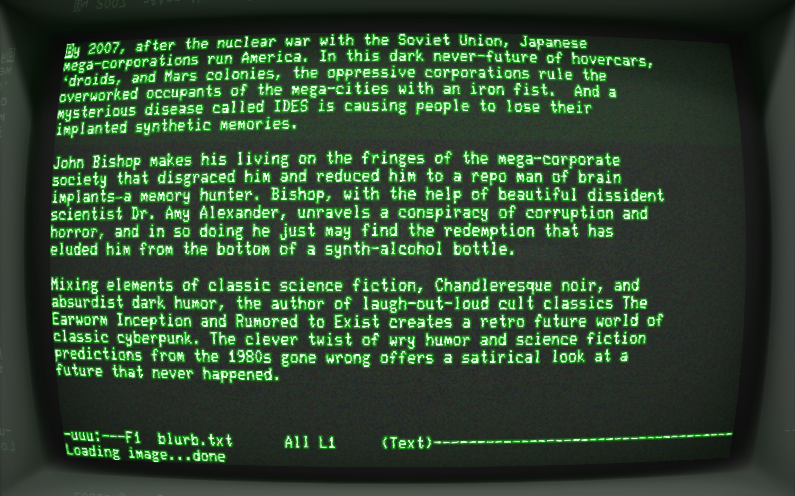
Are you ready to hear the description of my next book?

Well, let me fire up the VT-240 terminal, and pull it up in emacs for you:

Categories
general

Scrivener Tips, Redux

I am in the midst of production work for my next book, and this is the time I always learn new things about Scrivener.  Here are some random bits of info.  If this makes no sense to you, don’t worry; I’m mostly documenting this so that a year from now, I’ll google it again and find it here.  BTW all of this is in the latest version on the Mac.

Using a Code character style in Kindle output

Need to have a monospace font code style that shows up in your final Kindle output?

  1. Surround your text with the HTML <code> tag.  Like this
  2. Select the text, and select Format > Formatting > Preserve Formatting.  Your text gets surrounded by a little blue dotted outline.
  3. When you compile your book, under Compilation Options, select HTML Settings,  and under HTML, select Treat “Preserve Formatting” blocks as raw HTML.

Making first paragraphs in a chapter or section not indented

  1. When compiling, under Compilation Options, select Formatting.
  2. This gets a little squirrely, because it depends on how you break up your documents/scrivs/folders.  For this project, I had a scriv per chapter, and within them, I had blank lines for sections (where you’d normally have * * * or something in a print book.)  In that situation, select the Section Type of Level 1+ with just one document (the bottom item).
  3. Click Options.
  4. Select Remove first paragraph indents and the relevant option.  I used After empty lines and centered text, but yours might be something else.
  5. You might have to do this for different Section Type levels, depending on your structure.

My About the Author chapter is showing up as Chapter 32 in the Kindle TOC

  1. Make sure your scriv for the chapter has a properly-cased and human-readable title, like “About the Author” and not “WTF FFUUUCKCK FIX ME”.
  2. Under Compilation Options, go to Title Adjustments.
  3. There is a thing labeled Do not add title prefix or suffix to documents:.  It has a little gear next to it.  It’s not very OSX-ish and super easy to miss. Click the gear.
  4. Select the documents you want to not name “Chapter x”
  5. Click outside of this pop-up to close it, like on the dialog underneath it.  (It has no close button. I told you it was a junky piece of UI.)

I imported a Scrivener-generated Word doc into Pages and when I try to have different head/foot/page numbers in a section, it freaks out and I think my computer is possessed by Satan

Scrivener probably put a page break instead of a section break between a couple of chapters, and now the Pages “use previous section” heading/footing setting behaves wrong. Change the page breaks to section breaks.

Also, if you don’t use section breaks between chapters and your chapters start on even pages of your book, stop doing that.

The spell check isn’t catching things

That’s because it sucks.  You might want to check your spelling and grammar in another program.

Hope these help someone, or at least help me in six months when I do this again.

Categories
news

Updates on the next book

Okay. It’s about time to give you some more updates on the next book, because the release is imminent. The book is being edited right now, then it gets designed, goes through production, and all of that pain-in-the-ass stuff.  And then you buy it. Right?

Okay, so here are the latest updates. I’m putting them in a bulleted list, so hang on:

  • The title of the book is The Memory Hunter.
  • I have been posting daily updates on its facebook page, giving little hints about the book. You should go like this page, and tell everyone about it. I have only been giving out more hints as the page gets more likes.  So, go: https://www.facebook.com/thememoryhunter
  • I have also promised that the first people who will find out about the book will be the subscribers to my newsletter.  Also, I will be sending the first few chapters to my newsletter subscribers. That means you really need to subscribe to my list.  I only send mail a few times a year, and I almost always give out free stuff when I do, so do it.
  • This book is not some bizarro stream-of-consciousness plotless thing about how I shit my pants at the county fair during a riot. It is not like my other books. It is a plotted novel. It is extremely plotted.  It is so plotted, Michael Bay would say “god damn, that is plotted.” You could seriously write a Syd Field book on plot based on this thing.
  • That’s not to say it’s not like my other books. I think if you read the first ten of my books, you will find a lot of similarity and there’s the same kind of humor and twisted stuff within this.
  • In fact, there are a lot of connections between this book and my other books. There are recurring characters, places, concepts, and items from all of my books, even the nonfiction ones. I have seriously Frank Zappa-ed the fuck out of this.
  • I’ve also named a bunch of minor characters after some of my best supporters. I’ve given some of you warning about this, but expect to be called out on facebook about this, or maybe I’ll leave them a surprise until the book is published.
  • It’ll be on the Kindle, and of course in print.
  • This book will be available on most of the Smashwords-enabled platforms, which includes the Nook, Kobo, Apple/iTunes, Scribd, Oyster, FlipKart, and some others I’m forgetting, as well as the Smashwords store itself.
  • It is just over 80,000 words, so a full-sized book. I haven’t finished the layout yet, but I estimate it to be about 300 pages in print.
  • I will post more about the description and synopsis of the book later, but the tease so far is that it’s absurdist cyberpunk. It takes place in Seattle in 2007.
  • The cover is amazing. The picture above is a tiny clip from it. You have to see the whole thing.
  • If you review books on Amazon, Goodreads, or a blog, I absolutely need to talk to you now.

This book is a huge change for me, and I am really proud of it. I hope you will like it.  I’ll tell you more when we get closer, but you absolutely need to sign up for the mailing list and go check out the facebook page for more news.

Categories
general

The Cloud, the Book, the Pissing Contest

I’ve been bitching and moaning about how Adobe decided to move all of their software to the cloud, and make people pay per month forever to use their stuff.  I’ve also been bitching about how Apple decided to kill off Aperture, which happened about ten minutes after I imported and tagged 50,000 pictures, and would probably require me to spend six months of my life migrating to Lightroom.

Well, fuck it, I decided to give up and get a Creative Cloud membership, while Adobe is trying to court Aperture users and is quoting a lowball price.  I joined with the photographer’s membership, which is ten bucks a month, and includes Lightroom, Photoshop, and 2GB of cloud storage.  There’s some other junk that I don’t need or understand (Typekit?  Bridge?)  and there’s a ton of “try this!” links everywhere, to get you to upgrade to a full-blown membership.  But I don’t need Illustrator or InDesign this second, so I’m fine.

I have not used Photoshop in a long time.  I’ve been using Pixelmator for a while, to do book covers and whatnot.  (Here is my latest.)  And I make endless stupid things like the above drawing I re-captioned.  But I haven’t used Photoshop in forever.  It’s interesting to see how much it changed.

Back in 1991 when I returned to Bloomington after a year at IUSB commuter college hell, they had a shit-ton of new computer gear, because they’d recently tacked on a technology fee to tuition and were in a mad rush to spend it. The Fine Arts college had this cluster of brand spanking new top-of-the-line Macs, which I think were the IIfx at that time.  Each one had a gigantic color monitor, probably 20 inches, but about a yard thick, plus a second paperwhite portrait screen, along with a scanner and a Jazz drive, which used those insanely expensive removable hard drives that could hold something like 100 Megs, which was pure science fiction at the time. Anyway, they had Photoshop 1.0. I recently found a color printout me and my buddy Ray did when he visited once, an Ann Geddes overhead shot of nine babies in a nursery, but we’d horribly mangled them all: one beheaded, another eating that head, one with a swastika on its forehead, one spitting blood, etc.

That was my first exposure to Photoshop, and the new version makes the 1.0 version look more primitive than MS Paint. I am absolutely amazed by all of the retouching and healing tools, and how you can do stuff like move parts of an image and it will automatically fix the background.  The $10 a month is well-spent on getting more book covers done.  (And of course, photoshopping dicks into the mouths of various Facebook friends.)

Speaking of books, I am almost done with the next one.  I’m in the last sprint of edits, and I have a roughed-in cover, and I’m maybe a week from entering production drudgery.  This book is so amazingly different from anything I’m written, I’m not sure what people will think.  It’s absurdist, but it has an incredibly plotted story, like Michael Bay plotted.  I think it will really show readers that I have the ability to do more than just stories about taking a dump at the county fair.  But, I’m anxious to get it done, so I can get back to writing stories about taking a dump at the county fair.   Anyway, stay tuned.

I wanted to write something about Amazon Unlimited, and about the huge pissing contest between Amazon and Hachette.  But I really do not have the energy to care.  It’s billionaires fighting billionaires, and every move Amazon makes to make you think they are on your side or they’re saving you money is really one they’re making to increase their monopoly.  Amazon Unlimited is nothing but a race to the bottom, creating the equivalent of a thousand-channel cable TV plan that will cause readers to read five pages of everything and enjoy nothing.  And Hachette charges too much for ebooks, but Amazon is only bringing that to your attention because they want more of your money.

It’s all bullshit.  I’m still selling on Amazon, but eventually, their monopoly will squeeze out small authors, and I’m waiting for the day when they start charging KDP writers insane prices to list their books, or drop their royalties, or start an inane approval process for self-pubbed books “to increase quality to customers” (i.e. make it impossible for anyone they don’t like to publish weird stuff.)  It will happen.  But I’ll still be here.  If I have to photocopy my books at the local Kinko’s and sell them out of the trunk of my car, I will.  If I have to memorize them and go town to town reciting them like one of those poor fuckers with The Iliad, fine.  If I was here to make millions, I would have started selling penny stocks back in 1997.

OK, back to editing.  What’s up with you?
